In brief
At a glance
Quick Facts
- Primary nutrient in runoff
- Phosphorus, often bound to soil particles
- Primary nutrient in leaching
- Nitrate (NO₃⁻), highly soluble and mobile
- Main environmental effect of runoff
- Eutrophication of surface waters
- Main environmental effect of leaching
- Groundwater contamination
- Key human health risk from leaching
- Methemoglobinemia (blue baby syndrome) from high nitrate in drinking water
- Soil type most vulnerable to leaching
- Sandy soils with low water-holding capacity
- Common mitigation for runoff
- Riparian buffer strips and cover crops
- Common mitigation for leaching
- Nitrification inhibitors and optimized irrigation
Key Takeaways
- Fertilizer runoff is the surface transport of nutrients into waterways, while leaching is the downward movement of dissolved nutrients through soil into groundwater.
- Runoff primarily carries phosphorus attached to soil particles, causing eutrophication; leaching mainly moves nitrate, posing risks to drinking water and human health.
- Both processes are driven by excessive fertilizer application, irrigation, rainfall, soil properties, and land management practices.
- Effective mitigation requires integrated strategies such as precision nutrient management, cover crops, buffer strips, and improved irrigation efficiency.
What Is Fertilizer Runoff vs. Fertilizer Leaching?
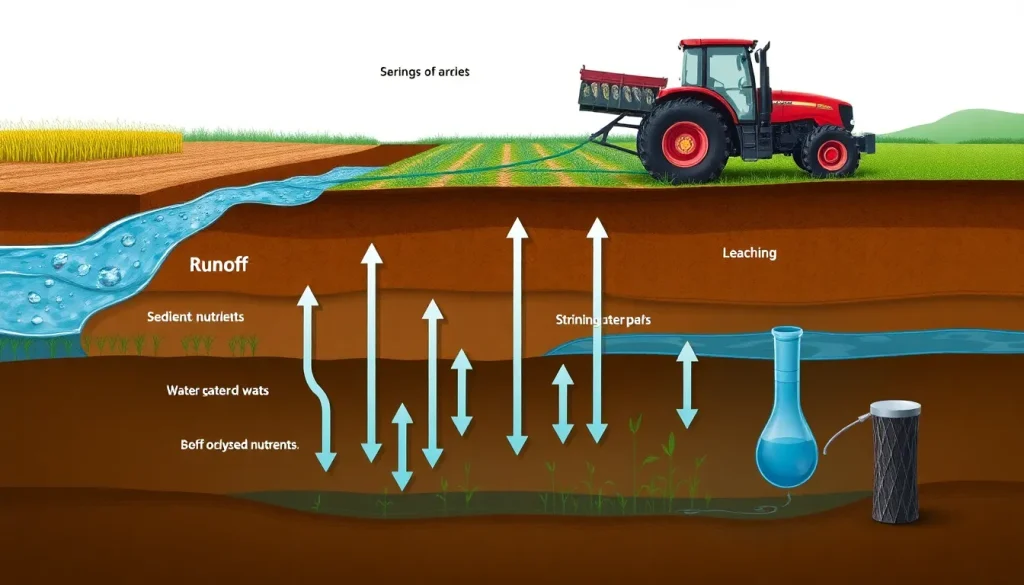
Fertilizer runoff and fertilizer leaching are two distinct pathways by which nutrients applied to agricultural land, lawns, or managed landscapes are transported away from the target area and into the broader environment. Runoff refers to the lateral movement of water over the soil surface, carrying dissolved nutrients and nutrient-laden soil particles into streams, rivers, lakes, and coastal waters. Leaching, in contrast, is the vertical movement of water through the soil profile, dissolving nutrients and carrying them downward beyond the root zone into groundwater aquifers. Both processes represent a loss of valuable nutrients from the soil and a source of pollution, but they differ fundamentally in the direction of flow, the nutrients most affected, and the environmental compartments they contaminate.
These two mechanisms are central to the global challenge of nutrient pollution. In runoff, phosphorus is often the nutrient of greatest concern because it binds strongly to soil particles and is transported with eroded sediment. Nitrogen, particularly in the form of nitrate, is highly soluble and moves readily with water, making it the primary pollutant in leaching. While runoff is visible and directly linked to surface water quality problems such as algal blooms, leaching is a hidden process that silently degrades groundwater, a critical source of drinking water for billions of people. Understanding the differences between runoff and leaching is the first step toward designing effective strategies to minimize nutrient losses from agricultural and urban landscapes.
How It Works
Fertilizer runoff occurs when precipitation or irrigation water exceeds the soil’s infiltration capacity, causing water to flow over the land surface. This overland flow picks up dissolved nutrients from recently applied fertilizers, as well as soil particles to which nutrients like phosphorus are attached. The water then moves across the landscape, eventually entering ditches, streams, or storm drains. Runoff is most common on sloping land, compacted or impervious surfaces, and when heavy rain follows shortly after fertilizer application. The nutrients carried in runoff are rapidly delivered to surface water bodies, where they can trigger immediate ecological responses.
Fertilizer leaching, on the other hand, is a subsurface process. Water that infiltrates the soil moves downward under the influence of gravity, dissolving soluble nutrients—especially nitrate—as it percolates through the soil profile. Leaching occurs when the amount of water entering the soil exceeds the soil’s water-holding capacity and the nutrient uptake capacity of plants. Once nutrients move below the root zone, they are no longer accessible to crops and continue their journey toward groundwater. The rate of leaching depends on soil texture, with sandy soils being particularly vulnerable due to their high permeability and low nutrient-holding capacity. Unlike runoff, leaching is a slow, invisible process that can take years or decades before contaminated groundwater reaches a well or resurfaces in springs and baseflow to streams.
Main Causes or Drivers
The primary driver of both runoff and leaching is the over-application or poorly timed application of fertilizers. When nitrogen or phosphorus is applied in amounts exceeding crop needs, the surplus is vulnerable to loss. The form of fertilizer also matters: highly soluble synthetic fertilizers release nutrients quickly, increasing the risk of both runoff and leaching, while slow-release or organic forms may reduce immediate losses. Timing is critical; applying fertilizer just before heavy rainfall or on frozen or saturated soils dramatically increases runoff potential. Similarly, applying nitrogen in the fall for spring crops can lead to substantial leaching over winter when plant uptake is minimal.
Soil properties and management practices further influence which pathway dominates. Runoff is exacerbated by compacted soils, steep slopes, lack of vegetative cover, and impervious surfaces. Leaching is more severe in coarse-textured, sandy soils with low organic matter and high drainage rates. Irrigation practices play a dual role: excessive irrigation can cause both runoff and leaching, while efficient irrigation scheduling reduces both. Land use changes, such as deforestation or conversion of grasslands to row crops, often increase both runoff and leaching by disrupting natural water and nutrient cycles. Climate factors, including intense rainfall events and prolonged wet periods, are also major drivers, and their increasing frequency in many regions is expected to worsen nutrient losses.
Environmental and Human Impacts
The environmental consequences of fertilizer runoff are most evident in surface waters. Excess phosphorus and nitrogen fuel eutrophication—a process where nutrient enrichment leads to explosive growth of algae and aquatic plants. Algal blooms can produce toxins harmful to fish, wildlife, and humans, and their subsequent decomposition depletes dissolved oxygen, creating “dead zones” where aquatic life cannot survive. Runoff also contributes to sedimentation, turbidity, and the degradation of aquatic habitats. Economically, these impacts affect commercial and recreational fisheries, tourism, and property values, while increasing water treatment costs for drinking water sourced from affected lakes and rivers.
Leaching primarily threatens groundwater quality, with nitrate being the most widespread contaminant. High nitrate levels in drinking water are linked to methemoglobinemia (“blue baby syndrome”) in infants and have been associated with certain cancers and thyroid disease in adults. Once groundwater is contaminated, remediation is extremely difficult and expensive, often requiring decades for natural flushing or costly treatment systems. Leached nutrients can also eventually reach surface waters through groundwater discharge, contributing to eutrophication in lakes and coastal zones. Additionally, leaching of nitrogen in the form of nitrate can lead to soil acidification and loss of base cations, degrading long-term soil fertility.
Solutions
Addressing fertilizer runoff and leaching requires a combination of agronomic, structural, and policy measures. The “4R” nutrient stewardship framework—Right source, Right rate, Right time, Right place—provides a foundational approach. Using the appropriate fertilizer type and formulation, applying only the amount needed by the crop, timing applications to match plant uptake, and placing fertilizer where roots can access it all reduce nutrient losses. Precision agriculture technologies, such as variable-rate application and soil nutrient mapping, further refine these practices.
For runoff control, conservation practices like contour farming, terracing, grassed waterways, and riparian buffer strips slow water flow and trap sediments and nutrients before they reach water bodies. Cover crops and reduced tillage improve soil structure and infiltration, reducing surface runoff. For leaching, strategies include using nitrification inhibitors to slow the conversion of ammonium to nitrate, planting deep-rooted cover crops to capture residual nitrogen, and optimizing irrigation to avoid deep percolation. Constructed wetlands and bioreactors can also intercept and treat drainage water. Policy instruments, such as nutrient management regulations, water quality trading, and incentive programs, encourage adoption of these practices at the landscape scale.
Common Misconceptions
One common misconception is that runoff and leaching are entirely separate problems with no overlap. In reality, they are interconnected: leached nutrients can eventually enter surface waters via groundwater flow, and runoff can infiltrate and contribute to leaching in downslope areas. Another misunderstanding is that organic fertilizers do not cause runoff or leaching. While organic sources release nutrients more slowly, they can still contribute to pollution if applied in excess or at the wrong time. A third misconception is that leaching only occurs in sandy soils; although sandy soils are most vulnerable, leaching can occur in any soil when water inputs exceed the soil’s capacity to hold water and nutrients, especially in tile-drained agricultural systems where subsurface drainage pipes shortcut the natural filtration process.
Regional Differences
The relative importance of runoff versus leaching varies significantly by region due to climate, soils, and agricultural systems. In humid temperate regions with heavy rainfall and sloping terrain, such as the U.S. Corn Belt or parts of Western Europe, both runoff and leaching are major concerns, but tile drainage systems can make leaching the dominant pathway for nitrogen loss. In arid and semi-arid regions where irrigation is essential, leaching is often the primary concern because excess irrigation water percolates below the root zone, carrying salts and nitrates into groundwater. In tropical regions with intense rainfall, runoff and erosion dominate, leading to severe phosphorus losses. Coastal areas with shallow groundwater are particularly sensitive to leaching because nutrients can quickly reach estuaries. Understanding these regional differences is crucial for tailoring effective nutrient management strategies.
FAQ
What is fertilizer runoff?
Fertilizer runoff is the movement of water over the soil surface that carries dissolved nutrients and nutrient-rich soil particles from fields into nearby streams, rivers, and lakes. It typically occurs when rainfall or irrigation exceeds the soil’s ability to absorb water.
What is fertilizer leaching?
Fertilizer leaching is the downward movement of dissolved nutrients, especially nitrate, through the soil profile into groundwater. It happens when water percolates beyond the root zone, carrying nutrients that plants cannot use.
Why do fertilizer runoff and leaching matter?
Both processes cause nutrient pollution, which harms water quality, aquatic ecosystems, and human health. Runoff leads to algal blooms and dead zones in surface waters, while leaching contaminates drinking water supplies and can cause serious health problems.
References
- United States Environmental Protection Agency (EPA). Nutrient Pollution: Sources and Solutions. https://www.epa.gov/nutrientpollution/sources-and-solutions
- Food and Agriculture Organization of the United Nations (FAO). The State of the World’s Land and Water Resources for Food and Agriculture. Chapter on water pollution from agriculture.
- Carpenter, S. R., et al. (1998). Nonpoint pollution of surface waters with phosphorus and nitrogen. Ecological Applications, 8(3), 559-568.