In brief
At a glance
Quick Facts
- Verdict
- Promising
- Problem addressed
- Urban environmental degradation, resource overconsumption, and social inequity
- Evidence strength
- Moderate
- Potential scale
- Global
- Relative cost
- Moderate to High
- Time to impact
- Years to Decades
Quick verdict
A sustainable city is not a single solution but an integrated approach to urban development that seeks to balance environmental, social, and economic needs. The concept is well-established and many individual components—such as energy-efficient buildings, public transit, and waste reduction—are proven. However, achieving holistic sustainability at city scale remains challenging, with mixed results globally. The approach is highly promising but requires long-term commitment, significant investment, and context-specific adaptation.
Problem addressed
Cities are home to over half the world’s population and account for about 70% of global carbon emissions and a disproportionate share of resource consumption. Urban areas face interconnected challenges: air pollution, traffic congestion, inadequate housing, social inequality, and vulnerability to climate change impacts like heatwaves and flooding. The sustainable city concept aims to address these by redesigning urban systems to reduce environmental footprints while improving quality of life for all residents.
How the solution works
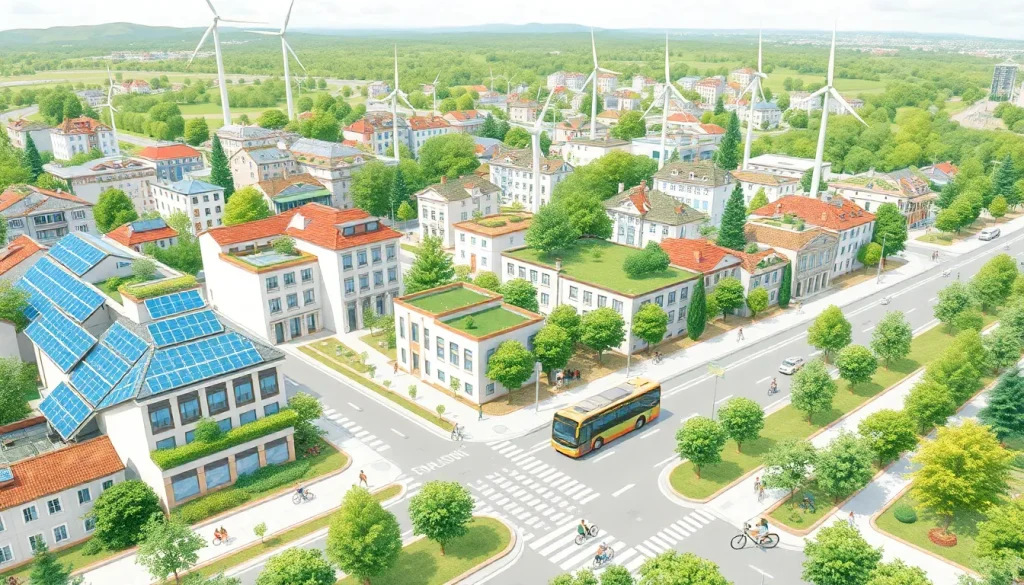
A sustainable city integrates multiple strategies across sectors. Key mechanisms include: compact, mixed-use urban form to reduce car dependency; green buildings with high energy and water efficiency; renewable energy systems; sustainable mobility networks (public transit, walking, cycling); circular waste management; green and blue infrastructure for climate resilience; and inclusive governance that engages communities. These elements work synergistically: for example, denser cities make public transit more viable, which reduces emissions and improves air quality, while green spaces mitigate heat islands and support biodiversity.
Evidence strength
Evidence for individual sustainable urban practices is strong. For instance, numerous studies show that compact city designs reduce per capita carbon emissions by 20–50% compared to sprawl. Building energy codes and retrofits have documented energy savings of 30–50%. Bus rapid transit systems have been shown to cut commute times and emissions. However, evidence for the combined effect of multiple interventions at city scale is more limited, often relying on modeling rather than long-term empirical data. Some cities have reported significant progress, but attribution is difficult due to confounding factors. The evidence base is growing but remains fragmented.
Potential scale
The potential scale is global: every city can adopt sustainable practices. The impact depends on the extent of adoption. If all cities implemented best practices, global urban emissions could be reduced by 30–50% by 2050, according to some estimates. However, scaling is constrained by financial resources, political will, institutional capacity, and existing infrastructure lock-in. Retrofitting existing cities is more challenging than building new sustainable cities from scratch.
Cost considerations
Costs vary widely. Some measures, like improving energy efficiency, have negative net costs over time due to savings. Others, like building new metro systems, require high upfront investment. A World Bank study suggests that sustainable urban infrastructure could cost 2–3% of GDP annually for developing countries, but the economic benefits from reduced congestion, health costs, and energy savings can offset these. The main barrier is often the high initial capital and the need for innovative financing mechanisms.
Implementation time
Some sustainable city interventions can be implemented quickly: bike lanes, green roofs, and energy retrofits can be deployed within a few years. Others, like new transit systems or changing urban form, take decades. Realizing a fully sustainable city is a multi-decade endeavor. Early benefits, such as improved air quality from reduced traffic, can appear within a few years of policy changes.
Environmental benefits
Sustainable cities can significantly reduce greenhouse gas emissions, air and water pollution, and resource consumption. For example, compact cities with good public transit can lower per capita transport emissions by 40–60%. Green buildings reduce energy use by 25–50%. Urban green spaces sequester carbon, reduce stormwater runoff, and cool local temperatures by 2–8°C. Waste reduction and recycling divert up to 80% of waste from landfills. These benefits are well-documented in case studies.
Social and economic co-benefits
Beyond environmental gains, sustainable cities improve public health through better air quality and active transport, reducing respiratory and cardiovascular diseases. They enhance social equity by providing affordable housing and accessible public services. Economic benefits include job creation in green sectors, increased property values near green spaces, and reduced household energy and transport costs. Community engagement in planning fosters social cohesion and local democracy.
Risks and unintended consequences
Pursuing sustainability can lead to gentrification and displacement if not managed inclusively. Green infrastructure projects may raise property values, pushing out lower-income residents. Overemphasis on density without adequate public space can reduce livability. Some technologies, like electric vehicles, may shift pollution rather than eliminate it. There is also a risk of “greenwashing” where cities adopt superficial measures without systemic change. Careful policy design is needed to mitigate these risks.
Where it works best
Sustainable city approaches are most effective in rapidly urbanizing regions where new infrastructure can be planned from scratch, such as in parts of Asia and Africa. They also work well in cities with strong governance, public support, and financial resources, like many European cities. Compact, mixed-use development is particularly suited to cities with high population density and existing transit networks.
Where it may not work
In cities with extreme car dependency and low density (e.g., many North American suburbs), retrofitting for sustainability is costly and faces political resistance. In low-income countries, lack of funding and institutional capacity can hinder implementation. Cities with weak governance or corruption may struggle to enforce regulations. Additionally, top-down, technocratic approaches that ignore local context often fail.
Comparison with alternatives
The main alternative to a sustainable city is the “business-as-usual” model of urban sprawl, car dependency, and resource-intensive development. This model leads to higher emissions, congestion, and social segregation. Other alternatives include “smart cities” that focus on technology without holistic sustainability, or “eco-cities” built from scratch, which can be expensive and exclusionary. The sustainable city concept is more comprehensive and adaptable than these alternatives, but it requires strong integration of social, economic, and environmental goals.
Case studies
Freiburg, Germany: Known for its Vauban district, a car-free neighborhood with passive houses, solar energy, and extensive green spaces. The city reduced per capita CO2 emissions by over 30% between 1992 and 2015 while growing economically.
Curitiba, Brazil: Pioneered bus rapid transit (BRT) in the 1970s, integrating land use and transport planning. The system now serves over 2 million passengers daily and has inspired similar systems worldwide. However, the city still faces challenges with sprawl and inequality.
Singapore: A high-density city-state that has invested heavily in green buildings, water management, and public transit. It aims to have 80% of buildings green-certified by 2030. Critics note high costs and top-down governance.
Copenhagen, Denmark: Aims to be carbon-neutral by 2025 through district heating, cycling infrastructure, and renewable energy. Cycling accounts for 49% of all commutes. The city’s approach is widely cited as a model, though its success is partly due to favorable policies and wealth.
Final assessment
The sustainable city is an essential and achievable goal, but it requires a long-term, integrated approach tailored to local conditions. The evidence for individual components is strong, and the co-benefits are substantial. However, systemic change is slow and faces political, financial, and social barriers. Success depends on inclusive governance, sustained investment, and adaptive management. For cities willing to commit, the transition to sustainability offers a pathway to resilience, equity, and improved quality of life.
FAQ
What is a sustainable city?
A sustainable city is one that meets the needs of its current residents without compromising the ability of future generations to meet their own needs, by balancing environmental, social, and economic goals. It typically includes green buildings, efficient transport, renewable energy, waste reduction, and inclusive governance.
Can existing cities become sustainable, or do we need to build new ones?
Existing cities can become more sustainable through retrofitting, policy changes, and incremental improvements. While building new sustainable cities from scratch is possible, it is often more practical and resource-efficient to transform existing urban areas, as they already house most of the population.
What are the biggest challenges to creating sustainable cities?
The main challenges include high upfront costs, political resistance, institutional inertia, social inequality, and the complexity of coordinating multiple sectors. Additionally, measuring and ensuring holistic sustainability is difficult, and there is a risk of focusing on environmental aspects while neglecting social equity.
References
- United Nations Human Settlements Programme (UN-Habitat). (2020). World Cities Report 2020: The Value of Sustainable Urbanization.
- Intergovernmental Panel on Climate Change (IPCC). (2022). Climate Change 2022: Mitigation of Climate Change. Chapter 8: Urban Systems and Other Settlements.
- World Bank. (2021). Urban Sustainability Framework.
- International Energy Agency (IEA). (2021). Net Zero by 2050: A Roadmap for the Global Energy Sector.
- C40 Cities Climate Leadership Group. (2020). Deadline 2020: How Cities Will Get the Job Done.