In brief
At a glance
Quick Facts
- Core concept
- Economic growth that is environmentally sustainable, achieved by decoupling GDP from resource use and environmental impacts.
- Key mechanism
- Decoupling—relative (slower growth of impacts) or absolute (declining impacts while GDP grows).
- Global material use
- More than tripled since 1970; material intensity (per GDP) has declined, but absolute material footprint continues to rise.
- CO₂ emissions
- Some high-income countries have reduced territorial emissions while growing GDP, but consumption-based emissions often show weaker decoupling.
- Rebound effect
- Efficiency gains can be partially offset by increased consumption, a phenomenon known as Jevons paradox.
- Main proponents
- OECD, World Bank, UNEP, and many national governments.
- Main critics
- Ecological economists, degrowth advocates, and some sustainability scientists who question the feasibility of absolute decoupling.
- Alternative paradigms
- Degrowth, steady-state economy, post-growth, and a-growth approaches that prioritize well-being over GDP growth.
Key Takeaways
- Green growth is an economic strategy aiming to decouple GDP growth from environmental harm through resource efficiency, clean technology, and ecosystem service valuation.
- Evidence shows relative decoupling (declining resource use per unit of GDP) is common, but absolute decoupling (total resource use declining while GDP grows) remains rare and often temporary at the global level.
- Proponents argue that market mechanisms, innovation, and policy can drive a transition to a low-carbon, circular economy without sacrificing prosperity.
- Critics contend that infinite growth on a finite planet is physically impossible, and that green growth may be a form of “weak sustainability” that fails to address overconsumption and systemic limits.
What Is Green Growth: Evidence, Arguments and Criticism?
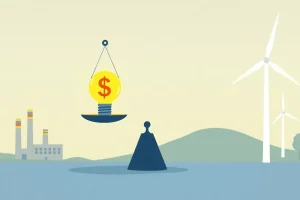
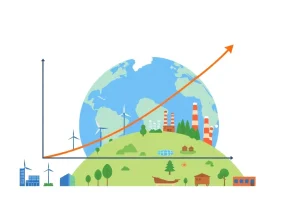
Green growth is an economic framework that asserts it is possible to continue increasing economic output (measured as gross domestic product, or GDP) while simultaneously reducing environmental pressures and natural resource depletion. The concept emerged from the recognition that traditional economic growth models, reliant on fossil fuels and linear resource consumption, are unsustainable. Green growth proposes a pathway where technological progress, resource efficiency, and investment in natural capital enable a decoupling of economic activity from environmental degradation. It is promoted by international organizations such as the OECD, World Bank, and UNEP as a strategy to achieve both prosperity and planetary boundaries.
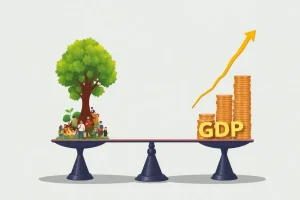
The debate around green growth centers on the strength and feasibility of this decoupling. Evidence, arguments, and criticism form a continuum: some studies highlight successful examples of relative decoupling (using fewer resources per unit of GDP) and even absolute decoupling in specific sectors or countries, while others point to the lack of global absolute decoupling and the physical limits to efficiency gains. Critics argue that green growth may be an oxymoron, as continuous economic expansion inevitably increases material and energy throughput, leading to rebound effects and shifting environmental burdens to other regions or future generations. This article examines the core ideas, the empirical evidence, and the main lines of argument and criticism surrounding green growth.
Overview
Green growth is rooted in the broader concept of sustainable development, but it places a distinct emphasis on maintaining economic growth as a central goal. It posits that environmental protection and economic expansion are not inherently contradictory, and that well-designed policies can turn environmental challenges into drivers of innovation, job creation, and long-term competitiveness. The approach typically involves investing in renewable energy, energy efficiency, sustainable agriculture, and circular economy models, while using market-based instruments like carbon pricing and removing environmentally harmful subsidies. International bodies such as the OECD have developed green growth indicators to track progress across dimensions like carbon productivity, resource productivity, and the environmental quality of life.
Critics, however, distinguish between “weak” and “strong” green growth. Weak green growth relies on relative decoupling and assumes that natural capital can be substituted by human-made capital, while strong green growth demands absolute decoupling and the maintenance of critical natural capital. The debate often hinges on whether technological progress can overcome physical limits to growth, a question that dates back to the 1970s Limits to Growth report. Today, green growth remains a dominant policy paradigm in many countries, but it faces increasing scrutiny from degrowth advocates and ecological economists who call for a fundamental rethinking of growth-dependent economic systems.
How It Works
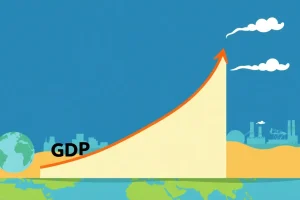
Green growth operates through several interconnected mechanisms designed to reduce the environmental intensity of economic activity. The primary mechanism is decoupling, which can be relative (resource use or emissions grow more slowly than GDP) or absolute (resource use or emissions decline while GDP grows). Decoupling is pursued via:
- Resource efficiency: producing more goods and services with less energy, water, and raw materials, often through technological improvements and lean manufacturing.
- Substitution: replacing fossil fuels with renewable energy sources, and replacing scarce or toxic materials with abundant, benign alternatives.
- Circular economy practices: designing products for durability, reuse, remanufacturing, and recycling to minimize waste and keep materials in use.
- Ecosystem service valuation: incorporating the economic value of natural capital into decision-making, such as through payments for ecosystem services or natural capital accounting.
- Green fiscal policy: using taxes, subsidies, and public investment to incentivize environmentally friendly activities and disincentivize harmful ones.
These strategies are often combined with broader structural changes, such as shifting economies toward service-based sectors, promoting sustainable urban planning, and fostering green innovation through research and development. The expectation is that these measures can enable economic growth to continue while environmental impacts decline in absolute terms, achieving what is sometimes called “absolute decoupling” or “green growth.”
What the Evidence Shows
Empirical evidence on green growth is mixed and often contested. At the global level, material footprint and CO₂ emissions have continued to rise alongside GDP, indicating that absolute decoupling has not been achieved on a planetary scale. The International Resource Panel reports that global material use has more than tripled since 1970 and continues to grow, though the material intensity of the world economy (resource use per unit of GDP) has declined. This represents relative decoupling, but not absolute decoupling. Similarly, global CO₂ emissions have risen over the long term, though some wealthy nations have reduced territorial emissions while growing their economies.
Several high-income countries have achieved absolute decoupling of CO₂ emissions from GDP in recent decades, partly due to shifts to service-based economies and cleaner energy. However, when accounting for consumption-based emissions (including those embedded in imported goods), the decoupling is often weaker or disappears. For material use, absolute decoupling is even rarer: a few countries have stabilized or slightly reduced their domestic material consumption, but global material footprint continues to grow. Studies also highlight the risk of rebound effects, where efficiency gains lead to increased consumption that offsets environmental savings. The evidence suggests that while green growth policies can yield relative decoupling and local environmental improvements, achieving global absolute decoupling at the scale and speed required to meet climate and biodiversity targets remains a significant challenge.
Benefits, Limitations and Trade-offs
Green growth offers several potential benefits. It provides a politically palatable narrative that aligns environmental action with economic self-interest, encouraging business investment and public support. Policies promoting renewable energy and energy efficiency can reduce pollution, improve public health, and create jobs in emerging sectors. Valuing natural capital can help protect ecosystems and the services they provide. Moreover, green growth strategies can enhance energy security and reduce dependence on volatile fossil fuel markets.
However, green growth faces significant limitations and trade-offs. The primary criticism is that it may be physically impossible to achieve absolute decoupling at the global scale and pace required to stay within planetary boundaries. Efficiency gains are often partially or fully offset by growth in consumption (the Jevons paradox or rebound effect). Technological solutions may shift environmental burdens from one category to another (e.g., from carbon emissions to land use for biofuels) or from one region to another (e.g., outsourcing heavy industry). Furthermore, green growth does not inherently address issues of equity or overconsumption; it may perpetuate a growth-dependent economic system that requires ever-increasing resource throughput. These limitations have led some to advocate for alternative paradigms such as degrowth, post-growth, or steady-state economics.
Common Misconceptions
One common misconception is that green growth and degrowth are simply two ends of a spectrum, with no middle ground. In reality, many researchers and policymakers advocate for “a-growth” or “post-growth” positions that are agnostic about GDP growth, focusing instead on directly achieving social and environmental goals regardless of what happens to GDP. Another misconception is that green growth implies business-as-usual with a green veneer; genuine green growth requires transformative changes in energy, industry, and consumption patterns, not just incremental efficiency improvements.
It is also often assumed that green growth automatically leads to absolute decoupling. The evidence shows that relative decoupling is common, but absolute decoupling is rare and often temporary. Additionally, some believe that green growth can solve environmental problems without addressing economic inequality or the growth imperative inherent in debt-based monetary systems. In practice, green growth policies may need to be complemented by measures that reduce working hours, cap resource use, or redistribute wealth to achieve sustainability goals.
Data Limitations and Uncertainties
Assessing green growth is complicated by data limitations and methodological uncertainties. Many studies rely on territorial emissions rather than consumption-based accounts, which can overstate decoupling in wealthy nations that import carbon-intensive goods. Material flow data often exclude hidden flows (e.g., mining overburden) and may not capture the full environmental footprint of economic activity. Metrics like GDP do not account for natural capital depletion or environmental degradation, making it difficult to measure true “green” growth. There is also uncertainty about future technological breakthroughs and the potential for absolute decoupling at the global level. Models projecting green growth scenarios depend on assumptions about technological change, resource substitution, and policy effectiveness that are inherently uncertain. These data gaps and uncertainties fuel the ongoing debate between green growth optimists and critics.
FAQ
What is green growth?
Green growth is an economic approach that aims to foster economic growth and development while ensuring that natural assets continue to provide the resources and environmental services on which our well-being relies. It focuses on decoupling economic activity from environmental degradation.
Is green growth possible?
The possibility of green growth is debated. Evidence shows that relative decoupling is common, but absolute decoupling of resource use and emissions from GDP at the global scale has not been achieved. Whether it can be achieved at the speed and scale needed to meet climate and biodiversity targets remains uncertain and is a central point of criticism.
What is the difference between green growth and degrowth?
Green growth seeks to continue economic growth while reducing environmental impacts through technology and efficiency. Degrowth argues that continuous growth is incompatible with ecological limits and calls for a planned reduction of material and energy throughput, prioritizing well-being and equity over GDP expansion.
References
- OECD (2011). Towards Green Growth. OECD Publishing.
- UNEP (2011). Towards a Green Economy: Pathways to Sustainable Development and Poverty Eradication.
- Haberl, H., et al. (2020). A systematic review of the evidence on decoupling of GDP, resource use and greenhouse gas emissions, part II: synthesizing the insights. Environmental Research Letters, 15(6), 065003.
- Hickel, J., & Kallis, G. (2020). Is Green Growth Possible? New Political Economy, 25(4), 469–486.