In brief
At a glance
Quick Facts
- Definition
- Loss and damage refers to climate impacts that cannot be avoided through mitigation or adaptation, including economic and non-economic losses.
- First formal recognition
- The concept was first formally recognized in the UNFCCC in 2007 at COP13 in Bali.
- Key mechanism
- The Warsaw International Mechanism for Loss and Damage was established in 2013 to address the issue.
- Paris Agreement
- Article 8 of the Paris Agreement (2015) recognizes the importance of averting, minimizing, and addressing loss and damage.
- Santiago Network
- Created in 2019 to provide technical assistance to vulnerable countries.
- Loss and Damage Fund
- Agreed upon at COP27 in 2022 to provide financial support to nations facing severe climate impacts.
- Economic losses
- Include damage to infrastructure, crops, and livelihoods; estimates run into hundreds of billions of dollars annually.
- Non-economic losses
- Include loss of life, cultural heritage, biodiversity, and psychological trauma.
- Slow onset events
- Sea level rise, desertification, and ocean acidification are key drivers of loss and damage.
- Most vulnerable
- Small island developing states and least developed countries are disproportionately affected.
Key Takeaways
- Loss and damage refers to the adverse effects of climate change that cannot be avoided through mitigation or adaptation, including both economic and non-economic losses.
- It is a central issue in international climate negotiations, particularly for vulnerable developing countries that have contributed least to global emissions but face the most severe impacts.
- The Warsaw International Mechanism and the Santiago Network are key institutional frameworks established under the UNFCCC to address loss and damage.
- Addressing loss and damage involves financial support, technical assistance, and comprehensive risk management, but funding remains a contentious and evolving area of climate policy.
What Is Loss and Damage in Climate Policy?
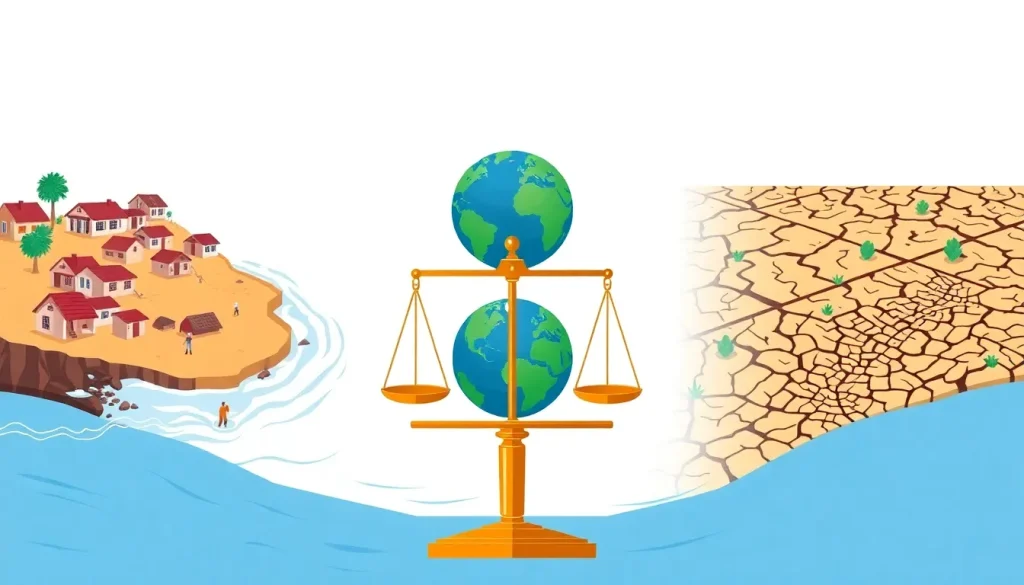
Loss and damage in climate policy refers to the negative consequences of climate change that occur despite efforts to reduce greenhouse gas emissions (mitigation) and adjust to changing conditions (adaptation). These impacts can be economic, such as the destruction of infrastructure, loss of agricultural productivity, and damage to property, or non-economic, including loss of life, displacement of communities, erosion of cultural heritage, and degradation of ecosystems. The concept acknowledges that there are limits to adaptation, and that some climate impacts are unavoidable, particularly for the most vulnerable populations and countries.
In the context of international climate negotiations, loss and damage has emerged as a critical issue for developing nations, especially small island developing states (SIDS) and least developed countries (LDCs), which face existential threats from sea-level rise, extreme weather events, and slow-onset changes. The term encompasses both sudden-onset events like hurricanes, floods, and heatwaves, and slow-onset processes such as desertification, ocean acidification, and glacial retreat. Addressing loss and damage is fundamentally a matter of climate justice, as those who have contributed least to global emissions often suffer the most severe consequences.
History
The concept of loss and damage has evolved over decades within the United Nations Framework Convention on Climate Change (UNFCCC). Early discussions focused on mitigation and adaptation, but by the early 2000s, vulnerable nations began advocating for recognition of irreversible harm. In 2007, the Bali Action Plan formally acknowledged the need to address loss and damage, leading to the establishment of the Warsaw International Mechanism (WIM) for Loss and Damage in 2013. The WIM was created to enhance knowledge, strengthen dialogue, and promote action on loss and damage, though it initially lacked a dedicated funding stream.

The Paris Agreement in 2015 marked a significant step by including a standalone article (Article 8) on loss and damage, which recognized the importance of averting, minimizing, and addressing loss and damage. However, it explicitly excluded liability and compensation, a concession to developed countries. In 2019, the Santiago Network was established to provide technical assistance to vulnerable countries. A major breakthrough came at COP27 in 2022, when parties agreed to create a dedicated Loss and Damage Fund to provide financial support to nations facing severe climate impacts. The operational details of this fund continue to be developed through ongoing negotiations.
How It Works
Addressing loss and damage involves a range of approaches, from risk assessment and insurance to direct financial support and technical assistance. The Warsaw International Mechanism (WIM) serves as the primary institutional framework, focusing on three key functions: enhancing knowledge and understanding of loss and damage, strengthening coordination among relevant stakeholders, and promoting action and support. The Santiago Network, established under the WIM, connects vulnerable countries with technical expertise to help them assess and manage loss and damage.
Financial mechanisms are central to operationalizing loss and damage. The Loss and Damage Fund, agreed upon in 2022, aims to provide grants and concessional finance to developing countries for both sudden and slow-onset events. Other tools include climate risk insurance, social protection schemes, and contingency funds. Comprehensive risk management frameworks integrate these elements, combining preventive measures, risk transfer, and post-disaster recovery. However, the scale of funding needed far exceeds current commitments, and debates continue over how to mobilize resources, including potential sources such as levies on fossil fuels or international travel.
Importance and Impact
Loss and damage is crucial because it addresses the gap between what adaptation can achieve and the actual impacts of climate change. Without effective mechanisms, vulnerable communities face irreversible harm, including loss of lives, livelihoods, and cultural identity. For small island states, sea-level rise threatens entire nations, while for arid regions, desertification can render land uninhabitable. The economic costs are staggering: studies estimate that loss and damage could reach hundreds of billions of dollars annually by mid-century, disproportionately affecting the world’s poorest.
Beyond economics, loss and damage has profound social and psychological impacts. Displacement, loss of ancestral lands, and the erosion of traditional knowledge systems can lead to long-term trauma and social fragmentation. Addressing loss and damage is therefore not only a financial imperative but also a moral one, tied to principles of equity and human rights. It also has implications for global stability, as climate-induced migration and resource scarcity can exacerbate conflicts and humanitarian crises.
Regional Differences
The nature and severity of loss and damage vary significantly across regions. Small island developing states (SIDS) face existential threats from sea-level rise, storm surges, and ocean acidification, which can contaminate freshwater supplies and destroy coastal infrastructure. In sub-Saharan Africa, slow-onset events like desertification and drought lead to crop failures, food insecurity, and loss of livestock, while sudden floods can displace entire communities. South Asia experiences both glacial melt affecting water supplies and extreme monsoons causing widespread flooding.
Latin America and the Caribbean are vulnerable to hurricanes, landslides, and the loss of biodiversity in critical ecosystems like the Amazon. In the Arctic, indigenous communities face the loss of sea ice and permafrost, which undermines traditional hunting and infrastructure. These regional differences require tailored approaches: for example, SIDS may prioritize planned relocation and marine ecosystem restoration, while arid regions focus on drought-resistant agriculture and water management. The common thread is that the most affected regions often have the least capacity to respond, underscoring the need for international support.
Solutions
Addressing loss and damage requires a multi-pronged strategy that combines financial, technical, and policy interventions. Key solutions include:
- Risk assessment and early warning systems: Improved data collection and modeling can help communities prepare for extreme events and slow-onset changes.
- Climate risk insurance: Parametric insurance and regional risk pools can provide rapid payouts after disasters, though affordability and coverage gaps remain challenges.
- Social protection and safety nets: Cash transfers, public works programs, and food assistance can help vulnerable populations cope with shocks.
- Planned relocation and migration with dignity: For communities facing irreversible loss, managed retreat and support for voluntary migration can reduce suffering.
- Ecosystem-based approaches: Restoring mangroves, wetlands, and forests can buffer against storms and erosion while preserving biodiversity.
- Dedicated funding mechanisms: The Loss and Damage Fund and other financial instruments must be adequately capitalized and accessible to those in need.
Effective solutions also require strong governance, community participation, and integration with broader development and climate adaptation plans. International cooperation is essential to ensure that resources reach the most vulnerable and that actions are aligned with human rights principles.
Common Misconceptions
One common misconception is that loss and damage is simply about compensation or liability. In reality, the UNFCCC framework explicitly excludes liability, and the focus is on solidarity and support rather than legal blame. Another misunderstanding is that loss and damage is entirely separate from adaptation. While it addresses impacts beyond adaptation limits, the two are closely linked: effective adaptation can reduce loss and damage, and loss and damage measures often build on adaptation efforts.
Some also believe that loss and damage only concerns sudden disasters. In fact, slow-onset events like sea-level rise and desertification are equally critical, as they cause gradual but irreversible harm. Finally, there is a misconception that loss and damage is only about money. While finance is vital, the issue also encompasses technical assistance, capacity building, and non-economic dimensions such as cultural loss and psychological trauma. A holistic understanding is necessary for effective policy responses.
FAQ
What is loss and damage in climate policy?
Loss and damage refers to the unavoidable negative impacts of climate change that occur despite mitigation and adaptation efforts. It includes both economic losses (e.g., destroyed infrastructure) and non-economic losses (e.g., loss of life, cultural heritage).
How does loss and damage differ from adaptation?
Adaptation aims to reduce vulnerability to climate impacts, while loss and damage addresses the residual impacts that cannot be adapted to. In practice, they are interconnected, but loss and damage specifically deals with irreversible or unavoidable harm.
Why is loss and damage important for developing countries?
Developing countries, particularly small island states and least developed countries, are disproportionately affected by climate change despite contributing little to global emissions. Loss and damage mechanisms provide essential financial and technical support to help them cope with impacts that threaten their development and survival.
References
- IPCC Special Report on Global Warming of 1.5°C (2018), Chapter 3: Impacts of 1.5°C Global Warming on Natural and Human Systems.
- UNFCCC, 'Loss and Damage: Online Guide' (available at unfccc.int).
- Mechler, R. et al. (2019) 'Loss and Damage from Climate Change: Concepts, Methods and Policy Options', Springer.