In brief
At a glance
Quick Facts
- Current figure
- 42% of green claims misleading (2021)
- Measurement date
- Sweep conducted in 2021, results published January 2021
- Previous figure
- 42% in 2014 sweep
- Change
- 0 percentage points
- Data source
- European Commission / ICPEN sweep
- Next update
- No fixed date; next sweep not yet announced
Current figure
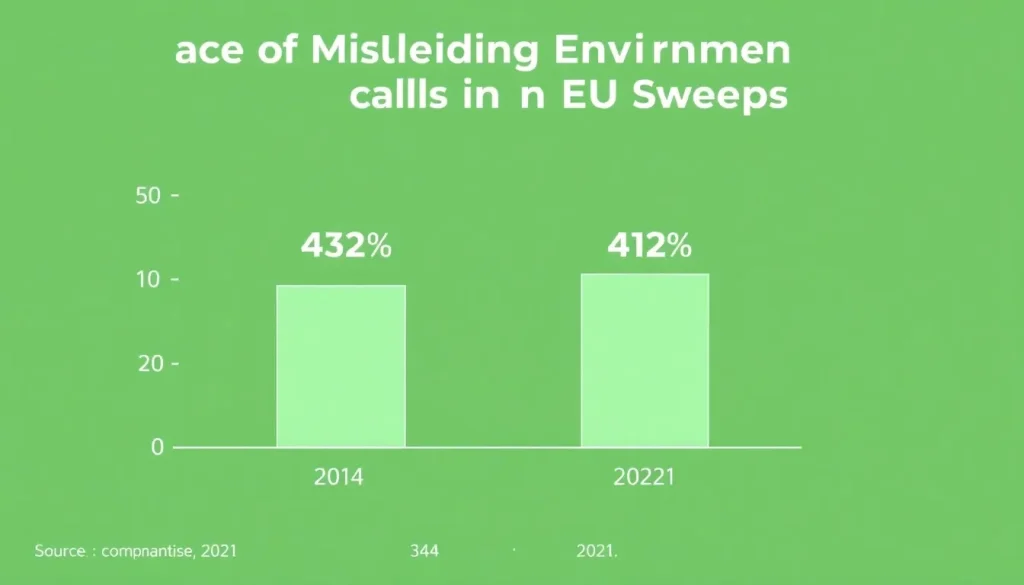
In 2021, a coordinated screening of websites by the European Commission and national consumer protection authorities found that 42% of environmental claims (green claims) were exaggerated, false, or deceptive and could potentially qualify as unfair commercial practices under EU rules.
Measurement date
The sweep was conducted in 2021, with results published on 28 January 2021. The European Commission carries out such sweeps periodically, but there is no fixed annual schedule. The 2021 sweep is the most recent comprehensive EU-level assessment of green claims available.
Previous figure
A similar EU-wide sweep in 2014 also found that 42% of environmental claims were problematic. The absolute change between the two sweeps is 0 percentage points, indicating a persistent level of potentially misleading claims over seven years.
Long-term trend
Data from the two major EU sweeps show no improvement in the accuracy of green claims over time. The 2014 sweep examined 344 websites and found 42% of claims to be exaggerated, false, or deceptive. The 2021 sweep examined 344 websites and again found 42% of claims to be problematic. This consistency suggests that greenwashing remains a significant and unresolved issue in consumer markets.
| Year | Websites Screened | Misleading Claims (%) |
|---|---|---|
| 2014 | 344 | 42% |
| 2021 | 344 | 42% |
Data source
The primary data source is the European Commission’s Directorate-General for Justice and Consumers, in cooperation with national consumer protection authorities of EU Member States, coordinated by the International Consumer Protection and Enforcement Network (ICPEN). The results are published in the European Commission’s press release and accompanying factsheet: “Screening of websites for ‘greenwashing’: half of green claims lack evidence” (January 2021). Additional data comes from the UK Competition and Markets Authority (CMA) and its Green Claims Code enforcement activities.
Methodology
The 2021 sweep involved consumer protection authorities from 27 EU countries, Norway, Iceland, and the United Kingdom. They screened 344 websites making environmental claims across various sectors, including clothing, cosmetics, and household equipment. Authorities assessed whether the claims complied with the EU Unfair Commercial Practices Directive, checking for clarity, specificity, accuracy, and substantiation. Claims were flagged if they were vague (e.g., “eco-friendly”), lacked evidence, or used misleading labels. The sample was not random but targeted websites where misleading claims were suspected, so the 42% figure represents the proportion of claims found to be problematic among those screened, not necessarily the prevalence across all online commerce.
Why annual values fluctuate
Since sweeps are not conducted annually, there is no year-on-year fluctuation. However, the rate of misleading claims can vary between sweeps due to changes in the sectors examined, the specific claims targeted, and evolving marketing tactics. For example, the 2021 sweep included a focus on claims related to circular economy and sustainability, which may have introduced new types of vague or unsubstantiated claims. Additionally, increased consumer demand for green products may incentivize more companies to make environmental claims, some of which may be misleading.
Regional variation
The 2021 sweep covered EU/EEA countries and the UK. While the overall rate of misleading claims was 42%, there were variations by sector and claim type. The UK’s Competition and Markets Authority (CMA) conducted its own review of the fashion sector in 2022, finding that 40% of green claims made by fashion brands were potentially misleading. The CMA also identified that 60% of claims lacked sufficient information for consumers to judge their accuracy. A breakdown by claim type in the EU sweep showed that 59% of claims lacked easily accessible evidence, and 37% used vague terms such as “eco-friendly” without substantiation.
| Region / Sector | Year | Misleading Claims (%) |
|---|---|---|
| EU/EEA/UK (all sectors) | 2021 | 42% |
| UK (fashion sector) | 2022 | 40% |
Meaning and limitations
The 42% figure indicates that a significant share of environmental claims made online are potentially misleading, but it does not represent the prevalence of greenwashing across all products or sectors. The sweep targeted websites where authorities suspected non-compliance, so the true rate of misleading claims in the broader market may be lower. Additionally, the assessment was based on the EU’s Unfair Commercial Practices Directive, which sets a high bar for clarity and substantiation; some claims flagged as misleading might not be intentionally deceptive. The figure is a useful indicator for consumers and regulators to remain vigilant, but it should not be interpreted as a definitive measure of all green claims.
Next expected update
The European Commission has not announced a date for the next sweep. However, with the proposed Directive on Green Claims expected to be adopted in 2024, further enforcement actions and sweeps are likely. The UK CMA continues to investigate misleading environmental claims and may publish updated findings periodically. Stakeholders should monitor the European Commission’s consumer policy page and the CMA’s website for announcements.
Downloadable chart or table
The table below summarizes the key data points from the EU sweeps. The underlying dataset can be downloaded from the European Commission’s press release database or the ICPEN website.
| Year | Websites Screened | Misleading Claims (%) | Key Finding |
|---|---|---|---|
| 2014 | 344 | 42% | Claims were exaggerated, false, or deceptive |
| 2021 | 344 | 42% | Half of claims lacked evidence; 37% used vague terms |
FAQ
What is the most common type of misleading environmental claim?
According to the 2021 EU sweep, the most common issues were vague and general claims (e.g., 'eco-friendly', 'green') used by 37% of websites, and lack of easily accessible evidence to support the claim, found in 59% of cases.
How can consumers identify misleading green claims?
Consumers should look for specific, verifiable claims backed by third-party certifications or detailed evidence. Be wary of vague terms, hidden trade-offs, and irrelevant claims. The UK CMA's Green Claims Code provides a checklist: claims must be truthful, accurate, clear, not omit important information, and be substantiated.
What are the consequences for companies making misleading environmental claims?
In the EU, companies can face enforcement actions by national consumer authorities, including fines, orders to change practices, and reputational damage. Under the proposed Green Claims Directive, companies may be required to provide scientific evidence for claims, and penalties could be strengthened. In the UK, the CMA can take court action for breaches of consumer protection law.
References
- European Commission, 'Screening of websites for 'greenwashing': half of green claims lack evidence', 28 January 2021.
- European Commission, 'Environmental claims in the EU: Inventory and assessment of practices', 2014.
- UK Competition and Markets Authority, 'Green claims and the Consumer Protection from Unfair Trading Regulations', 2022.
- UK Competition and Markets Authority, 'Misleading environmental claims: fashion sector', 2022.
- International Consumer Protection and Enforcement Network (ICPEN), 'Sweep on environmental claims', 2021.