In brief
At a glance
Quick Facts
- Definition of Environmental Regulation
- Government-mandated rules that set specific limits, technology requirements, or bans to control pollution.
- Definition of Market-Based Policy
- Policy instruments that use economic incentives—such as taxes, tradable permits, or subsidies—to encourage pollution reduction.
- Key Difference
- Regulation prescribes behavior; market-based policies incentivize desired outcomes through price signals.
- Cost-Effectiveness
- Market-based policies are generally more cost-effective because they allow firms to choose the cheapest abatement method.
- Certainty of Outcome
- Regulation provides more certainty about emission levels, while market-based policies provide more certainty about costs.
- Innovation Incentive
- Market-based policies create continuous incentives for technological innovation, unlike fixed regulatory standards.
- Hybrid Approaches
- Many real-world policies combine elements of both, such as performance standards with emissions trading.
Key Takeaways
- Environmental regulation prescribes specific actions or limits, while market-based policies use economic signals to incentivize pollution reduction.
- Market-based approaches are generally more cost-effective and encourage innovation, but may not guarantee specific environmental outcomes.
- Command-and-control regulations provide greater certainty about emission levels and are often simpler to enforce, but can be economically inefficient.
- Real-world policy often blends both approaches, using hybrid designs to balance effectiveness, equity, and political feasibility.
What Is Environmental Regulation vs Market-Based Policy?
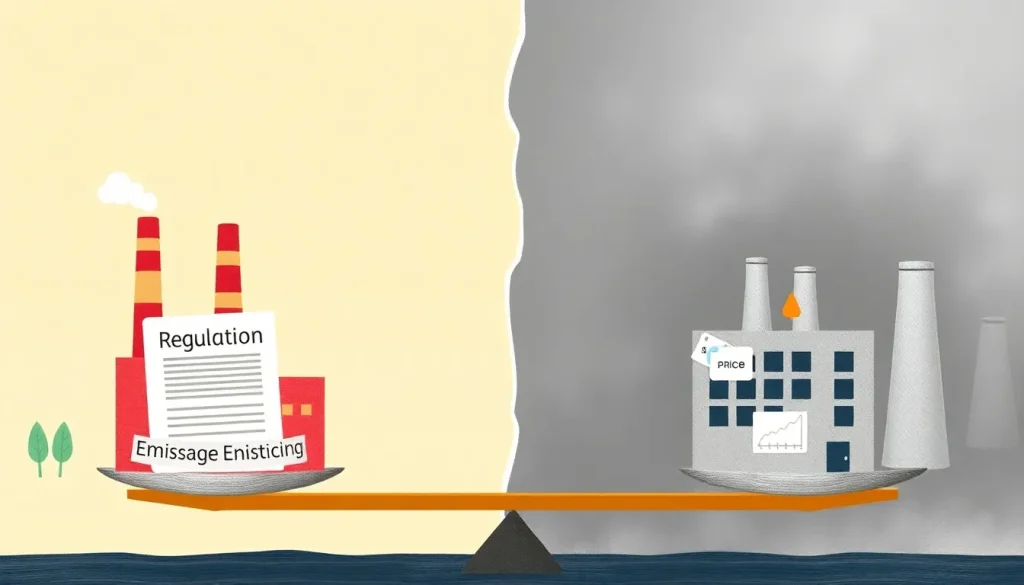
Environmental regulation and market-based policy represent two fundamental strategies for addressing pollution and natural resource degradation. Environmental regulation, often called command-and-control, relies on government mandates that set specific limits, require particular technologies, or ban certain activities outright. In contrast, market-based policy uses economic incentives—such as taxes, tradable permits, or subsidies—to encourage businesses and individuals to reduce their environmental impact voluntarily. Both approaches share the same ultimate goal: to protect ecosystems and public health by reducing harmful emissions and resource depletion.
The distinction lies in how they achieve compliance. Regulation tells polluters exactly what to do and by when, leaving little room for flexibility. Market-based instruments, on the other hand, set a price on pollution or create a market for environmental goods, allowing each firm to decide how best to respond based on its own costs and capabilities. This fundamental difference has profound implications for economic efficiency, innovation, and the distribution of costs across society. Understanding these two policy frameworks is critical for designing effective environmental governance in an era of climate change and resource scarcity.
Overview
Environmental policy instruments can be broadly categorized into two types: regulatory (or command-and-control) and market-based (or economic incentive) approaches. Regulatory policies set uniform standards that all polluters must meet, such as emission limits, technology requirements, or outright bans on certain substances. Market-based policies, by contrast, create financial motivations for polluters to reduce their environmental footprint, often by putting a price on pollution or creating property rights for environmental resources. These two categories are not always mutually exclusive; many real-world policies combine elements of both.
The choice between regulation and market-based instruments involves trade-offs among effectiveness, cost, administrative simplicity, and political acceptability. Command-and-control regulations are often favored when the environmental harm is severe and immediate, or when monitoring and enforcement are straightforward. Market-based policies are typically preferred when flexibility and cost minimization are priorities, and when emissions come from many diverse sources. The debate over which approach is superior has shaped environmental policy for decades, from the early days of the U.S. Clean Air Act to modern carbon pricing initiatives.
History
Environmental regulation emerged as a dominant policy tool in the 1960s and 1970s, driven by growing public concern over pollution and ecological degradation. Landmark laws such as the U.S. Clean Air Act (1970) and Clean Water Act (1972) established strict emission standards and technology-based requirements. These early regulations were largely prescriptive, specifying allowable pollution levels and the equipment that must be used to achieve them. The approach was effective in reducing visible pollution and improving air and water quality in many industrialized nations.
By the 1980s, economists and policymakers began advocating for market-based instruments as a more efficient alternative. The concept of tradable pollution permits, first proposed by economist John Dales in 1968, gained traction. The U.S. Acid Rain Program, established under the 1990 Clean Air Act Amendments, introduced a cap-and-trade system for sulfur dioxide (SO₂) emissions, which successfully reduced acid rain at a fraction of the predicted cost. This success spurred interest in emissions trading worldwide, leading to the European Union Emissions Trading System (EU ETS) in 2005 and various carbon pricing initiatives. Today, both regulatory and market-based approaches coexist, often in hybrid forms, as policymakers seek to balance environmental effectiveness with economic efficiency.
How It Works
Environmental regulation operates through direct government intervention. Authorities set specific standards—such as maximum allowable emissions of a pollutant, required use of a particular technology (e.g., scrubbers on smokestacks), or performance benchmarks—and enforce compliance through permits, inspections, and penalties. For example, a regulation might require all power plants to install flue-gas desulfurization systems to reduce sulfur dioxide emissions. This approach ensures a predictable environmental outcome but can be economically inefficient because it imposes the same requirements on all sources, regardless of their individual abatement costs.
Market-based policies, on the other hand, create economic incentives for pollution reduction. The two most common types are:
- Emissions trading systems (cap-and-trade): A government sets a total cap on emissions and issues tradable permits equal to that cap. Firms that can reduce emissions cheaply may sell excess permits to those with higher abatement costs, achieving the overall cap at the lowest total cost.
- Pollution taxes or charges: A fee is levied on each unit of pollution emitted, giving firms a continuous incentive to reduce emissions as long as the cost of doing so is less than the tax. This approach provides cost certainty but leaves the resulting emission level uncertain.
Other market-based instruments include subsidies for clean technologies, deposit-refund systems for waste, and performance-based standards that allow trading of credits. In all cases, the key mechanism is that polluters face a price for their emissions, leading them to internalize the environmental cost and seek the most cost-effective abatement options.
Benefits, Limitations and Trade-offs
Both regulatory and market-based approaches have distinct advantages and drawbacks. Command-and-control regulation offers high certainty about emission levels and environmental outcomes, which is crucial when dealing with toxic pollutants or acute health risks. It is also often simpler to administer and enforce, as compliance can be verified through inspections and monitoring of specific technologies. However, it tends to be economically inefficient because it does not account for differences in abatement costs across firms, potentially imposing unnecessarily high costs on some while others could reduce more cheaply. It also provides little incentive for innovation beyond meeting the standard.
Market-based policies are generally more cost-effective because they allow firms to choose the least expensive abatement method. They also create ongoing incentives for technological innovation, as any reduction in emissions below the permit level or tax threshold yields financial savings. However, they may not guarantee specific environmental outcomes if the cap is set too high or the tax too low. They can also raise equity concerns, as the costs may fall disproportionately on low-income households if, for example, a carbon tax increases energy prices. Additionally, market-based systems require robust monitoring, reporting, and verification to prevent fraud and ensure environmental integrity. Political opposition often arises from the perception that such policies grant a “right to pollute.”
In practice, many policies blend elements of both. For instance, a performance standard might allow emissions trading, or a regulation might be combined with a subsidy for compliance. The optimal mix depends on the specific pollutant, the structure of the industry, and the political context.
Examples
Real-world applications illustrate the strengths and weaknesses of each approach. The U.S. Clean Air Act’s National Ambient Air Quality Standards (NAAQS) are a classic example of command-and-control regulation. They set maximum allowable concentrations for six criteria pollutants and require states to develop implementation plans to meet them. This has led to significant improvements in air quality but has also been criticized for its rigidity and high compliance costs.
The U.S. Acid Rain Program, established under Title IV of the 1990 Clean Air Act Amendments, is a landmark market-based policy. It set a cap on SO₂ emissions from power plants and allowed trading of emission allowances. The program achieved its reduction targets ahead of schedule and at about one-quarter of the estimated cost of a comparable regulatory approach. Similarly, the European Union Emissions Trading System (EU ETS) is the world’s largest cap-and-trade system for greenhouse gases, covering thousands of installations across Europe. While it has faced challenges with permit overallocation and price volatility, it has contributed to emission reductions in the power and industrial sectors.
Carbon taxes, another market-based instrument, have been implemented in countries such as Sweden and Canada. Sweden’s carbon tax, introduced in 1991, is among the highest in the world and has been credited with reducing emissions while maintaining economic growth. These examples demonstrate that both regulatory and market-based policies can be effective, but their success depends on careful design, enforcement, and adaptation over time.
FAQ
What is the main difference between environmental regulation and market-based policy?
Environmental regulation uses direct government mandates to control pollution, such as emission limits or technology requirements. Market-based policy uses economic incentives, like taxes or tradable permits, to encourage voluntary pollution reduction.
Which is more effective: regulation or market-based instruments?
Effectiveness depends on the context. Regulation provides more certainty about environmental outcomes, while market-based policies are often more cost-effective and encourage innovation. Many successful policies combine elements of both.
What are examples of market-based environmental policies?
Examples include cap-and-trade systems (e.g., the EU Emissions Trading System), carbon taxes (e.g., Sweden's carbon tax), and deposit-refund schemes for beverage containers. These policies use price signals to reduce pollution.
References
- Stavins, R. N. (2003). Experience with Market-Based Environmental Policy Instruments. In Handbook of Environmental Economics.
- Environmental Protection Agency. (n.d.). Economic Incentives. Retrieved from https://www.epa.gov/environmental-economics/economic-incentives
- Tietenberg, T., & Lewis, L. (2018). Environmental and Natural Resource Economics. Routledge.