In brief
At a glance
Quick Facts
- Definition
- Climate reparations are payments or other forms of compensation from high-emitting, wealthy nations to low-emitting, vulnerable nations for climate change loss and damage.
- Historical emissions
- Industrialized countries are responsible for the majority of historical greenhouse gas emissions since the Industrial Revolution.
- Loss and damage
- The term refers to impacts of climate change that cannot be avoided through mitigation or adaptation, including economic and non-economic losses.
- UNFCCC principle
- The United Nations Framework Convention on Climate Change acknowledges 'common but differentiated responsibilities and respective capabilities'.
- Warsaw International Mechanism
- Established in 2013 to address loss and damage, initially without a mandate for compensation.
- Loss and Damage Fund
- A dedicated fund was agreed upon at COP27 in 2022, but operational details and funding sources remain under negotiation.
- Vulnerable nations
- Small island developing states and least developed countries are among the most vulnerable to climate impacts despite contributing least to emissions.
- Funding needs
- Estimates of the financial needs for adaptation and loss and damage in developing countries run into hundreds of billions of dollars annually.
- Political opposition
- Many developed countries resist formal liability and compensation frameworks, fearing legal and financial consequences.
- Proposed mechanisms
- Ideas include a global carbon tax, debt relief, direct transfers, and insurance schemes.
Key Takeaways
- Climate reparations are proposed payments or other forms of compensation from high-emitting, wealthy nations to low-emitting, vulnerable nations for the loss and damage caused by climate change.
- The core argument for reparations rests on the principles of historical responsibility and climate justice, as the countries least responsible for emissions often suffer the most severe impacts.
- Opponents raise concerns about legal liability, the difficulty of attributing specific damages to climate change, and the potential for endless financial claims.
- Despite political resistance, the concept of loss and damage has gained traction in international climate negotiations, leading to the establishment of a dedicated fund, though operational details and funding sources remain contested.
What Is Climate Reparations: Arguments and Challenges?
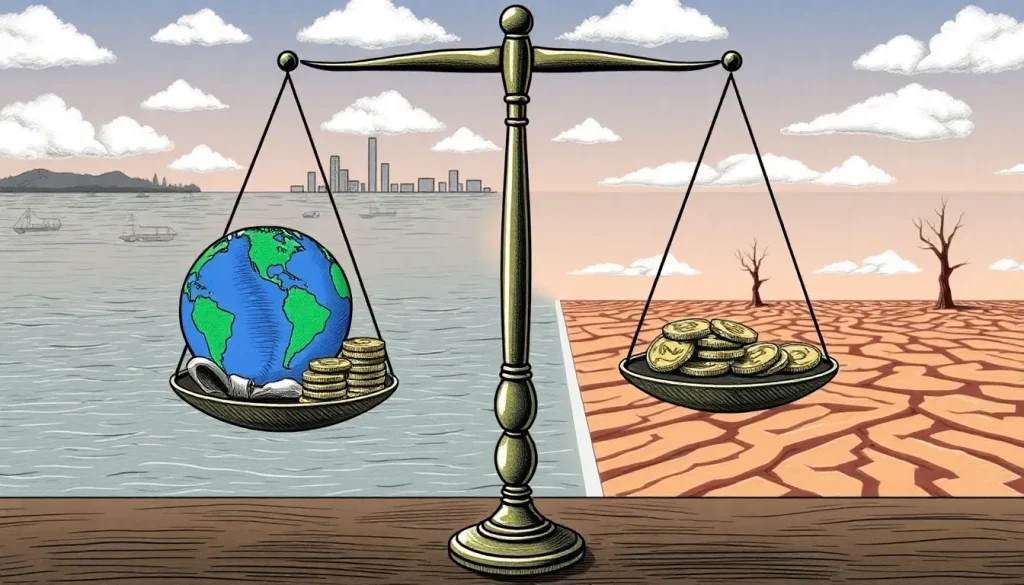
Climate reparations refer to the idea that countries and entities most responsible for historical greenhouse gas emissions should provide compensation to those that are most vulnerable to the impacts of climate change but have contributed least to the problem. This compensation can take many forms, including financial payments, debt relief, technology transfer, or direct support for adaptation and recovery from climate-induced disasters. The concept is deeply intertwined with the broader framework of climate justice, which seeks to address the ethical and equity dimensions of climate change, recognizing that the burdens of global warming are not shared equally.
The debate over climate reparations is not merely academic; it sits at the heart of international climate negotiations and has become a defining issue in the relationship between developed and developing nations. While the term “reparations” itself is often avoided in diplomatic settings due to its connotations of legal liability and historical redress, the underlying principles are embedded in the United Nations Framework Convention on Climate Change (UNFCCC) through the concept of “loss and damage.” The arguments for and against climate reparations encompass moral, economic, legal, and political dimensions, and the challenges to implementation are substantial, ranging from quantifying responsibility to overcoming geopolitical resistance.
Overview
Climate reparations are not a single, agreed-upon policy but rather a spectrum of proposals aimed at addressing the disproportionate impacts of climate change. At its core, the concept acknowledges that the global climate crisis is a result of cumulative historical emissions, predominantly from industrialized nations in the Global North. These emissions have locked in a certain amount of warming, leading to sea-level rise, extreme weather events, and other slow-onset changes that disproportionately affect developing countries, particularly small island states and least developed nations. The call for reparations is thus a demand for corrective justice: those who caused the problem should pay to help those who are suffering the consequences.
The discussion around climate reparations has evolved from early debates on “compensation” to the more formalized language of “loss and damage” within the UNFCCC. Loss and damage refers to the impacts of climate change that cannot be avoided through mitigation or adaptation. It includes both economic losses (e.g., destroyed infrastructure, reduced crop yields) and non-economic losses (e.g., loss of life, cultural heritage, biodiversity). The push for a dedicated funding mechanism to address loss and damage has become a central demand of developing countries, culminating in the establishment of a Loss and Damage Fund at COP27 in 2022. However, the fund’s operationalization, including who pays and who receives, remains a major point of contention.
History
The roots of climate reparations can be traced back to the early days of international climate diplomacy. The 1992 UNFCCC itself enshrined the principle of “common but differentiated responsibilities and respective capabilities” (CBDR), which acknowledges that while all countries share a common responsibility to protect the environment, developed countries bear a greater burden due to their historical contributions to the problem and their greater financial and technological resources. This principle laid the groundwork for later discussions on financial transfers and support for developing countries.
The specific issue of loss and damage emerged more prominently in the early 2000s, driven by the Alliance of Small Island States (AOSIS) and other vulnerable nations. They argued that mitigation (reducing emissions) and adaptation (adjusting to impacts) were insufficient to address the irreversible harm already being caused by climate change. In 2013, the Warsaw International Mechanism for Loss and Damage was established to enhance knowledge and coordination, but it lacked a mandate for providing compensation. The push for a dedicated funding stream intensified over the following decade, culminating in the historic decision at COP27 in Sharm el-Sheikh to create a Loss and Damage Fund. Subsequent negotiations have focused on the fund’s design, with developing countries advocating for it to be a standalone facility under the UNFCCC, while developed countries have pushed for it to be housed within existing institutions and to draw on a broader donor base.
How It Works
There is no single, universally accepted model for climate reparations, but several mechanisms have been proposed. The most direct form is financial compensation: developed countries would make payments to a global fund, which would then disburse resources to vulnerable countries to cover losses and damages from climate-related events. This could include payouts for extreme weather disasters, slow-onset events like sea-level rise, or even non-economic losses such as the loss of cultural heritage. The amounts could be determined based on historical emissions, current wealth, or a combination of both.
Other proposed mechanisms include debt relief or cancellation for climate-vulnerable countries, which would free up fiscal space for climate adaptation and recovery. Technology transfer on concessional terms is another form of reparation, enabling developing countries to leapfrog to clean energy and build resilient infrastructure. Some advocates also call for a global carbon tax on fossil fuel extraction, with revenues directed to a loss and damage fund. Additionally, there are proposals for insurance schemes, where developed countries subsidize premiums for vulnerable nations, or for direct bilateral agreements. The operationalization of any mechanism requires robust systems for assessing needs, distributing funds, and ensuring accountability, all of which present significant logistical challenges.
Benefits, Limitations and Trade-offs
The primary benefit of climate reparations is the potential to address a profound injustice. By providing resources to those most affected, reparations could help vulnerable communities rebuild after disasters, adapt to changing conditions, and preserve their cultures and livelihoods. This could also foster greater trust and cooperation in international climate negotiations, making it easier to achieve ambitious mitigation targets. Furthermore, reparations could stimulate economic development in recipient countries, reducing global inequality and potentially preventing climate-induced migration and conflict.
However, the limitations and trade-offs are substantial. A major challenge is the difficulty of attributing specific damages to climate change, as opposed to natural variability or other factors. This makes it hard to determine who should pay and how much. There is also the risk of “moral hazard,” where the availability of compensation might reduce incentives for mitigation or adaptation. Politically, many developed countries resist the term “reparations” because it implies legal liability and could open the door to unlimited claims. They prefer the language of “solidarity” or “support.” Additionally, there are concerns about governance and corruption in recipient countries, and about the capacity to absorb and effectively use large financial flows. The trade-off often lies between the moral imperative to act and the practical and political obstacles to doing so.
Regional Differences
The demand for climate reparations is most strongly voiced by countries in the Global South, particularly small island developing states (SIDS) and least developed countries (LDCs). For SIDS like Tuvalu, Kiribati, and the Maldives, sea-level rise poses an existential threat, and they argue that their very survival depends on compensation from major emitters. African nations, which have contributed negligibly to global emissions, face severe droughts, floods, and food insecurity, and they see reparations as a matter of justice. Latin American and Asian countries also experience significant losses, though their positions vary based on their own emission profiles and economic status.
In contrast, developed countries in the Global North, such as the United States, the European Union, and Australia, have historically been cautious or resistant to formal reparations. They emphasize the need for all countries to contribute to climate action, including emerging economies like China and India, which are now major emitters. The EU has been more open to discussing loss and damage funding but insists on broadening the donor base. The United States, under various administrations, has consistently opposed language that could be interpreted as accepting legal liability. Meanwhile, some oil-producing states in the Gulf region, which have high per capita emissions but also face climate risks, occupy a complex position. These regional differences reflect divergent historical responsibilities, economic capacities, and geopolitical interests, making consensus difficult.
Common Misconceptions
One common misconception is that climate reparations are simply foreign aid or charity. In fact, proponents frame them as a legal and moral obligation, akin to reparations for other historical injustices. Another misconception is that reparations would only benefit corrupt governments; while governance challenges exist, many proposals include safeguards and direct community-level disbursement mechanisms. Some also believe that climate reparations would let developing countries off the hook for their own emissions, but the focus is on historical responsibility, and most developing nations are also taking steps to mitigate and adapt. Finally, there is a misconception that the concept is new or radical; it has been part of international climate law discussions for decades, rooted in the UNFCCC’s principle of common but differentiated responsibilities.
FAQ
What is climate reparations?
Climate reparations refer to the idea that wealthy, high-emitting nations should compensate poorer, low-emitting nations for the loss and damage caused by climate change, based on historical responsibility and capacity to pay.
How does climate reparations work?
There is no single model, but proposed mechanisms include financial payments into a global loss and damage fund, debt relief, technology transfer, and insurance schemes. The fund would disburse resources to vulnerable countries for recovery and adaptation.
Why does climate reparations matter?
It matters because it addresses a fundamental injustice: the countries that contributed least to climate change are often the most affected. Implementing reparations could help vulnerable communities survive and thrive, foster international cooperation, and uphold principles of equity in global climate policy.
References
- IPCC Sixth Assessment Report, Working Group II: Impacts, Adaptation and Vulnerability
- United Nations Framework Convention on Climate Change (UNFCCC) and the Paris Agreement
- World Bank, 'Shock Waves: Managing the Impacts of Climate Change on Poverty'