In brief
At a glance
Quick Facts
- Definition
- Breeding endangered species in controlled environments to boost populations and potentially reintroduce them to the wild.
- Primary goal
- Prevent extinction and establish self-sustaining wild populations.
- Key success factors
- Genetic diversity, habitat protection, threat reduction, and post-release monitoring.
- Notable successes
- California condor, black-footed ferret, Arabian oryx, Przewalski’s horse.
- Major limitation
- Does not address habitat loss or other root causes of decline.
- Typical cost
- High; requires long-term funding for facilities, staff, and monitoring.
- Genetic management
- Studbooks and software track pedigrees to minimize inbreeding.
- Release strategies
- Hard release (direct) or soft release (acclimatization enclosures).
Key Takeaways
- Captive breeding can prevent the immediate extinction of species by maintaining a genetically viable safety-net population outside the wild.
- Reintroduction success hinges on addressing the original causes of decline, such as habitat destruction, invasive species, or poaching.
- Animals bred in captivity may lose natural behaviors essential for survival, making post-release adaptation challenging.
- It is most effective when integrated with habitat protection, policy enforcement, and community engagement, rather than as a standalone solution.
What Is Captive Breeding?
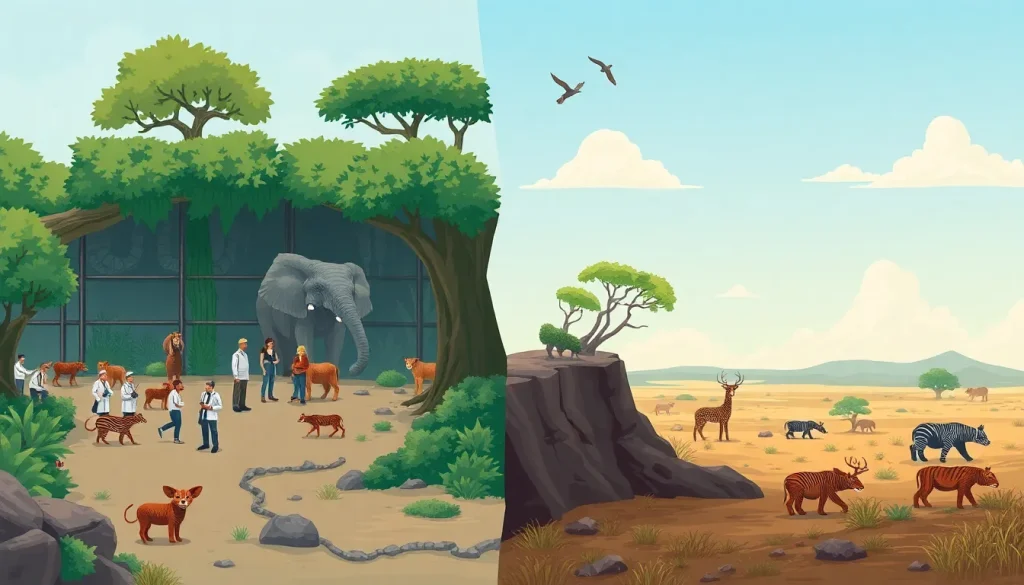
Captive breeding is a conservation technique in which endangered or threatened species are bred in human-controlled environments—such as zoos, aquariums, wildlife reserves, or dedicated breeding centers—with the goal of increasing population numbers and, in many cases, eventually reintroducing individuals into their natural habitats. It is a form of ex situ conservation, meaning the protection of species outside their native ecosystems, as opposed to in situ conservation, which focuses on preserving species within their natural surroundings. The primary objective is to create a demographic and genetic safety net that can prevent extinction when wild populations are critically low or facing imminent threats.
Captive breeding programs are often managed cooperatively at national or international levels through studbooks and species survival plans. These programs carefully track the genetic lineage of each individual to avoid inbreeding and maintain genetic diversity, which is crucial for the long-term health and adaptability of the species. While the immediate aim is to produce offspring, the ultimate measure of success is the establishment of self-sustaining wild populations. Captive breeding is not a new concept, but its application as a structured conservation tool has grown significantly since the mid-20th century, driven by the accelerating loss of biodiversity.
How It Works
Captive breeding programs follow a systematic, science-based process that typically includes several key stages: selection of founder individuals, genetic management, breeding and rearing, preparation for release, and post-release monitoring. Each stage is critical to the overall success of the program.
Founder Selection and Genetic Management: The program begins with the careful selection of founder animals—individuals taken from the wild or from existing captive populations—to establish a genetically diverse breeding stock. Studbooks, often maintained by zoos or conservation organizations, record the pedigree of every individual. Software tools help calculate genetic diversity metrics and recommend pairings to minimize inbreeding and preserve as much of the original gene pool as possible. In some cases, assisted reproductive technologies such as artificial insemination, embryo transfer, or even cloning are used to overcome breeding challenges.
Breeding and Rearing: Animals are housed in environments that aim to meet their physical and psychological needs while minimizing human imprinting. For species destined for reintroduction, keepers often use techniques like puppet feeding, minimal human contact, and naturalistic enclosures to encourage the development of wild behaviors. Veterinary care ensures high survival rates of offspring, which is often much higher than in the wild.
Pre-release Training and Release: Before release, animals may undergo conditioning to develop survival skills such as hunting, foraging, predator avoidance, and social interactions. Release strategies vary: hard releases involve directly freeing animals into the wild, while soft releases use acclimatization enclosures at the release site to gradually transition animals. The choice depends on the species’ behavioral flexibility and the availability of suitable habitat.
Post-release Monitoring and Management: After release, individuals are often tracked using radio collars, tags, or camera traps to assess survival, reproduction, and dispersal. This data informs whether the program is meeting its goals and allows for adaptive management, such as supplemental feeding, veterinary intervention, or additional releases to bolster the population.
Examples
Several high-profile species have been saved from extinction through captive breeding and reintroduction, demonstrating the potential of this approach when conditions are favorable.
- California Condor: In 1987, the last 27 wild California condors were captured to start a captive breeding program. Through intensive management, the population grew, and birds were reintroduced to the wild beginning in 1992. As of the early 2020s, there are over 300 condors in the wild, though they still require ongoing management due to threats like lead poisoning.
- Black-footed Ferret: Thought extinct until a small population was discovered in 1981, the remaining 18 ferrets were brought into captivity. A successful breeding program enabled reintroduction into the North American Great Plains. Today, there are several hundred ferrets in the wild, but they remain dependent on captive-bred individuals to supplement populations and maintain genetic diversity.
- Arabian Oryx: Extinct in the wild by 1972 due to hunting, the species was saved through a captive breeding program using animals from private collections and zoos. Reintroductions began in the 1980s, and the Arabian oryx was downlisted from “extinct in the wild” to “vulnerable” by 2011—the first species to achieve such a recovery through captive breeding.
- Przewalski’s Horse: The last wild Przewalski’s horse was seen in 1969. A captive breeding program from just 12 founders successfully rebuilt the population, and reintroductions into Mongolia and China began in the 1990s. Today, several hundred horses roam free in protected areas.
- European Bison: Extinct in the wild in the early 20th century, the species survived only in zoos. Coordinated breeding and reintroduction efforts have established free-ranging herds in several European countries, with the population now numbering in the thousands.
Benefits, Limitations and Trade-offs
Captive breeding offers clear benefits but also comes with significant limitations and trade-offs that must be carefully weighed.
Benefits:
- Prevents Immediate Extinction: It can serve as a last resort when wild populations are no longer viable, buying time to address threats.
- Boosts Population Numbers Rapidly: Controlled conditions often result in higher reproductive rates and offspring survival than in the wild.
- Genetic Management: Allows for careful genetic monitoring and the preservation of genetic diversity that might otherwise be lost.
- Research Opportunities: Captive populations provide valuable data on species biology, behavior, and health that can inform conservation strategies.
- Public Engagement: Captive animals in zoos can raise awareness and funding for conservation efforts.
Limitations and Trade-offs:
- Behavioral and Genetic Changes: Captive environments can lead to domestication, loss of natural behaviors, and genetic adaptation to captivity, reducing fitness in the wild.
- High Costs: Maintaining captive populations and running reintroduction programs requires substantial, long-term financial and human resources.
- Habitat Dependency: Without protected and restored habitats, reintroduced animals cannot survive. Captive breeding cannot compensate for ongoing habitat destruction.
- Disease Risks: Captive animals may carry diseases that can be transmitted to wild populations upon release.
- Ethical Concerns: Keeping animals in captivity raises welfare issues, and reintroduction can subject animals to stress and high mortality rates.
- Limited Capacity: Only a fraction of threatened species can be maintained in captivity due to space, cost, and biological constraints.
What the Evidence Shows
Scientific assessments of captive breeding and reintroduction programs reveal a mixed but instructive picture. A review of reintroduction projects found that success rates vary widely depending on the species, the quality of habitat, and the methods used. For example, reintroductions of captive-bred mammals and birds into protected areas with controlled threats have higher success rates than those into degraded habitats. Studies indicate that animals from captive populations often have lower survival rates than wild-born individuals, particularly in the first year after release, due to naivety about predators and difficulties in finding food.
Genetic analyses show that even well-managed captive populations can lose genetic diversity over generations, especially if the founder population is small. This can reduce the adaptive potential of reintroduced populations. However, when captive breeding is combined with habitat restoration and ongoing management, the evidence demonstrates that it can be a decisive factor in preventing extinction. The key lesson is that captive breeding is not a cure-all; it is a tool whose effectiveness is determined by the broader conservation context.
Common Misconceptions
Misconception 1: Captive breeding alone can save a species. In reality, without addressing the root causes of decline—such as habitat loss, poaching, or invasive species—reintroduced animals are unlikely to survive. Captive breeding must be part of a comprehensive recovery plan.
Misconception 2: Animals bred in captivity are identical to their wild counterparts. Captive conditions can lead to behavioral, physiological, and genetic changes that reduce an animal’s ability to thrive in the wild. This is why pre-release training and careful genetic management are essential.
Misconception 3: Reintroduction is always the end goal of captive breeding. Some captive populations serve solely as an insurance against extinction, with no current plans for release because suitable habitat no longer exists or threats remain uncontrolled. In such cases, the species exists only in captivity, which is a form of conservation triage.
Misconception 4: Captive breeding is a cheap and easy solution. It is resource-intensive, requiring decades of commitment, specialized facilities, and ongoing funding. The cost per individual released can be extremely high, and many programs fail to achieve self-sustaining wild populations.
FAQ
What is captive breeding?
Captive breeding is the practice of breeding endangered species in controlled environments like zoos or breeding centers to increase their population and, ideally, reintroduce them into the wild.
How does captive breeding prevent extinction?
It creates a backup population outside the wild, protecting species from immediate threats. When combined with habitat protection and threat reduction, it can enable reintroduction and recovery.
Why does captive breeding matter?
It is a critical last-resort tool for species on the brink of extinction. It also supports genetic diversity, research, and public awareness, contributing to broader conservation efforts.
References
- IUCN/SSC (International Union for Conservation of Nature/Species Survival Commission). Guidelines for Reintroductions and Other Conservation Translocations.
- Conway, W. G. (1980). An overview of captive propagation. In Conservation Biology: An Evolutionary-Ecological Perspective.
- Frankham, R., Ballou, J. D., & Briscoe, D. A. (2010). Introduction to Conservation Genetics. Cambridge University Press.
- Seddon, P. J., Armstrong, D. P., & Maloney, R. F. (2007). Developing the science of reintroduction biology. Conservation Biology.