In brief
At a glance
Quick Facts
- Definition
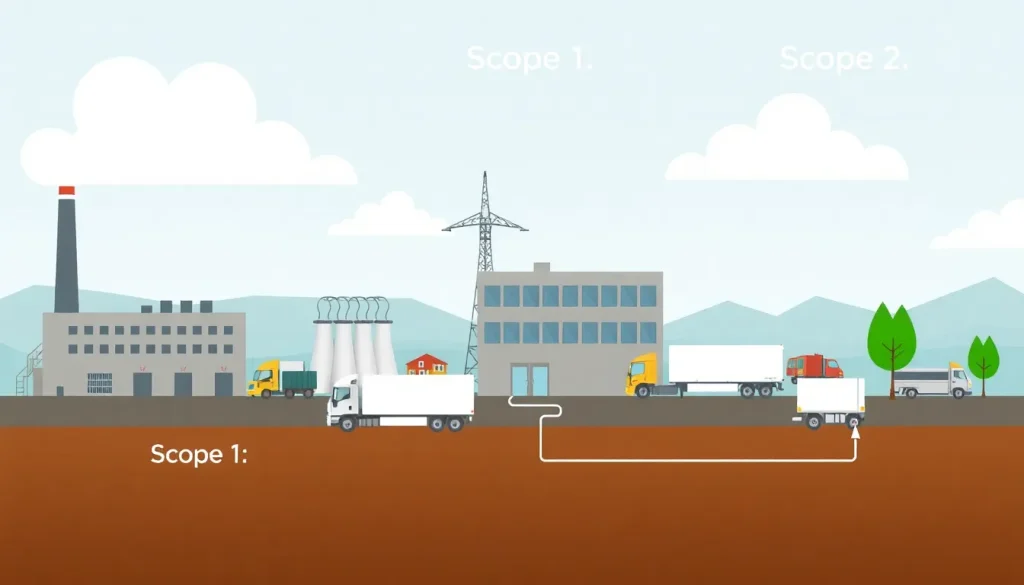
- Scope 1, 2, and 3 are emission categories from the Greenhouse Gas Protocol, the most widely used international accounting tool.
- Scope 1
- Direct emissions from sources owned or controlled by the company, such as fuel combustion in boilers or vehicles.
- Scope 2
- Indirect emissions from the generation of purchased electricity, steam, heating, and cooling consumed by the company.
- Scope 3
- All other indirect emissions that occur in the company's value chain, including both upstream and downstream activities.
- Reporting requirement
- Many corporate sustainability frameworks require Scope 1 and 2 reporting, while Scope 3 is often voluntary but increasingly expected.
- Global standard
- The GHG Protocol was developed by the World Resources Institute (WRI) and the World Business Council for Sustainable Development (WBCSD).
- Scope 3 categories
- The GHG Protocol defines 15 categories of Scope 3 emissions, including purchased goods and services, business travel, and use of sold products.
- Importance
- For many companies, Scope 3 emissions represent the largest portion of their carbon footprint, often over 80%.
Key Takeaways
- Scope 1, 2, and 3 emissions are a classification system from the Greenhouse Gas Protocol that helps organizations measure and manage their greenhouse gas emissions.
- Scope 1 covers direct emissions from owned or controlled sources; Scope 2 covers indirect emissions from purchased energy; Scope 3 covers all other indirect emissions across the value chain.
- For most companies, Scope 3 emissions represent the largest portion of their carbon footprint, often exceeding 80% of total emissions.
- Accurate scope-based accounting is critical for setting science-based targets, complying with regulations, and identifying reduction opportunities throughout the value chain.
What Is Scope 1, Scope 2 and Scope 3 Emissions Explained?
Scope 1, Scope 2, and Scope 3 emissions are a categorization framework established by the Greenhouse Gas (GHG) Protocol to help organizations delineate their direct and indirect greenhouse gas emissions. This classification is the foundation of corporate carbon accounting, enabling companies to measure, report, and manage their climate impact in a standardized and comparable way. The three scopes are defined by the source of emissions and the level of control an organization has over them, ranging from direct emissions from owned assets (Scope 1) to indirect emissions from purchased energy (Scope 2) and all other indirect emissions that occur in the value chain (Scope 3).
The GHG Protocol, developed by the World Resources Institute and the World Business Council for Sustainable Development, introduced this scopes framework in its Corporate Standard, first published in 2001. The framework is now the most widely used international accounting tool for greenhouse gas emissions, adopted by thousands of companies, governments, and other organizations. By separating emissions into these three scopes, the protocol helps prevent double counting of emissions between different entities and provides a comprehensive picture of an organization’s carbon footprint, which is essential for effective climate strategy and target setting.
Overview
The three scopes provide a complete inventory of a company’s greenhouse gas emissions. Scope 1 includes all direct emissions from sources that are owned or controlled by the company, such as emissions from combustion in owned boilers, furnaces, vehicles, and chemical production. Scope 2 accounts for indirect emissions from the generation of purchased electricity, steam, heating, and cooling consumed by the company. Although the emissions physically occur at the facility where the energy is generated, they are attributed to the company because it uses the energy. Scope 3 encompasses all other indirect emissions that occur in the company’s value chain, both upstream and downstream. This includes emissions from purchased goods and services, business travel, employee commuting, waste disposal, use of sold products, transportation and distribution, and investments. The GHG Protocol further divides Scope 3 into 15 distinct categories to help companies systematically account for these emissions.
How It Works
The scopes framework operates on the principle of operational and financial control. A company first defines its organizational boundaries—which entities it owns or controls—and then categorizes emissions based on where they occur relative to those boundaries. Scope 1 emissions are direct emissions from sources within the company’s operational control, such as fuel burned in company-owned vehicles or manufacturing processes. Scope 2 emissions are indirect emissions from the generation of purchased energy; the company does not directly emit the GHGs but is responsible for the energy consumption. To calculate Scope 2, companies typically use emission factors provided by electricity suppliers or regional grid averages. Scope 3 emissions are all other indirect emissions, both upstream (e.g., from suppliers) and downstream (e.g., from product use). Measuring Scope 3 is more complex and often requires data from suppliers, customers, and life cycle assessments. Companies may use spend-based methods (applying emission factors to financial data) or activity-based methods (using physical data like kilometers traveled) to estimate these emissions.
Importance and Impact
Understanding and reporting emissions across all three scopes is crucial for comprehensive climate risk management and strategic planning. For many industries, Scope 3 emissions constitute the majority of their carbon footprint—often over 80%—meaning that a company’s most significant climate impact lies outside its direct operations. By accounting for Scope 3, companies can identify hotspots in their value chain, engage suppliers, innovate product design, and influence consumer behavior. This holistic view is increasingly demanded by investors, regulators, and customers. Moreover, initiatives like the Science Based Targets initiative (SBTi) require companies to measure and reduce Scope 3 emissions if they represent a significant portion of total emissions. Failure to address Scope 3 can expose companies to reputational, regulatory, and transition risks as the global economy shifts toward net-zero.
Examples
To illustrate, consider a clothing retailer. Its Scope 1 emissions might include natural gas burned for heating in its own stores and warehouses, and fuel used in company-owned delivery trucks. Scope 2 emissions would come from the electricity purchased to power its stores, offices, and distribution centers. Scope 3 emissions would be the largest category, including emissions from the production of raw materials (e.g., cotton farming, synthetic fiber manufacturing), fabric dyeing and finishing by suppliers, transportation of goods from factories to warehouses, business travel by employees, and the energy used by customers to wash and dry the clothing. Another example is a technology company: Scope 1 includes emissions from company-owned data centers’ backup generators; Scope 2 includes electricity to run those data centers; Scope 3 includes emissions from manufacturing components by suppliers, employee commuting, and the use of sold devices by customers.
Benefits, Limitations and Trade-offs
The scopes framework provides a clear, standardized method for emissions accounting, enabling comparability across companies and industries. It helps organizations prioritize reduction efforts, set targets, and track progress. However, there are limitations. Scope 1 and 2 are relatively straightforward to measure, but Scope 3 accounting is often complex, data-intensive, and reliant on estimates and assumptions. Companies may face challenges in obtaining accurate data from suppliers, especially for downstream emissions. There is also a risk of double counting across different companies’ Scope 3 inventories, though the protocol is designed to minimize this. Additionally, the focus on three scopes can sometimes oversimplify the nuanced nature of emissions sources. Despite these challenges, the framework remains the most effective tool for comprehensive carbon management, and ongoing updates to the GHG Protocol aim to improve guidance on Scope 3 accounting.
Common Misconceptions
One common misconception is that Scope 3 emissions are optional or less important than Scope 1 and 2. In reality, for many sectors, Scope 3 represents the largest share of emissions and is critical for achieving net-zero goals. Another misunderstanding is that Scope 2 emissions are always zero if a company purchases renewable energy certificates (RECs). While RECs can offset Scope 2 emissions on paper, the actual physical emissions from the grid may not change unless the renewable energy is additional. Some also believe that Scope 3 reporting is only for large corporations, but small and medium enterprises can also benefit from understanding their value chain emissions. Finally, there is confusion that the scopes are mutually exclusive for all entities; however, one company’s Scope 1 emissions can be another company’s Scope 3 emissions, which is why the protocol emphasizes transparent reporting to avoid double counting at the aggregate level.
FAQ
What are Scope 1, 2, and 3 emissions?
They are a classification system from the Greenhouse Gas Protocol. Scope 1 covers direct emissions from owned sources, Scope 2 covers indirect emissions from purchased energy, and Scope 3 covers all other indirect emissions in the value chain.
How do companies measure Scope 3 emissions?
Companies typically use a combination of spend-based methods (applying emission factors to financial data) and activity-based methods (using physical data like kilometers traveled or kilograms of material). Data is often collected from suppliers, industry averages, and life cycle databases.
Why is it important to report all three scopes?
Reporting all three scopes provides a complete picture of a company's climate impact, identifies the largest emission sources, and is increasingly required by investors, regulators, and sustainability frameworks. For most companies, Scope 3 represents the majority of emissions and is critical for effective reduction strategies.
References
- Greenhouse Gas Protocol: A Corporate Accounting and Reporting Standard (Revised Edition), World Resources Institute and World Business Council for Sustainable Development.
- CDP (formerly Carbon Disclosure Project) Technical Note: Relevance of Scope 3 Categories by Sector.
- Science Based Targets initiative (SBTi) Corporate Net-Zero Standard.