In brief
At a glance
Quick Facts
- Definition of overshoot
- A temporary exceedance of a global warming level, such as 1.5°C, followed by a decline back below that level.
- Key requirement for temperature decline
- Achieving net-negative CO₂ emissions through large-scale carbon dioxide removal (CDR).
- Timescale for cooling
- Decades to centuries, due to ocean thermal inertia and the long lifetime of CO₂.
- Irreversible impacts
- Sea-level rise from ice sheet loss, species extinctions, and ecosystem shifts may not reverse even if temperatures fall.
- CDR methods
- Include afforestation, BECCS, direct air capture, enhanced weathering, and ocean alkalinization.
- IPCC assessment
- Pathways limiting warming to 1.5°C often involve overshoot and rely on net-negative emissions later in the century.
- Risk of tipping points
- Overshoot increases the chance of crossing irreversible thresholds in ice sheets, ecosystems, and ocean circulation.
- Moral hazard concern
- Expectation of future CDR may reduce the urgency of immediate emission cuts.
Key Takeaways
- Global temperature can decline after temporarily exceeding 1.5°C, but only if net-negative CO₂ emissions are achieved—removing more greenhouse gases from the atmosphere than are emitted.
- Even if temperatures eventually fall, many climate impacts such as sea-level rise, ice sheet loss, and ecosystem damage are irreversible on human timescales.
- Overshooting 1.5°C increases the risk of crossing tipping points that could trigger self-reinforcing warming, making a return to lower temperatures more difficult.
- Rapid and deep emission cuts remain essential; relying on future temperature decline after overshoot introduces significant uncertainties and risks.
What Is Overshooting 1.5°C and Can Temperature Fall Afterwards?
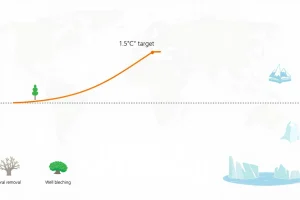
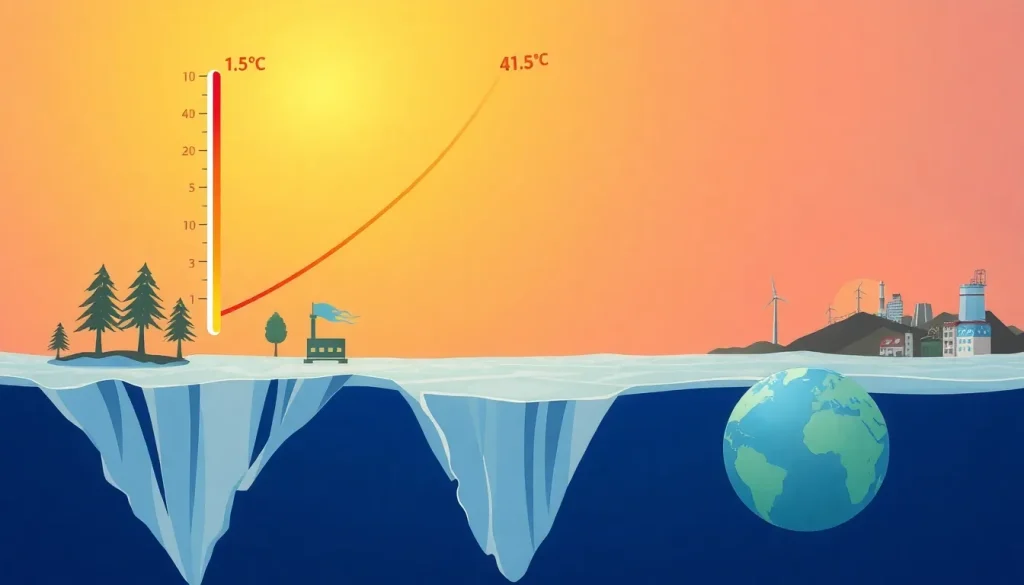
Overshooting 1.5°C refers to a scenario in which global average surface temperature temporarily exceeds the 1.5°C threshold above pre-industrial levels, a limit set by the Paris Agreement to avoid the most severe climate impacts. The question of whether temperature can fall after such an overshoot is central to climate policy discussions, as many modelled pathways that limit warming to 1.5°C by the end of the century involve some degree of overshoot during the coming decades. In these pathways, temperatures peak above 1.5°C and are then brought back down through a combination of rapid emission reductions and the large-scale removal of carbon dioxide from the atmosphere.
From a physical science perspective, global temperature can indeed decline after an overshoot, but this outcome is not automatic. It requires that the world achieve net-negative carbon dioxide emissions—removing more CO₂ from the atmosphere than is emitted each year. Because the relationship between cumulative CO₂ emissions and peak warming is near-linear, reducing the total stock of atmospheric CO₂ through carbon dioxide removal (CDR) can, in principle, lower temperatures. However, the decline would be slow, and some components of the climate system respond with long time lags, meaning that even if temperatures fall, many impacts will persist for centuries or millennia.
Overview
The concept of overshoot and subsequent temperature decline is embedded in the Intergovernmental Panel on Climate Change (IPCC) assessment reports. In its Special Report on Global Warming of 1.5°C, the IPCC examined pathways that limit warming to 1.5°C with no or limited overshoot, as well as those with high overshoot. The latter rely on net negative emissions later in the century to bring temperatures back down. These pathways assume large-scale deployment of CDR technologies, such as bioenergy with carbon capture and storage (BECCS) and direct air capture (DAC), as well as massive afforestation and reforestation efforts. The feasibility of such deployment at the required scale remains highly uncertain, and the environmental and social side effects could be substantial.
Temperature decline after overshoot is not simply a mirror image of the warming that preceded it. The climate system exhibits hysteresis, meaning that its response to a reduction in radiative forcing is not symmetric with its response to an increase. For example, the ocean’s thermal inertia slows both warming and cooling, and the melting of ice sheets can become self-sustaining once initiated. Thus, while a reduction in atmospheric CO₂ concentrations would eventually lead to lower surface temperatures, the path back to 1.5°C would be different from the path that led to the overshoot, and some changes—such as ice sheet loss and species extinctions—would be irreversible.
How It Works
The physical basis for temperature decline after overshoot lies in the relationship between atmospheric CO₂ concentrations and the Earth’s energy balance. CO₂ and other greenhouse gases trap outgoing infrared radiation, creating a radiative forcing that warms the planet. When CO₂ concentrations fall, the radiative forcing decreases, and the planet begins to cool. However, the cooling rate is governed by the rate at which the ocean and land release stored heat. The ocean, in particular, has a large heat capacity and a slow circulation, meaning that surface temperatures would decline gradually over decades to centuries even after atmospheric CO₂ is reduced.
To achieve a decline in atmospheric CO₂, net-negative emissions are required. This can be accomplished through two broad categories of CDR: nature-based solutions and technological solutions. Nature-based methods include afforestation, reforestation, soil carbon sequestration, and coastal blue carbon restoration. Technological methods include BECCS, DAC, enhanced weathering, and ocean alkalinization. Each method has different potentials, costs, permanence, and side effects. The scale of CDR needed to reverse an overshoot of 1.5°C is enormous—on the order of hundreds of billions of tonnes of CO₂ removed over the century—and would require a global infrastructure comparable in size to current fossil fuel industries.
What the Evidence Shows
Climate model simulations consistently show that global mean surface temperature can be reduced after an overshoot if net-negative emissions are deployed. In idealized scenarios where CO₂ concentrations are increased and then symmetrically decreased, the temperature largely follows the forcing, though with a lag. However, more realistic Earth system models reveal complexities: the Southern Ocean and North Atlantic exhibit delayed cooling, and the global hydrological cycle does not return to its previous state. Precipitation patterns, for instance, may remain altered even if global average temperature returns to 1.5°C, because regional climate responses depend on the spatial pattern of aerosol and greenhouse gas forcing, which changes over time.
Evidence also indicates that certain tipping elements, such as the West Antarctic Ice Sheet or the Amazon rainforest, could be destabilized during the overshoot period and not recover even if temperatures later decline. Once a threshold is crossed, the system may shift to a new state, and lowering the global temperature may not reverse the change. This irreversibility is a key reason why overshoot pathways are considered riskier than pathways that stay below 1.5°C without overshoot. The IPCC’s Sixth Assessment Report emphasizes that the higher the overshoot, the greater the risk of triggering irreversible changes.
Importance and Impact
The possibility of temperature decline after overshoot has profound implications for climate policy and risk management. It underpins the concept of “net-zero” and “net-negative” targets adopted by many countries and corporations. If temperature could not be reduced after overshoot, then any temporary exceedance of 1.5°C would lock in permanent warming, making immediate emission cuts even more urgent. The fact that temperature can, in theory, be brought back down provides a rationale for phased climate action, but it also introduces moral hazard: the belief that future CDR can compensate for insufficient emission reductions today.
The impacts of overshoot, even if temperature later declines, are severe and long-lasting. During the overshoot period, extreme weather events, sea-level rise, and ecosystem disruption would be more intense than at 1.5°C. Coral reefs, for example, would face widespread bleaching, and many would not recover even if temperatures later fall. Human systems, particularly in vulnerable regions, would suffer from heat stress, reduced crop yields, and water scarcity. The economic costs of adapting to these temporary but severe impacts, combined with the costs of deploying CDR at scale, could be immense.
Benefits, Limitations and Trade-offs
The primary benefit of allowing temperature to fall after overshoot is that it offers a potential pathway to meet the Paris Agreement’s long-term temperature goal while accommodating a slower near-term transition. This flexibility could reduce the immediate economic disruption of rapid decarbonization and allow more time for technological innovation. However, this benefit is contingent on the successful development and deployment of CDR technologies at a scale that is currently unproven. The limitations are substantial: CDR methods compete for land, water, and energy; they may have negative impacts on biodiversity and food security; and the permanence of carbon storage is uncertain, especially for nature-based solutions vulnerable to wildfires or climate change itself.
There are also trade-offs between different types of CDR. Afforestation, for example, can provide co-benefits like habitat restoration but requires vast land areas and may reduce the land available for food production. BECCS can generate energy but also demands large-scale biomass cultivation, potentially leading to deforestation and water stress. Direct air capture has a smaller land footprint but is currently energy-intensive and expensive. Relying on a future temperature decline thus shifts the burden of climate action to future generations and to technologies that may not be viable at the required scale, raising ethical and governance concerns.
Common Misconceptions
A common misconception is that once global temperature overshoots 1.5°C, it is impossible to ever return to that level. In reality, the laws of physics allow for cooling if greenhouse gas concentrations are reduced, but the timescale is long and some changes are irreversible. Another misconception is that carbon dioxide removal can quickly lower temperatures. Because of the ocean’s thermal inertia and the long lifetime of CO₂ in the atmosphere, even aggressive CDR would take decades to significantly reduce warming. Finally, some believe that overshoot and return is a safe or easy option. The scientific consensus is that every increment of warming increases risks, and overshooting 1.5°C—even temporarily—would cause severe and potentially irreversible harm to natural and human systems.
FAQ
What does it mean to overshoot 1.5°C?
Overshooting 1.5°C means that global average surface temperature temporarily rises above 1.5°C compared to pre-industrial levels, before eventually declining back below that threshold.
How can global temperature fall after overshooting 1.5°C?
Temperature can fall if net-negative CO₂ emissions are achieved—removing more carbon dioxide from the atmosphere than is emitted. This reduces the greenhouse effect and allows the Earth to cool, though the process is slow.
Why does overshooting 1.5°C matter if temperature can later decline?
Even temporary overshoot causes severe and often irreversible impacts, such as ice sheet loss, sea-level rise, and ecosystem damage. It also increases the risk of crossing tipping points that could lead to runaway changes.
References
- IPCC, 2018: Global Warming of 1.5°C. An IPCC Special Report on the impacts of global warming of 1.5°C above pre-industrial levels and related global greenhouse gas emission pathways.
- IPCC, 2021: Climate Change 2021: The Physical Science Basis. Contribution of Working Group I to the Sixth Assessment Report of the Intergovernmental Panel on Climate Change.
- National Academies of Sciences, Engineering, and Medicine, 2019: Negative Emissions Technologies and Reliable Sequestration: A Research Agenda.