In brief
At a glance
Quick Facts
- Status
- Six of nine boundaries transgressed; interactions intensifying
- Control variable
- No single variable; assessed via interaction matrices and Earth-system models
- Proposed boundary
- Safe operating space defined by respecting all individual boundaries simultaneously
- Current value
- Multiple boundaries in high-risk zone; feedbacks amplifying transgression (2023 assessment)
- Pre-industrial baseline
- Holocene: stable interactions maintaining Earth-system resilience
Current status
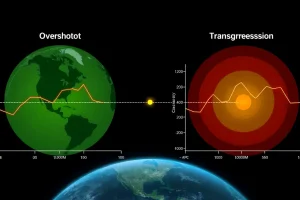
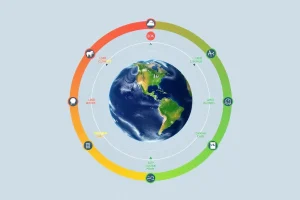
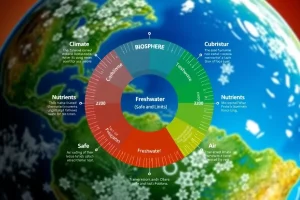
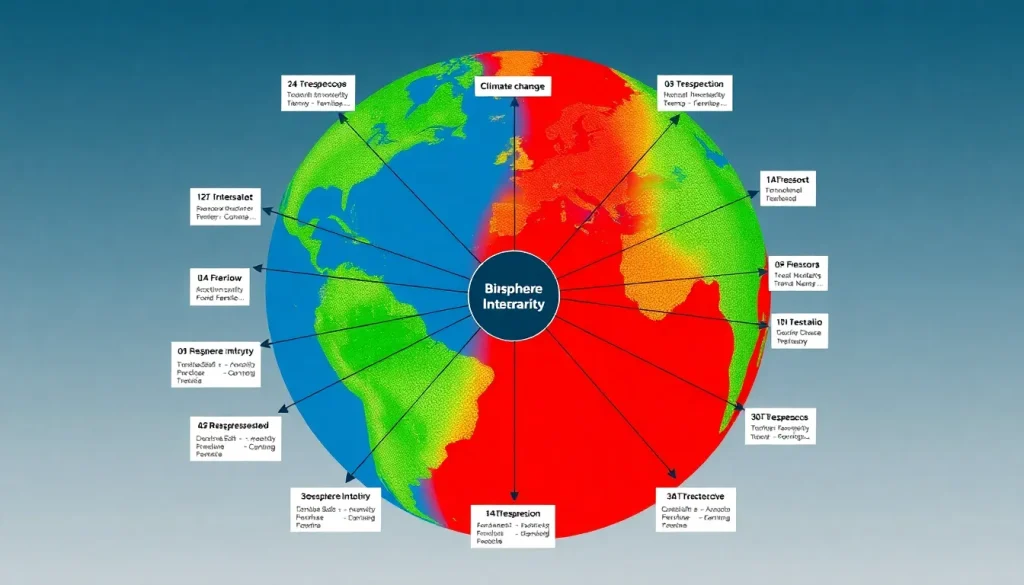
The planetary boundaries framework identifies nine critical Earth-system processes that regulate the stability and resilience of the planet. As of the 2023 update, six of these boundaries are assessed as transgressed: climate change, biosphere integrity (genetic and functional), land-system change, freshwater change, biogeochemical flows (nitrogen and phosphorus), and novel entities. Crucially, these boundaries do not operate in isolation. Their interactions are intensifying, creating feedback loops that can amplify human pressures and push the Earth system further away from the Holocene-like state that has allowed human civilizations to flourish. The most recent assessment explicitly highlights that the transgression of multiple boundaries increases the risk of triggering irreversible tipping points and large-scale, non-linear changes in the Earth system.
Control variable
There is no single control variable for boundary interactions. Instead, scientists assess interactions through a combination of Earth-system models, network analysis, and expert elicitation. The framework uses a matrix approach to map the direction and strength of interactions between each pair of boundaries. For example, the interaction between climate change and biosphere integrity is quantified by modeling how changes in global temperature affect species extinction rates and ecosystem carbon storage, and vice versa. The control variables of individual boundaries (e.g., atmospheric CO2 concentration, extinction rate, forest area remaining) serve as inputs to these interaction analyses. The 2023 update by Richardson et al. introduced a more systematic assessment of boundary interactions, categorizing them as “amplifying,” “dampening,” or “uncertain.”
Proposed boundary or threshold
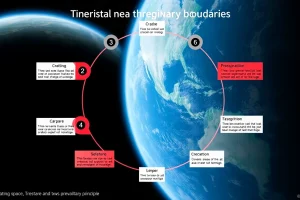
The planetary boundaries framework does not set a single threshold for interactions. Instead, the safe operating space is defined by the individual boundaries, with the understanding that transgressing one boundary can shift the safe level for others. For example, the climate boundary is set at 350 ppm CO2 and a radiative forcing of +1.0 W/m², while the biosphere integrity boundary is set at an extinction rate of less than 10 extinctions per million species-years (E/MSY) and a Biodiversity Intactness Index (BII) of 90% or above. However, these boundaries are not independent: if climate change exceeds its boundary, the safe level for biosphere integrity may effectively become stricter because warming exacerbates biodiversity loss. The framework thus implies that the “safe operating space” is a multidimensional region where all boundaries are respected simultaneously, and interactions can shrink or expand this space.
Current measured value
As of 2023, the control variables for several boundaries are well beyond their proposed safe limits, and their interactions are amplifying the transgression. For instance, atmospheric CO2 concentration is approximately 417 ppm (2022), far above the 350 ppm boundary, and the rate of species extinction is estimated at over 100 E/MSY, more than ten times the safe boundary. The functional biosphere integrity metric (BII) is estimated at 84% globally, below the 90% boundary. These transgressions are not independent: climate change accelerates biodiversity loss, while deforestation (land-system change) contributes to both climate change and biodiversity decline. The interactions are evident in the increasing frequency of compound extreme events, such as simultaneous heatwaves and droughts that stress ecosystems and agriculture.
How the boundary is calculated
Interactions among planetary boundaries are assessed using a combination of process-based Earth-system models, statistical analyses, and expert judgment. Dynamic global vegetation models (e.g., LPJmL) coupled with climate models simulate how land-use change affects carbon and water cycles. Integrated assessment models (IAMs) explore scenarios of future human development and their impacts on multiple boundaries. Network analysis is applied to the planetary boundaries interaction matrix to identify the most central and influential boundaries. For example, Steffen et al. (2015) used a simple interaction matrix to show that climate change and biosphere integrity are “core boundaries” because they mediate many other interactions. The 2023 update refined this by incorporating more detailed feedbacks, such as the effect of freshwater change on carbon sinks and the role of aerosols in modifying climate and biosphere interactions.
Historical trend
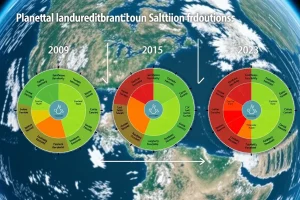
Since the Industrial Revolution, human activities have simultaneously increased pressures on all planetary boundaries, leading to a rapid intensification of their interactions. In the pre-industrial Holocene, boundary interactions were largely stable and maintained the Earth system in a self-regulating state. The Great Acceleration from the 1950s onward saw exponential growth in greenhouse gas emissions, land conversion, fertilizer use, and water consumption, causing multiple boundaries to approach or exceed their safe limits. This has led to a shift from predominantly linear, additive effects to non-linear, synergistic interactions. For example, historical deforestation in the Amazon has not only reduced biodiversity but also decreased regional rainfall, which in turn stresses remaining forests and increases fire risk, creating a positive feedback loop that amplifies both land-system change and climate change.
What is driving the change
The primary driver of boundary interactions is the scale and intensity of human activities, particularly agriculture, industrial production, and energy consumption. These activities often impact several boundaries simultaneously. For instance, the use of synthetic nitrogen fertilizers increases biogeochemical flows, which leads to water pollution (freshwater change), eutrophication and biodiversity loss (biosphere integrity), and emissions of nitrous oxide, a potent greenhouse gas (climate change). Similarly, deforestation for agriculture directly alters land-system change, reduces carbon sinks (climate change), destroys habitats (biosphere integrity), and disrupts regional water cycles (freshwater change). The globalized economy further connects these drivers, as demand for commodities in one region can drive boundary transgressions in another, creating teleconnections that link distant parts of the Earth system.
What crossing the boundary means
When interactions cause multiple boundaries to be transgressed, the risk of triggering tipping points and cascading effects increases substantially. A tipping point occurs when a small additional perturbation causes a large, often irreversible change in the Earth system. For example, the combined pressures of climate change, deforestation, and fires could push the Amazon rainforest past a tipping point, leading to a dieback that would release vast amounts of carbon, accelerate global warming, and disrupt regional and global rainfall patterns. Such a cascade would further impact biosphere integrity, freshwater availability, and possibly even ocean circulation. The 2023 planetary boundaries update warns that the current level of transgression has already brought the Earth system into a zone of increasing risk where such cascades become more likely, threatening the stability of the entire Earth system.
Regional variations
Interactions among planetary boundaries manifest differently across regions due to varying environmental conditions and human pressures. In the Amazon basin, land-system change, climate change, and freshwater change are tightly coupled, with deforestation reducing evapotranspiration and altering the South American monsoon. In the Arctic, climate warming is amplified by the ice-albedo feedback, while novel entities like persistent organic pollutants accumulate in food webs, stressing already vulnerable ecosystems. In South Asia, the interaction between freshwater use and climate change is critical: groundwater depletion for irrigation exacerbates the impacts of changing monsoon patterns, threatening food and water security for billions. In coastal zones, the combination of sea-level rise (climate change), nutrient runoff (biogeochemical flows), and habitat destruction (land-system change) creates “hotspots” of interacting pressures that degrade marine ecosystems and increase risks to human settlements.
Interaction with other boundaries
The planetary boundaries framework identifies a dense web of interactions, but some boundaries are more central than others. Climate change and biosphere integrity are considered “core boundaries” because they mediate the largest number of interactions. Climate change affects almost all other boundaries: it accelerates biodiversity loss, alters freshwater availability, intensifies land degradation, and drives ocean acidification. Biosphere integrity, in turn, underpins many ecosystem functions that regulate other boundaries, such as carbon sequestration, water purification, and nutrient cycling. Beyond these two, the following interactions are particularly strong:
- Biogeochemical flows and biosphere integrity: Excess nitrogen and phosphorus cause eutrophication, leading to aquatic dead zones and terrestrial biodiversity loss.
- Land-system change and climate change: Deforestation releases CO2 and reduces carbon sinks, while also altering surface albedo and evapotranspiration.
- Freshwater change and biosphere integrity: Water extraction and pollution degrade freshwater ecosystems, reducing their resilience and ability to support biodiversity.
- Climate change and ocean acidification: Both are driven by CO2 emissions and together threaten marine life, particularly calcifying organisms.
- Novel entities and biosphere integrity: Chemical pollution, plastics, and other synthetic substances harm organisms and can disrupt endocrine systems, affecting reproduction and survival.
These interactions often create positive feedback loops. For example, climate change increases the frequency of wildfires, which destroy forests (land-system change), release carbon (climate change), and reduce biodiversity (biosphere integrity), further weakening the land carbon sink.
Impacts on people and ecosystems
The interconnected transgression of planetary boundaries has profound consequences for human societies and ecosystems. Food security is threatened by the combined effects of climate change (crop failures), biodiversity loss (loss of pollinators and soil health), freshwater scarcity, and nutrient pollution. Water security is undermined by the interaction of climate change (altered precipitation), land-use change (reduced infiltration), and freshwater overuse. Human health is impacted by heatwaves, the spread of vector-borne diseases, and exposure to pollutants. Economically, the increasing frequency of compound extreme events—such as simultaneous droughts and heatwaves—causes greater damage than isolated events. Ecosystem services, including carbon storage, water purification, and flood regulation, are degraded when multiple boundaries are crossed, reducing nature’s capacity to buffer against environmental change. The most vulnerable populations, often in low-income countries, bear the brunt of these interacting crises despite contributing least to their causes.
Possible pathways back toward the safe zone
Addressing the interconnected nature of planetary boundaries requires integrated, systemic solutions rather than isolated fixes. Key pathways include:
- Rapid decarbonization: Reducing greenhouse gas emissions to net-zero can alleviate pressure on climate change, ocean acidification, and, indirectly, biosphere integrity and freshwater systems.
- Nature-based solutions: Protecting and restoring ecosystems, such as forests, wetlands, and grasslands, can simultaneously enhance carbon sinks, conserve biodiversity, regulate water cycles, and reduce land degradation.
- Sustainable food systems: Shifting to agroecological practices, reducing food waste, and adopting plant-rich diets can lower pressures on land, water, nitrogen, and phosphorus cycles while supporting biodiversity.
- Circular economy: Reducing resource extraction and closing material loops can decrease novel entities, biogeochemical flows, and land-system change.
- Integrated water management: Coordinating water use across sectors and protecting watersheds can address freshwater change while benefiting ecosystems and climate resilience.
- Strong governance: Policies must be designed to account for boundary interactions, such as linking climate targets with biodiversity and water strategies. International cooperation is essential to manage teleconnections and prevent burden-shifting.
These pathways align with the Sustainable Development Goals and can generate co-benefits, but they require transformative changes in economic systems, consumption patterns, and governance structures.
Scientific uncertainty
The interactions among planetary boundaries are characterized by deep uncertainty. Earth-system models are still limited in their ability to fully capture non-linear feedbacks, tipping point thresholds, and the combined effects of multiple stressors. The strength and even direction of some interactions remain poorly quantified; for example, the net effect of aerosol pollution on climate and biosphere interactions is uncertain. Regional variations add complexity, as local conditions can dampen or amplify global interactions. The planetary boundaries framework itself relies on expert judgment to fill gaps where empirical data are lacking, particularly for novel entities and functional biosphere integrity. Furthermore, the time lags involved in Earth-system responses mean that the full consequences of today’s transgressions may not be apparent for decades or centuries, making it difficult to validate interaction models against observations.
Criticism and alternative frameworks
The planetary boundaries framework has been criticized for oversimplifying complex interactions and for its global-scale focus, which may obscure important regional dynamics. Some researchers argue that the concept of a single “safe operating space” does not adequately account for the heterogeneity of Earth-system processes and human societies. Alternative or complementary frameworks include:
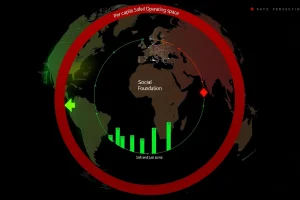
- Doughnut Economics (Raworth, 2017): Combines planetary boundaries with social foundations, emphasizing the need to meet human needs within ecological limits.
- Earth-system governance: Focuses on the institutional and political dimensions of managing global environmental change, including interactions across scales.
- Tipping point research: Specifically investigates critical thresholds and cascading effects, providing a more dynamic view of Earth-system risks.
- Planetary Boundaries 2.0 (Rockström et al., 2023): The ongoing evolution of the framework itself, which increasingly incorporates interactions and feedbacks, addressing some earlier criticisms.
Despite these debates, the planetary boundaries framework remains a widely used and influential tool for communicating the urgency of staying within a safe operating space and for guiding policy at global and national levels.
FAQ
Which planetary boundaries are most closely connected?
Climate change and biosphere integrity are the most central, mediating interactions among many other boundaries. Strong connections also exist between biogeochemical flows and biosphere integrity, land-system change and climate change, and freshwater change and biosphere integrity. These interactions often create positive feedback loops that amplify human pressures.
Why do interactions between planetary boundaries matter?
Interactions matter because they can amplify the transgression of individual boundaries, increasing the risk of triggering tipping points and cascading effects. For example, climate change can accelerate biodiversity loss, which in turn reduces the capacity of ecosystems to sequester carbon, further worsening climate change. This means that addressing one boundary in isolation may be insufficient if others are also being transgressed.
How do scientists study the connections between planetary boundaries?
Scientists use Earth-system models, network analysis, and expert elicitation. They create interaction matrices that map the direction and strength of influences between each pair of boundaries. Process-based models simulate feedbacks, such as how land-use change affects carbon and water cycles. The 2023 planetary boundaries update included a more detailed assessment of these interactions.
References
- Rockström, J., Steffen, W., Noone, K., et al. (2009). A safe operating space for humanity. Nature, 461, 472–475.
- Steffen, W., Richardson, K., Rockström, J., et al. (2015). Planetary boundaries: Guiding human development on a changing planet. Science, 347(6223), 1259855.
- Richardson, K., Steffen, W., Lucht, W., et al. (2023). Earth beyond six of nine planetary boundaries. Science Advances, 9(37), eadh2458.
- Lade, S. J., Steffen, W., de Vries, W., et al. (2020). Human impacts on planetary boundaries amplified by Earth system interactions. Nature Sustainability, 3, 119–128.
- Steffen, W., Broadgate, W., Deutsch, L., Gaffney, O., & Ludwig, C. (2015). The trajectory of the Anthropocene: The Great Acceleration. The Anthropocene Review, 2(1), 81–98.