In brief
At a glance
Quick Facts
- Status
- 6 of 9 boundaries transgressed (2023)
- Control variable
- Multiple, boundary-specific
- Proposed boundary
- Defined for each boundary; e.g., 350 ppm CO₂
- Current value
- Varies; e.g., CO₂ ~417 ppm (2022)
- Pre-industrial baseline
- Holocene epoch (last 11,700 years)
Current status
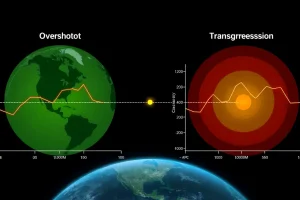
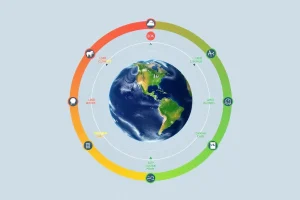
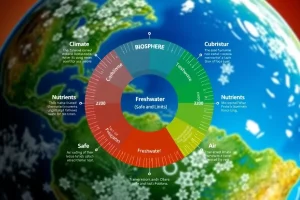
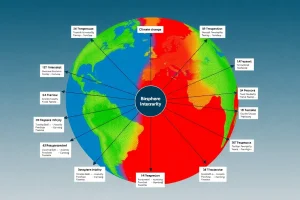
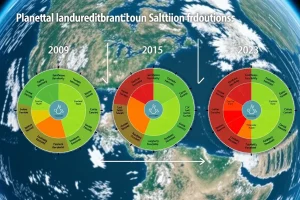
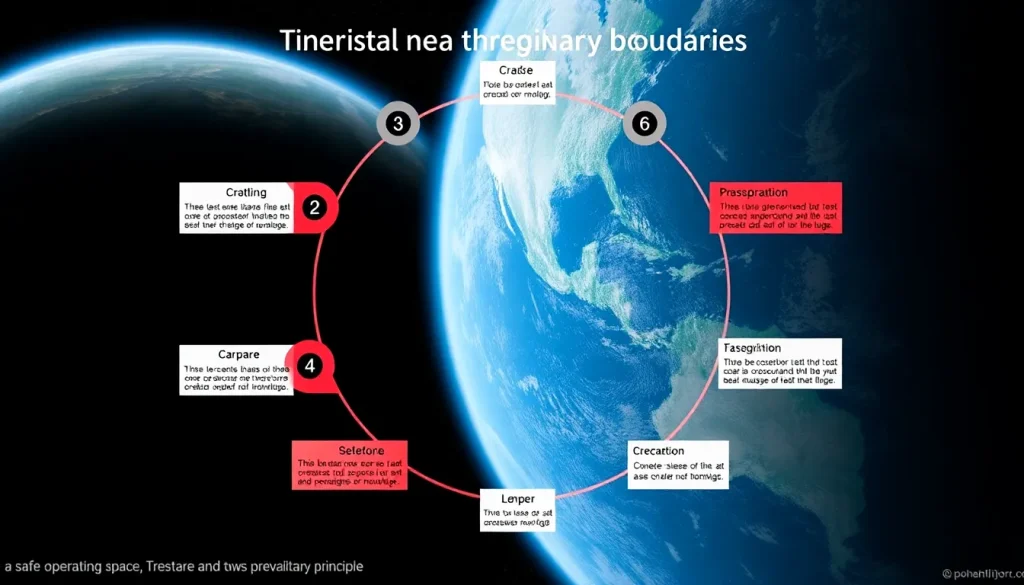
The planetary boundaries framework, first proposed in 2009 and updated in 2015 and 2023, identifies nine Earth-system processes that regulate the stability and resilience of the planet. As of the 2023 assessment by Richardson et al., six of the nine boundaries are transgressed: climate change, biosphere integrity (genetic diversity and functional integrity), land-system change, freshwater change, biogeochemical flows (nitrogen and phosphorus), and novel entities (including plastics and synthetic chemicals). Three boundaries remain within the safe operating space: stratospheric ozone depletion, atmospheric aerosol loading, and ocean acidification. However, ocean acidification is approaching its boundary. The transgression of multiple boundaries increases the risk of destabilizing the Earth system and undermining the precautionary principle that underpins the framework.
Control variable
The planetary boundaries framework does not have a single control variable; instead, each of the nine boundaries is defined by one or more specific control variables that capture the key Earth-system process. For example, climate change is tracked by atmospheric CO₂ concentration and radiative forcing; biosphere integrity by genetic diversity (extinction rate) and functional integrity (e.g., net primary production human appropriation); and novel entities by the percentage of synthetic chemicals released without safety testing. The choice of control variables is guided by the need to represent the process at a global scale, its relationship to a threshold or tipping point, and the availability of data. The precautionary principle is embedded in the selection of control variables: where a process is poorly understood, a conservative indicator is chosen to provide early warning.
Proposed boundary or threshold
The planetary boundaries framework proposes a safe operating space defined by boundaries set at a precautionary distance from critical thresholds. For each control variable, a boundary value is proposed that aims to keep the Earth system within a Holocene-like state, avoiding the risk of triggering non-linear, abrupt, or irreversible changes. For example, the climate change boundary is set at 350 ppm CO₂ and a radiative forcing of +1.0 W/m², well below the threshold of +1.5 W/m² that marks the zone of increasing risk. The boundary for biosphere integrity (genetic diversity) is set at an extinction rate of 100 E/MSY. These boundaries are not fixed tipping points but rather precautionary limits intended to maintain a safe distance from thresholds that are often uncertain. The framework explicitly incorporates the precautionary principle by setting boundaries at the lower end of the zone of uncertainty.
Current measured value
According to the 2023 update, the current status of the nine boundaries is as follows: Climate change—atmospheric CO₂ concentration is ~417 ppm (2022), exceeding the boundary of 350 ppm; radiative forcing is ~2.91 W/m², beyond the boundary of +1.0 W/m². Biosphere integrity—genetic diversity: extinction rate is estimated at >100 E/MSY, far beyond the boundary of <10 E/MSY; functional integrity: human appropriation of net primary production (HANPP) is ~30% of potential NPP, exceeding the boundary of 10% (zone of increasing risk). Land-system change: global forest cover as a percentage of original forest cover is ~60%, below the boundary of 75%. Freshwater change: both green water (soil moisture) and blue water (surface and groundwater) boundaries are transgressed, with significant regional deviations. Biogeochemical flows: phosphorus flow from freshwater to oceans is ~22 Tg P/yr, exceeding the boundary of 11 Tg P/yr; nitrogen flow is ~150 Tg N/yr, far above the boundary of 62 Tg N/yr. Novel entities: the boundary is transgressed as the percentage of synthetic chemicals released without adequate safety testing is high. Ocean acidification: current surface ocean aragonite saturation state is ~85% of pre-industrial levels, approaching the boundary of 80%. Stratospheric ozone depletion: global ozone column is within the boundary, though Antarctic ozone hole recovery is ongoing. Atmospheric aerosol loading: regional boundaries are not globally transgressed, but South Asia shows high aerosol optical depth.
How the boundary is calculated
The planetary boundaries are derived from a synthesis of Earth-system science, including paleoclimate data, global biogeochemical models, and assessments of human impacts. The framework uses a two-tiered approach: a safe boundary is set at the lower end of the zone of uncertainty, and a danger or high-risk zone is defined where the risk of triggering tipping points becomes significant. For well-understood processes like climate change, the boundary is based on the Holocene variability and the threshold for ice-sheet melting. For more uncertain processes like novel entities, a precautionary boundary is set at zero release of untested synthetic chemicals. The calculation involves identifying a global threshold (e.g., atmospheric CO₂ level at which ice sheets become unstable), then applying a precautionary buffer to account for uncertainty and regional heterogeneity. The framework uses Earth-system models, historical data, and expert elicitation to quantify the boundaries. The precautionary principle is operationalized by setting the boundary at the lower end of the zone of uncertainty, as recommended in international environmental law (e.g., Principle 15 of the Rio Declaration).
Historical trend
Since the Holocene epoch began about 11,700 years ago, Earth-system processes have remained relatively stable, providing the conditions for human civilizations to develop. The Industrial Revolution marked a sharp departure, with exponential increases in greenhouse gas emissions, land conversion, water use, and chemical pollution. The planetary boundaries framework was first quantified in 2009, when three boundaries were already transgressed (climate change, biodiversity loss, and nitrogen cycle). By 2015, four boundaries were crossed (adding land-system change). The 2023 assessment found six boundaries transgressed, with freshwater change and novel entities newly assessed as beyond the safe zone. The trend shows accelerating human pressures pushing multiple Earth-system processes further into high-risk zones, with no boundary showing a reversal toward the safe operating space. The precautionary principle suggests that early action is needed to prevent irreversible damage, yet the historical trend indicates a continued movement away from safety.
What is driving the change
The primary driver of transgression across planetary boundaries is the exponential growth of human activities since the mid-20th century, often termed the Great Acceleration. Key drivers include: fossil fuel combustion and land-use change (climate change, ocean acidification); agricultural expansion and intensification (biosphere integrity, land-system change, freshwater use, biogeochemical flows); industrial production and consumption (novel entities, atmospheric aerosol loading); and population growth coupled with rising per capita consumption. These drivers are interconnected through the global economic system, which prioritizes short-term growth over long-term sustainability. The precautionary principle is challenged by the difficulty of attributing specific impacts to individual drivers and the time lags between pressures and Earth-system responses.
What crossing the boundary means
Transgressing a planetary boundary does not imply an immediate catastrophe but rather a shift from a safe operating space into a zone of increasing risk, where the likelihood of triggering non-linear, abrupt, or irreversible changes rises. Crossing multiple boundaries can amplify risks through feedback loops and cascading effects. For example, climate change and biosphere loss can mutually reinforce each other: deforestation reduces carbon sinks, accelerating warming, which in turn stresses ecosystems. The precautionary principle warns that once a threshold is crossed, the Earth system may shift to a new state (e.g., a “Hothouse Earth”) with conditions less hospitable to human societies. The framework emphasizes that boundaries are interdependent; transgressing one can undermine the resilience of others, making the entire system more vulnerable to shocks.
Regional variations
While the planetary boundaries are defined at the global scale, their transgression and impacts vary regionally. For instance, freshwater use is a global boundary based on total consumptive use, but water scarcity is highly regional, with some basins far exceeding local thresholds while others remain within limits. Similarly, land-system change is assessed globally by forest cover, but deforestation is concentrated in tropical regions. Biogeochemical flows of nitrogen and phosphorus cause eutrophication in specific watersheds and coastal zones. The precautionary principle must be applied at multiple scales: global boundaries provide a top-down constraint, but regional and local actions are needed to respect them. The framework has been downscaled to national and sub-national levels in some studies, highlighting the need for differentiated responsibilities.
Interaction with other boundaries
The nine planetary boundaries are tightly coupled. Climate change and biosphere integrity are considered “core” boundaries because they have the potential to drive the Earth system into a new state on their own. Other boundaries interact strongly: land-system change affects climate, biodiversity, and freshwater cycles; freshwater change influences biosphere integrity and biogeochemical flows; novel entities can impact biosphere integrity and ecosystem functions. The precautionary principle is particularly relevant for these interactions, as the combined effect of multiple transgressions may be greater than the sum of individual impacts. The framework aims to capture these interactions, but fully modeling them remains a scientific challenge.
Impacts on people and ecosystems
Transgressing planetary boundaries threatens the stability of the Earth system and the ecosystem services upon which human well-being depends. Consequences include: increased frequency and intensity of extreme weather events, sea-level rise, and food and water insecurity from climate change; loss of pollinators, soil fertility, and fisheries from biosphere degradation; water shortages and conflicts from freshwater overuse; toxic pollution and health risks from novel entities; and dead zones in coastal areas from nutrient overload. These impacts disproportionately affect vulnerable populations and can exacerbate inequalities. The precautionary principle argues for early action to avoid such harms, especially when they may be irreversible.
Possible pathways back toward the safe zone
Returning to the safe operating space requires transformative changes across multiple sectors. Key pathways include: rapid decarbonization of the global economy to meet the Paris Agreement goals; protecting and restoring ecosystems, including reforestation and sustainable land management; improving water efficiency and governance; reducing nutrient pollution through better agricultural practices and wastewater treatment; and implementing circular economy principles to minimize novel entities. The precautionary principle supports proactive measures such as banning or strictly regulating potentially harmful chemicals before they cause widespread damage. Global cooperation, policy integration, and shifts in consumption patterns are essential. The framework itself can guide target-setting for international agreements like the Sustainable Development Goals.
Scientific uncertainty
The planetary boundaries framework is subject to significant scientific uncertainties. These include: the exact position of thresholds and tipping points; the choice of control variables and their global representativeness; the interactions between boundaries; and the time lags in Earth-system responses. For some boundaries (e.g., novel entities, atmospheric aerosol loading), data are sparse, and the boundary is defined qualitatively. The precautionary principle is invoked to justify setting boundaries conservatively in the face of such uncertainty, but critics argue that this may lead to overly restrictive limits. Ongoing research aims to reduce uncertainties through improved Earth-system modeling, paleo-data, and monitoring.
Criticism and alternative frameworks
The planetary boundaries framework has been both influential and controversial. Criticisms include: the arbitrary nature of some boundary values; the difficulty of defining a single global boundary for processes that are inherently regional; the potential for the framework to be misused as a top-down policy tool that ignores local contexts; and the challenge of operationalizing the precautionary principle without stifling innovation. Some scientists argue that the framework oversimplifies complex Earth-system dynamics. Alternative or complementary approaches include the “doughnut economics” model (Raworth, 2017), which combines planetary boundaries with social foundations; the “safe and just operating space” concept; and the “planetary health” framework. Despite criticisms, the planetary boundaries framework remains a widely used heuristic for understanding global environmental limits and the need for precautionary action.
FAQ
What is the precautionary principle in the context of planetary boundaries?
The precautionary principle holds that where there are threats of serious or irreversible damage, lack of full scientific certainty shall not be used as a reason for postponing cost-effective measures to prevent environmental degradation. In the planetary boundaries framework, this principle is applied by setting boundaries at a safe distance from critical thresholds, erring on the side of caution when uncertainties are high.
How many planetary boundaries have been crossed?
As of the 2023 assessment, six of the nine planetary boundaries are transgressed: climate change, biosphere integrity, land-system change, freshwater change, biogeochemical flows, and novel entities. Three remain within the safe operating space: stratospheric ozone depletion, atmospheric aerosol loading, and ocean acidification (though ocean acidification is approaching its boundary).
What is the difference between a planetary boundary and a tipping point?
A planetary boundary is a human-determined limit that aims to keep the Earth system within a safe operating space, set at a precautionary distance from a tipping point. A tipping point is a critical threshold in the Earth system beyond which a small change can trigger a large, often irreversible shift in the state of the system. The boundary is intended to prevent reaching the tipping point.
References
- Rockström, J., et al. (2009). A safe operating space for humanity. Nature, 461, 472-475.
- Steffen, W., et al. (2015). Planetary boundaries: Guiding human development on a changing planet. Science, 347(6223), 1259855.
- Richardson, K., et al. (2023). Earth beyond six of nine planetary boundaries. Science Advances, 9(37), eadh2458.
- United Nations Conference on Environment and Development. (1992). Rio Declaration on Environment and Development, Principle 15.
- Raworth, K. (2017). Doughnut Economics: Seven Ways to Think Like a 21st-Century Economist. Random House.