In brief
At a glance
Quick Facts
- Status
- Conceptual distinction; not a specific boundary
- Control variable
- Duration and magnitude of exceedance relative to boundary
- Proposed boundary
- The safe boundary for each process (e.g., 350 ppm CO₂)
- Current value
- Varies; e.g., CO₂ ~419 ppm (2023) exceeds climate boundary
- Pre-industrial baseline
- Holocene conditions (last 11,700 years)
Current status
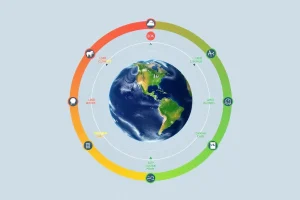
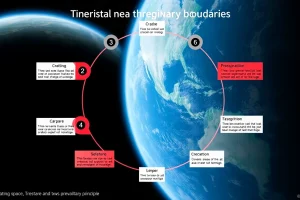
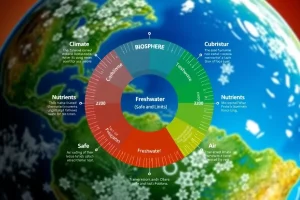
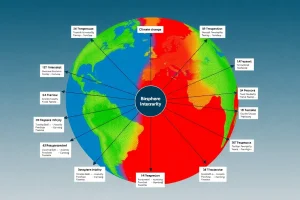
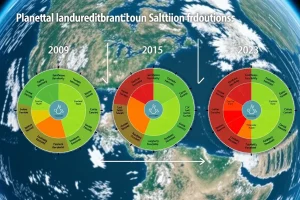
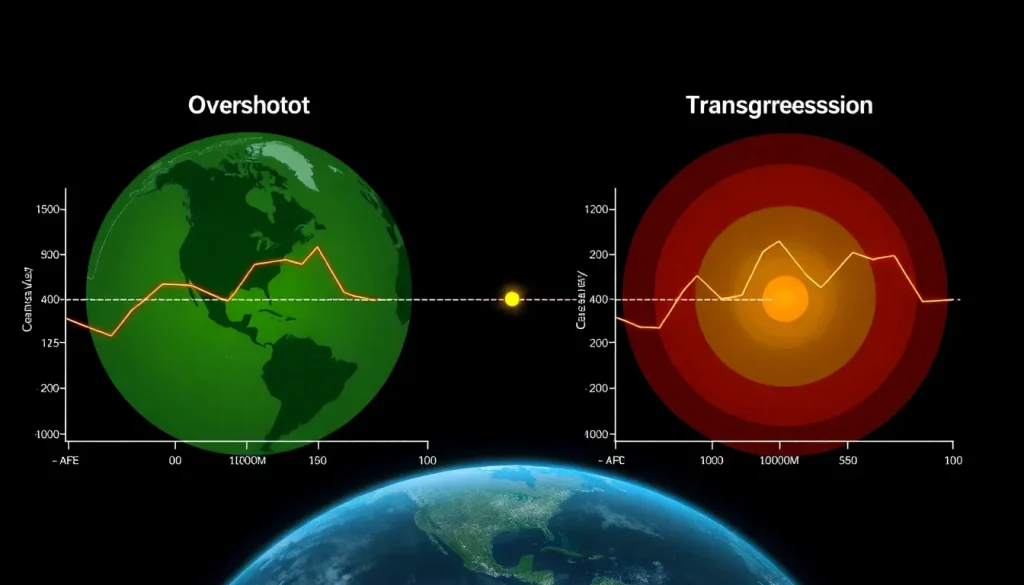
The distinction between overshoot and transgression is not a separate planetary boundary but a conceptual clarification within the planetary boundaries framework. The framework, first proposed in 2009 and updated in 2015 and 2023, identifies nine Earth-system processes that regulate the stability and resilience of the Holocene-like state. For each process, a quantitative boundary is set at the lower end of a zone of increasing risk. Transgression occurs when a control variable moves beyond this boundary into the zone of increasing risk, indicating a departure from the safe operating space. Overshoot, on the other hand, refers to a temporary exceedance of a boundary with the potential to return to the safe operating space, provided the system has not crossed a critical threshold or tipping point. Currently, several boundaries are transgressed (e.g., climate change, biosphere integrity, biogeochemical flows), and for some, such as climate change, the concept of overshoot is actively debated in policy contexts, with scenarios exploring temporary exceedance of temperature limits followed by a return through negative emissions.
Control variable
In the planetary boundaries framework, each boundary is defined by one or more control variables that capture the state of the Earth-system process. For example, the climate change boundary uses atmospheric CO₂ concentration (350 ppm) and radiative forcing (1.0 W/m²) as control variables. The concept of overshoot versus transgression does not have its own control variable; rather, it is a temporal and dynamic interpretation of how a control variable behaves relative to its boundary. The key metric for distinguishing overshoot from transgression is the duration and magnitude of exceedance, as well as the reversibility of the control variable. If a control variable exceeds the boundary but can be brought back below it without triggering irreversible changes, the system is said to have overshot the boundary. If the exceedance leads to a permanent shift in the Earth-system process (e.g., crossing a tipping point), it constitutes a transgression into a new, potentially hazardous state.
Proposed boundary or threshold
The planetary boundaries framework proposes a safe operating space defined by boundaries for each of the nine processes. These boundaries are set at a level intended to avoid triggering non-linear, abrupt, or irreversible Earth-system changes. For example, the climate change boundary is proposed at 350 ppm CO₂ and 1.0 W/m² radiative forcing, with the zone of increasing risk extending up to a high-risk threshold (e.g., 450 ppm CO₂, 2°C global warming). The boundary for biosphere integrity is set at an extinction rate of less than 10 extinctions per million species-years (E/MSY) and a Biodiversity Intactness Index (BII) of 90% or higher. The concept of overshoot is not a separate boundary but a scenario in which a control variable temporarily exceeds the proposed safe boundary, with the expectation that it can be reduced back below the boundary through human intervention or natural processes. The distinction between overshoot and transgression thus depends on whether the exceedance is temporary and reversible, and whether the system retains the capacity to return to the safe operating space.
Current measured value
As of 2023, several planetary boundaries are assessed to be in the zone of increasing risk or beyond. For climate change, atmospheric CO₂ concentration is approximately 419 ppm, exceeding the proposed boundary of 350 ppm and approaching the high-risk threshold. Radiative forcing is estimated at 2.91 W/m², well above the 1.0 W/m² boundary. For biosphere integrity, the extinction rate is estimated at over 100 E/MSY, far beyond the boundary of 10 E/MSY, and the Biodiversity Intactness Index is below the safe limit in many regions. For biogeochemical flows (nitrogen and phosphorus), global phosphorus flow to oceans and regional nitrogen boundaries are transgressed. These transgressions are not temporary overshoots; they represent sustained exceedances that have persisted for decades and are likely to continue without significant intervention. In the case of climate change, some scenarios explore an overshoot pathway where global mean temperature temporarily exceeds 1.5°C or 2°C but is later reduced through carbon dioxide removal. However, such overshoot scenarios carry risks of irreversible impacts, such as ice sheet loss or ecosystem collapse, which would constitute a permanent transgression.
How the boundary is calculated
The planetary boundaries are calculated using a combination of Earth-system modeling, paleoclimatic data, and expert assessment. For each boundary, scientists identify a control variable and a threshold value based on the Holocene baseline and the point at which the Earth system is likely to exit the stable state. The safe boundary is set at a precautionary distance from the threshold to account for uncertainty. For example, the climate change boundary of 350 ppm CO₂ was chosen because it corresponds to the upper limit of CO₂ concentrations during the Holocene and is associated with a radiative forcing of 1.0 W/m², which is below the level likely to trigger large-scale ice sheet disintegration. The concept of overshoot is typically explored using integrated assessment models (IAMs) that simulate future emissions pathways and the potential for carbon dioxide removal to bring atmospheric CO₂ back below the boundary. These models assess the feasibility and risks of overshoot scenarios, including the required scale of negative emissions technologies and the potential for irreversible impacts. The distinction between overshoot and transgression is thus not a fixed calculation but a scenario-dependent assessment of the Earth system’s response to temporary exceedance of a boundary.
Historical trend
Historically, the Earth system operated within the Holocene stable state for the past 11,700 years, with control variables remaining within the proposed boundaries. Since the Industrial Revolution, human activities have driven several control variables beyond the safe operating space. Atmospheric CO₂ has risen from a pre-industrial level of about 280 ppm to over 419 ppm, with the steepest increase occurring in the last 70 years. The rate of species extinction has accelerated to 100–1,000 times the background rate. Nitrogen and phosphorus cycles have been massively perturbed by agricultural fertilizers. These trends indicate a sustained transgression of multiple boundaries, not a temporary overshoot. The concept of overshoot is more relevant to future scenarios where deliberate efforts (e.g., carbon dioxide removal) could bring some control variables back within boundaries, but the historical record shows a persistent and deepening transgression for several boundaries.
What is driving the change
The primary driver of planetary boundary transgression is the exponential growth of human population, consumption, and technological activity since the mid-20th century, often termed the Great Acceleration. Key drivers include fossil fuel combustion (climate change, ocean acidification), land-use change and habitat destruction (biosphere integrity, land-system change), industrial agriculture (biogeochemical flows, freshwater use), and chemical pollution (novel entities). These drivers are interconnected and amplify each other. The distinction between overshoot and transgression is driven by the rate and scale of these pressures relative to the Earth system’s capacity to absorb and recover. If pressures are reduced quickly enough, an overshoot may be reversed; if they persist, transgression becomes locked in.
What crossing the boundary means
Crossing a planetary boundary means entering a zone of increasing risk where the Earth system may undergo non-linear, abrupt, or irreversible changes. Transgression implies that the system has moved into a less stable state, potentially triggering tipping points such as the collapse of the Atlantic Meridional Overturning Circulation, Amazon rainforest dieback, or ice sheet disintegration. These changes can cascade through the Earth system, amplifying warming, altering hydrological cycles, and reducing the capacity of ecosystems to provide services. Overshoot, if temporary and limited, may avoid some of these worst outcomes, but it still exposes the system to heightened risks during the exceedance period. The longer and deeper the overshoot, the greater the likelihood of crossing irreversible thresholds, effectively turning an overshoot into a transgression.
Regional variations
While the planetary boundaries framework is global in scope, several boundaries operate at sub-global scales, and the impacts of transgression or overshoot are regionally differentiated. For example, freshwater use is assessed at the river-basin scale, and land-system change is evaluated by biome. Biogeochemical flows of nitrogen and phosphorus cause regional eutrophication. Climate change, though global, has regional manifestations such as Arctic amplification, sea-level rise affecting coastal regions, and changes in monsoon patterns. The concept of overshoot also has regional dimensions: some regions may experience temporary exceedance of local boundaries (e.g., water scarcity) that can be reversed, while others may face permanent transgression (e.g., desertification). The ability to return to a safe operating space after overshoot depends on regional resilience and management capacity.
Interaction with other boundaries
Planetary boundaries are tightly coupled. Transgression of one boundary can exacerbate pressures on others. For example, climate change amplifies biosphere integrity loss through habitat shifts and extreme events; land-system change contributes to climate change and freshwater depletion; biogeochemical flows drive ocean acidification and biodiversity loss. Overshoot in one domain can cascade: a temporary climate overshoot that causes widespread forest dieback could permanently transgress the land-system change and biosphere integrity boundaries. Thus, the distinction between overshoot and transgression must consider these interactions. A temporary exceedance in one boundary might trigger irreversible transgression in another, making the overall Earth-system response more complex and less predictable.
Impacts on people and ecosystems
Transgression of planetary boundaries poses severe risks to human well-being and ecosystem health. Climate change transgression leads to more frequent and intense heatwaves, floods, droughts, and sea-level rise, threatening food security, water availability, and infrastructure. Biosphere integrity loss undermines pollination, pest control, and nutrient cycling, reducing agricultural productivity. Biogeochemical flow transgression causes harmful algal blooms and dead zones in coastal waters, impacting fisheries. Overshoot, even if temporary, can cause lasting damage: a temporary spike in temperature could kill coral reefs that take decades to recover, or trigger irreversible species extinctions. The human and economic costs of overshoot are substantial, and the most vulnerable populations are often disproportionately affected.
Possible pathways back toward the safe zone
Returning to the safe operating space after transgression or overshoot requires rapid and sustained reductions in the pressures driving the exceedance. For climate change, this involves deep decarbonization of the global economy, coupled with carbon dioxide removal (CDR) to draw down atmospheric CO₂. However, CDR technologies are not yet proven at scale and carry their own risks. For biosphere integrity, pathways include expanding protected areas, restoring degraded ecosystems, and shifting to sustainable agriculture. For biogeochemical flows, improving nutrient use efficiency and reducing fertilizer application are critical. The feasibility of reversing an overshoot depends on the magnitude and duration of the exceedance, as well as the availability of scalable solutions. In many cases, preventing transgression in the first place is far more cost-effective than attempting to return after overshoot.
Scientific uncertainty
Significant uncertainties surround both the precise location of planetary boundaries and the reversibility of overshoot. The boundary values are based on expert judgment and modeling with inherent uncertainties, particularly for novel entities and biosphere integrity. The Earth system’s response to temporary exceedance is poorly understood: tipping points may be crossed at lower thresholds than currently estimated, and the time lag between pressure reduction and system recovery is uncertain. Carbon cycle feedbacks, such as permafrost thaw, could make it harder to reverse a climate overshoot. The effectiveness and side effects of CDR technologies are also uncertain. These uncertainties underscore the precautionary principle embedded in the framework: boundaries are set at the lower end of the zone of uncertainty to avoid irreversible harm.
Criticism and alternative frameworks
The planetary boundaries framework has been criticized for its global, top-down approach, which may oversimplify regional dynamics and ignore social-ecological complexities. Some researchers argue that the concept of a single safe operating space is too rigid and that boundaries should be context-dependent. The distinction between overshoot and transgression is also debated: critics note that the framework does not explicitly incorporate temporal dynamics, and the assumption that overshoot can be reversed may be overly optimistic given the risk of tipping points. Alternative frameworks include the “doughnut economics” model, which combines planetary boundaries with social foundations, and the “safe and just operating space” concept, which emphasizes equity. Other approaches focus on resilience and adaptive governance rather than fixed boundaries. Despite these critiques, the planetary boundaries framework remains influential in policy and science for communicating the urgency of staying within Earth’s limits.
FAQ
What is the difference between overshoot and transgression in the planetary boundaries framework?
Overshoot is a temporary exceedance of a planetary boundary, with the expectation that the control variable can be brought back below the boundary through human intervention or natural processes. Transgression, on the other hand, is a sustained crossing of the boundary into the zone of increasing risk, often associated with irreversible changes or tipping points. The key distinction is the duration and reversibility of the exceedance.
Can a planetary boundary be overshot without being transgressed?
Yes, in theory, if the exceedance is short-lived and the Earth system has not crossed a critical threshold. For example, climate overshoot scenarios assume that global temperature can temporarily exceed 1.5°C but later return below that level through carbon dioxide removal. However, the longer and deeper the overshoot, the greater the risk of triggering irreversible changes, effectively turning the overshoot into a transgression.
What are the risks of overshooting a planetary boundary?
Even temporary overshoot can cause lasting damage, such as coral bleaching, species extinctions, or ice sheet loss that cannot be reversed on human timescales. Overshoot also increases the likelihood of crossing tipping points, which could lead to cascading Earth-system changes. Additionally, relying on future technologies to reverse overshoot introduces moral hazard and technological uncertainties.
References
- Rockström, J., et al. (2009). "A safe operating space for humanity." Nature, 461, 472–475.
- Steffen, W., et al. (2015). "Planetary boundaries: Guiding human development on a changing planet." Science, 347(6223), 1259855.
- Richardson, K., et al. (2023). "Earth beyond six of nine planetary boundaries." Science Advances, 9(37), eadh2458.
- IPCC (2021). Climate Change 2021: The Physical Science Basis. Contribution of Working Group I to the Sixth Assessment Report.
- Lenton, T. M., et al. (2019). "Climate tipping points — too risky to bet against." Nature, 575, 592–595.