In brief
At a glance
Quick Facts
- Status
- Not an official planetary boundary; proposed as a governance metric
- Control variable
- Material footprint per capita (tonnes/capita/year)
- Proposed boundary
- 6–8 tonnes per capita per year (sustainable range)
- Current value
- ~12 tonnes per capita (global average, 2020)
- Pre-industrial baseline
- ~2 tonnes per capita (estimated, 1800)
Current status
The planetary boundaries framework identifies nine Earth-system processes that regulate the stability and resilience of the planet. However, it does not explicitly define a boundary for how resources should be shared among countries. The question of equitable resource distribution is a governance challenge that cuts across multiple boundaries, particularly those related to resource consumption (e.g., freshwater use, land-system change, biogeochemical flows). While no single “resource sharing” boundary exists, the concept of a “fair share” of the global safe operating space is increasingly discussed in sustainability science. Current assessments indicate that high-income countries vastly exceed their fair share of resource use, while many low-income countries remain below sustainable consumption thresholds, creating a double challenge of overconsumption and deprivation.
Control variable
In the absence of an official planetary boundary for resource sharing, a commonly proposed control variable is material footprint per capita (tonnes/capita/year). Material footprint measures the total amount of raw materials extracted to meet a country’s final consumption demands, including materials embodied in imports. It serves as a proxy for the pressure a country’s consumption places on global resources. Alternative indicators include the ecological footprint (global hectares per capita) or planetary pressures–adjusted human development index (PHDI), but material footprint is directly linked to several planetary boundaries (e.g., land-system change, freshwater use, climate change).
Proposed boundary or threshold
There is no single agreed-upon boundary for resource sharing, but several proposals exist. The doughnut economics model suggests a per capita material footprint of 6–8 tonnes per year as a sustainable and just “ceiling,” derived by dividing the total allowable global resource use (within planetary boundaries) by the global population. This range is based on the assumption that total global material use should not exceed ~50 billion tonnes per year to remain within a safe operating space. A per capita boundary of 6–8 tonnes would allow for a global population of 8–10 billion. High-income countries currently have material footprints of 20–30 tonnes per capita, far exceeding this proposed boundary.
Current measured value
As of 2020, the global average material footprint was approximately 12 tonnes per capita per year, according to the UNEP International Resource Panel. This value masks extreme inequalities: high-income countries average 25–30 tonnes per capita, while low-income countries often fall below 3 tonnes per capita. The global average already exceeds the proposed sustainable range, indicating that humanity as a whole is in a zone of increasing risk regarding resource use, even though many individuals still lack access to basic resources.
How the boundary is calculated
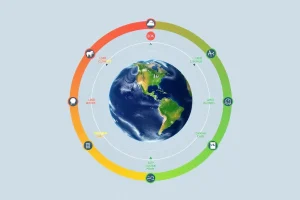
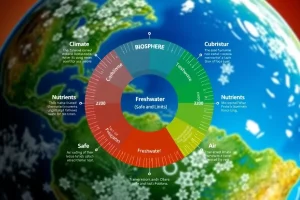
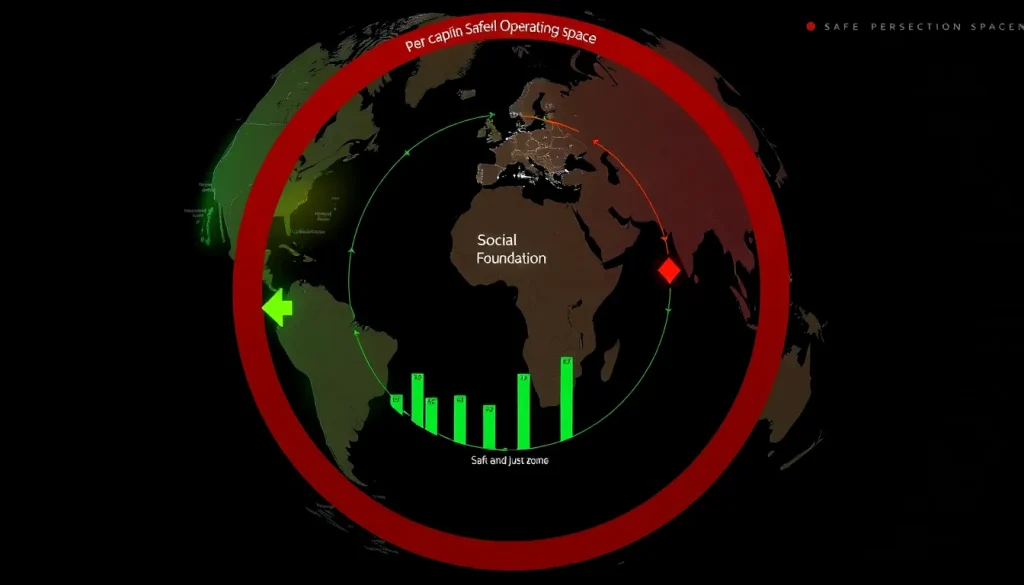
The proposed per capita resource boundary is derived by aggregating the safe operating space for multiple planetary boundaries (climate, land, water, nutrients) and converting them into a total allowable resource budget. For example, the climate boundary (350 ppm CO₂) can be translated into a maximum allowable material extraction rate, given assumptions about carbon intensity. Similarly, land-system change and freshwater boundaries impose limits on biomass harvest and water withdrawals. These limits are summed to estimate a global sustainable material flow of roughly 50 billion tonnes per year. Dividing this by the global population yields a per capita boundary. The doughnut model visualizes this as an outer ring (ecological ceiling) and an inner ring (social foundation), with the safe and just space in between.
Historical trend
Global material footprint has risen sharply from about 5 tonnes per capita in 1900 to over 12 tonnes per capita today. The increase accelerated after 1950, driven by industrialization in high-income countries and, more recently, by rapid growth in emerging economies. While the global average has risen, the distribution has become more unequal: high-income countries’ footprints have grown faster, while many low-income countries have seen only modest increases, remaining below the level needed to meet basic needs. The pre-industrial baseline is estimated at around 2 tonnes per capita, reflecting a largely agrarian economy with minimal fossil fuel use.
What is driving the change
The primary drivers of increasing resource use are economic growth models that equate well-being with material consumption, population growth, and technological lock-in to resource-intensive infrastructure. High-income countries’ consumption patterns—characterized by high meat diets, large living spaces, and car-dependent mobility—are particularly resource-intensive. Global trade allows these countries to import resources, displacing the environmental pressures to exporting regions. Additionally, the pursuit of GDP growth as a policy goal encourages ever-increasing material throughput, even when it surpasses sustainable levels.
What crossing the boundary means
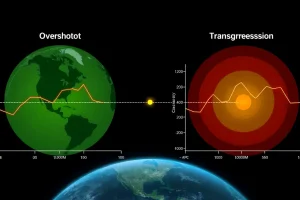
Exceeding a fair-share resource boundary means that some countries are consuming beyond the planet’s capacity, while others lack the resources for basic human needs. This dual transgression undermines Earth-system resilience: overconsumption drives climate change, biodiversity loss, and nutrient pollution, while underconsumption perpetuates poverty and social instability. Crossing the boundary also increases the risk of triggering tipping points in the Earth system, such as Amazon dieback or ice sheet collapse, which would have catastrophic global consequences. Moreover, it exacerbates geopolitical tensions over resource access.
Regional variations
Resource use is highly unequal across regions. North America and Europe have material footprints of 25–30 tonnes per capita, while Africa and parts of South Asia remain below 3 tonnes. China’s footprint has risen rapidly to around 20 tonnes, while India’s is about 5 tonnes. This variation means that the global average masks both overconsumption and underconsumption. A just resource sharing framework would require high-consuming regions to reduce their footprints dramatically, while allowing low-consuming regions to increase theirs to meet basic needs, converging toward a sustainable per capita level.
Interaction with other boundaries
Resource sharing is intimately linked to several planetary boundaries. High material footprints drive climate change (through fossil fuel extraction and use), land-system change (deforestation for agriculture and mining), freshwater use (water withdrawals for industry and irrigation), and biogeochemical flows (fertilizer and waste). Conversely, efforts to reduce resource use in high-income countries could alleviate pressure on all these boundaries simultaneously. The boundary also interacts with social foundations: ensuring everyone has access to food, water, energy, and housing requires a redistribution of resource use within the safe operating space.
Impacts on people and ecosystems
Inequitable resource distribution has profound impacts. Overconsumption in wealthy nations degrades ecosystems globally, leading to habitat loss, species extinction, and pollution that disproportionately affect vulnerable communities. Underconsumption in low-income countries results in malnutrition, lack of clean water, and energy poverty, undermining human health and well-being. The combined effect is a world where the wealthy few live beyond planetary means while billions lack the essentials for a dignified life. This inequity fuels conflict, migration, and political instability, further eroding the social fabric needed for collective action on sustainability.
Possible pathways back toward the safe zone
Achieving a fair distribution of resources within planetary boundaries requires transformative changes. Key pathways include: contraction and convergence strategies, where high-consuming countries reduce their material footprints while low-consuming countries are allowed to increase theirs, meeting at a sustainable per capita level; resource caps and rationing mechanisms, such as carbon budgets or material extraction limits; circular economy models that decouple well-being from material throughput; technology transfer and financial support to enable low-income countries to leapfrog to sustainable infrastructure; and governance reforms that prioritize well-being over GDP growth, such as doughnut economics at national and city levels. International cooperation is essential, as no single country can achieve a fair share in isolation.
Scientific uncertainty
Several uncertainties surround the concept of a resource sharing boundary. The translation of planetary boundaries into a single material footprint metric involves assumptions about substitutability, technological change, and the relative weight of different environmental pressures. The exact sustainable level of global material use is debated, with estimates ranging from 30 to 70 billion tonnes per year depending on efficiency gains and consumption patterns. The per capita approach also raises ethical questions about population growth and historical responsibility. Furthermore, the aggregation of different resources (biomass, fossil fuels, minerals) into a single tonnage metric may obscure critical differences in environmental impact.
Criticism and alternative frameworks
Critics argue that a per capita resource boundary oversimplifies complex resource systems and ignores differences in resource efficiency and geographic context. Some propose alternative metrics, such as the ecological footprint, which measures the biologically productive area required to support consumption, or the planetary pressures–adjusted human development index (PHDI), which combines development indicators with environmental pressures. The doughnut economics model is a prominent alternative that integrates planetary boundaries with social foundations, emphasizing the need to meet everyone’s needs within the means of the planet. Others advocate for a rights-based approach, where each person has an equal entitlement to the global commons, operationalized through resource dividends or cap-and-share systems. These frameworks all grapple with the central question of how to share finite planetary resources fairly.
FAQ
Is there an official planetary boundary for resource sharing?
No, the original planetary boundaries framework does not include a specific boundary for resource sharing. However, the concept of fair shares is implicit in the need to distribute the safe operating space equitably among countries. Several proposals, such as per capita material footprint limits, have been put forward to operationalize this idea.
How can high-income countries reduce their material footprint?
High-income countries can reduce their material footprint through a combination of strategies: adopting circular economy principles (reuse, repair, recycling), shifting to plant-based diets, reducing energy demand through efficiency and sufficiency, promoting public and active transport, and implementing policies that cap resource use. International cooperation on technology transfer and financial support is also crucial.
What is the difference between material footprint and ecological footprint?
Material footprint measures the total tonnage of raw materials (biomass, fossil fuels, metal ores, non-metallic minerals) extracted to meet a country's consumption. Ecological footprint measures the biologically productive land and sea area required to provide the resources a population consumes and to absorb its waste, expressed in global hectares. Both are indicators of resource pressure, but material footprint is more directly linked to physical resource use and several planetary boundaries.
References
- Rockström, J., et al. (2009). A safe operating space for humanity. Nature, 461, 472–475.
- Steffen, W., et al. (2015). Planetary boundaries: Guiding human development on a changing planet. Science, 347(6223), 1259855.
- Raworth, K. (2017). Doughnut Economics: Seven Ways to Think Like a 21st-Century Economist. Random House.
- UNEP International Resource Panel. (2020). Global Resources Outlook 2019: Natural Resources for the Future We Want.
- O’Neill, D. W., et al. (2018). A good life for all within planetary boundaries. Nature Sustainability, 1, 88–95.