In brief
At a glance
Quick Facts
- Global sea-level rise since 1900
- Approximately 20 cm (8 inches)
- Primary cause in 20th century
- Thermal expansion contributed roughly half of the observed rise
- Dominant cause in 21st century
- Melting land ice, especially from Greenland and Antarctica
- Thermal expansion mechanism
- Water expands as it warms; ocean absorbs >90% of excess heat
- Ice melt potential
- Greenland Ice Sheet holds ~7.4 m sea-level equivalent; Antarctica ~58 m
- Rate acceleration
- Global mean sea level rose ~1.5 mm/yr in 20th century, now ~3.3 mm/yr
- Regional variation
- Local sea-level change can differ by tens of cm due to currents, land motion, and gravity
- Future commitment
- Even if warming stops, sea level will rise for centuries due to thermal inertia and ice sheet dynamics
Key Takeaways
- Global mean sea level has risen by about 20 cm since 1900, with the rate accelerating in recent decades.
- Thermal expansion occurs when ocean water warms and expands, contributing roughly half of the observed rise over the past century.
- Melting land ice – from glaciers, ice caps, and the Greenland and Antarctic ice sheets – adds freshwater to the ocean and is now the primary driver of sea-level rise.
- Sea-level rise is not uniform; regional differences arise from ocean currents, land subsidence, and gravitational effects of melting ice sheets.
- Even if global warming were halted today, thermal expansion and ongoing ice sheet melt would continue to raise sea levels for centuries.
What Is Sea-Level Rise: Thermal Expansion vs Melting Ice?
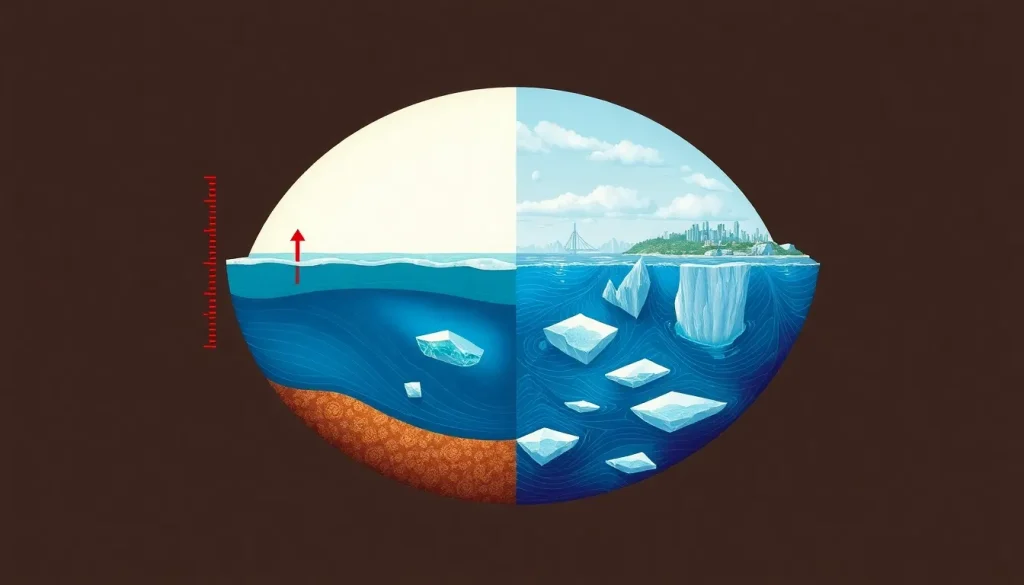
Sea-level rise refers to the long-term increase in the average height of the ocean surface relative to the land. It is driven primarily by two physical processes linked to global warming: thermal expansion of seawater and the addition of freshwater from melting land ice. Thermal expansion is the increase in volume that occurs when ocean water warms, because heated water molecules move more vigorously and occupy more space. Melting ice, on the other hand, adds mass to the ocean when glaciers, ice caps, and the vast ice sheets of Greenland and Antarctica lose ice that was previously stored on land. Both mechanisms are direct consequences of rising atmospheric and ocean temperatures caused by greenhouse gas emissions.
Understanding the relative contributions of thermal expansion and melting ice is essential for projecting future sea-level rise and its impacts. While thermal expansion dominated the observed rise during much of the 20th century, the balance has shifted. Since the early 1990s, improved satellite observations have shown that ice melt – particularly from the Greenland and Antarctic ice sheets – has accelerated and now accounts for a larger share of the increase. This shift has profound implications because ice sheet loss can become self-sustaining and irreversible on human timescales, while thermal expansion will persist for centuries due to the slow pace of ocean heat uptake.
How It Works
Thermal expansion, also called thermosteric sea-level change, is a fundamental physical property of water. As the ocean absorbs more than 90% of the excess heat trapped by greenhouse gases, its temperature rises. Water, like most substances, expands when heated. This expansion increases the volume of the existing ocean water without adding any new mass. The effect is subtle but global: a uniform warming of the entire ocean by 1°C would raise sea level by roughly 0.5–1 meter, depending on the initial temperature and pressure. In reality, warming is not uniform; the upper ocean warms faster, and expansion is concentrated there. Over the past century, thermal expansion has contributed an estimated 0.3–0.5 mm per year to sea-level rise, with the rate increasing as the ocean continues to warm.
Melting land ice contributes to sea-level rise by adding freshwater that was previously stored on land. This includes mountain glaciers, ice caps, and the two great ice sheets. When land ice melts, the water eventually flows into the ocean, increasing its total mass – a process called barystatic sea-level change. Unlike sea ice, which already displaces its own weight in water and does not change sea level when it melts, land ice melt directly raises the ocean surface. The total potential sea-level equivalent of all land ice is enormous: glaciers and ice caps hold about 0.4 meters, the Greenland Ice Sheet about 7.4 meters, and the Antarctic Ice Sheet about 58 meters. Even a small fraction of this ice loss can cause significant sea-level rise.
Main Causes or Drivers
The ultimate driver of both thermal expansion and melting ice is global warming, caused by the accumulation of heat-trapping greenhouse gases in the atmosphere. However, the specific mechanisms differ. Thermal expansion is driven by the increase in ocean heat content, which is directly linked to rising global air temperatures and the absorption of solar radiation. The ocean’s large heat capacity means it warms slowly, but once warmed, it retains heat for centuries. This thermal inertia ensures that even if atmospheric temperatures were stabilized, sea level would continue to rise for hundreds of years as the deep ocean gradually warms.
Melting land ice is driven by warmer air and ocean temperatures. Glaciers and ice caps respond relatively quickly to atmospheric warming, with mass loss occurring through surface melting and runoff. The Greenland Ice Sheet loses mass through both surface melt and the calving of icebergs into the ocean. In Antarctica, surface melting is limited, but warming ocean waters erode the floating ice shelves from below, causing them to thin and weaken. This allows the grounded ice behind them to flow faster into the sea – a process known as dynamic ice loss. The rate of ice loss from both ice sheets has increased markedly since the turn of the 21st century, making them the dominant contributors to barystatic sea-level rise.
What the Evidence Shows
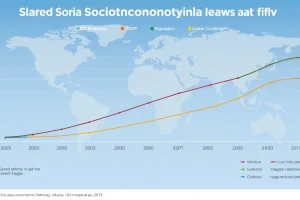
Long-term tide gauge records, dating back to the late 19th century, provide direct evidence of global mean sea-level rise. These measurements show a rise of approximately 1.5–2.0 mm per year during the 20th century. Since the early 1990s, satellite altimetry has provided precise, near-global coverage, revealing an average rate of about 3.3 mm per year – more than double the earlier rate. This acceleration is consistent with increasing ocean heat content and accelerating ice loss.
Attribution studies that combine observations with climate models indicate that thermal expansion accounted for roughly 40–50% of the observed sea-level rise over the 20th century, with melting glaciers and ice caps contributing most of the remainder. In the 21st century, the balance has shifted. Ice melt from Greenland and Antarctica has become the largest source, contributing over half of the total rise in some recent decades. The evidence also shows that the rate of ice sheet mass loss is increasing, raising concerns about future sea-level projections.
Regional Differences
Sea-level rise is not uniform across the globe. While the global mean provides a useful benchmark, local sea-level change can differ by tens of centimeters from the average due to several factors. Ocean dynamics, such as changes in currents and wind patterns, can pile up water in some regions and lower it in others. For example, the western tropical Pacific has experienced faster-than-average rise, while some eastern Pacific regions have seen slower rise or even a slight fall in recent decades.
Land motion also plays a critical role. In areas where the land is subsiding – often due to groundwater extraction, sediment compaction, or tectonic activity – relative sea-level rise is amplified. Conversely, regions experiencing post-glacial rebound, such as parts of Scandinavia and Canada, are still rising after the removal of ice-age ice sheets, partially offsetting global sea-level rise. Additionally, the gravitational pull of large ice sheets affects local sea level: as an ice sheet loses mass, its gravitational attraction weakens, causing sea level to fall nearby and rise farther away. This means that melting from Greenland has a disproportionate impact on sea level in the Southern Hemisphere, and vice versa for Antarctica.
Why It Matters
Understanding the relative roles of thermal expansion and melting ice is crucial for projecting future sea-level rise and planning adaptation. Thermal expansion is relatively predictable based on ocean heat uptake, but ice sheet dynamics introduce large uncertainties. The potential for rapid, irreversible ice loss from Greenland and Antarctica could lead to sea-level rise of a meter or more by the end of the century, with profound consequences for coastal communities, ecosystems, and infrastructure.
Sea-level rise exacerbates coastal flooding, erosion, and saltwater intrusion into freshwater supplies. Low-lying island nations and densely populated delta regions are particularly vulnerable. Even a modest rise increases the frequency of high-tide flooding and the destructive power of storm surges. Because both thermal expansion and ice melt will continue for centuries after greenhouse gas emissions are reduced, long-term planning must account for ongoing sea-level rise. The choices made today about emissions and adaptation will determine the severity of impacts for generations to come.
FAQ
What is the difference between thermal expansion and melting ice as causes of sea-level rise?
Thermal expansion increases the volume of existing ocean water as it warms, without adding mass. Melting land ice adds freshwater mass to the ocean, directly raising sea level. Both are driven by global warming but operate through different physical mechanisms.
Which contributes more to current sea-level rise: thermal expansion or melting ice?
Since the early 21st century, melting land ice – particularly from the Greenland and Antarctic ice sheets – has become the dominant contributor, accounting for more than half of the observed rise. Thermal expansion remains significant but is now a smaller share.
Why does sea-level rise vary by region?
Regional differences arise from ocean currents and wind patterns that redistribute water, land subsidence or uplift, and gravitational changes as ice sheets lose mass. These factors can cause local sea-level change to be higher or lower than the global average.
References
- Intergovernmental Panel on Climate Change (IPCC) Assessment Reports, Working Group I: The Physical Science Basis
- NASA Global Climate Change – Sea Level (climate.nasa.gov)
- NOAA National Ocean Service – Sea Level Rise (oceanservice.noaa.gov)