In brief
At a glance
Quick Facts
- Global Oxygen Production
- Phytoplankton produce an estimated 50–80% of Earth’s oxygen.
- Carbon Absorption
- They absorb about 10 gigatonnes of carbon from the atmosphere each year.
- Biological Carbon Pump
- Dead phytoplankton sink, sequestering carbon in the deep ocean for centuries to millennia.
- Cloud Formation
- Some species emit dimethyl sulfide (DMS), which helps form clouds that reflect sunlight.
- Habitat
- They thrive in the sunlit surface layer of oceans, lakes, and rivers worldwide.
- Climate Feedback
- Warming oceans can reduce phytoplankton populations, weakening the ocean’s ability to absorb CO2.
Key Takeaways
- Phytoplankton produce roughly half of Earth’s oxygen and absorb vast amounts of carbon dioxide, acting as a major biological regulator of climate.
- Through the biological carbon pump, they transfer carbon from the atmosphere to the deep ocean, where it can remain for centuries.
- Certain species release dimethyl sulfide (DMS), a gas that promotes cloud formation and increases the planet’s reflectivity, cooling the surface.
- Changes in phytoplankton abundance and distribution due to ocean warming, acidification, and nutrient shifts can amplify or dampen climate change.
What Is How Phytoplankton Influence Earth’s Climate?
Phytoplankton influence Earth’s climate by serving as a primary engine of the global carbon cycle and by altering the atmosphere’s radiative properties. These microscopic, photosynthetic organisms drift in the sunlit upper layers of oceans, lakes, and rivers, where they convert carbon dioxide and water into organic matter and oxygen. In doing so, they remove the greenhouse gas CO₂ from the atmosphere and form the base of marine food webs. Additionally, many species emit dimethyl sulfide (DMS), a sulfur-containing gas that oxidizes in the air to create sulfate aerosols—tiny particles that can seed cloud droplets. This dual role means phytoplankton not only draw down carbon but also influence how much sunlight reaches Earth’s surface.
The term “phytoplankton” encompasses a diverse group of organisms, including cyanobacteria, diatoms, dinoflagellates, and coccolithophores. Despite their small size, their collective metabolic activity rivals that of all land plants combined. Because they are sensitive to environmental conditions such as temperature, light, and nutrient availability, phytoplankton populations respond to climate variability and, in turn, feed back into the climate system. Understanding these interactions is essential for predicting future climate trajectories and the health of marine ecosystems.
Overview
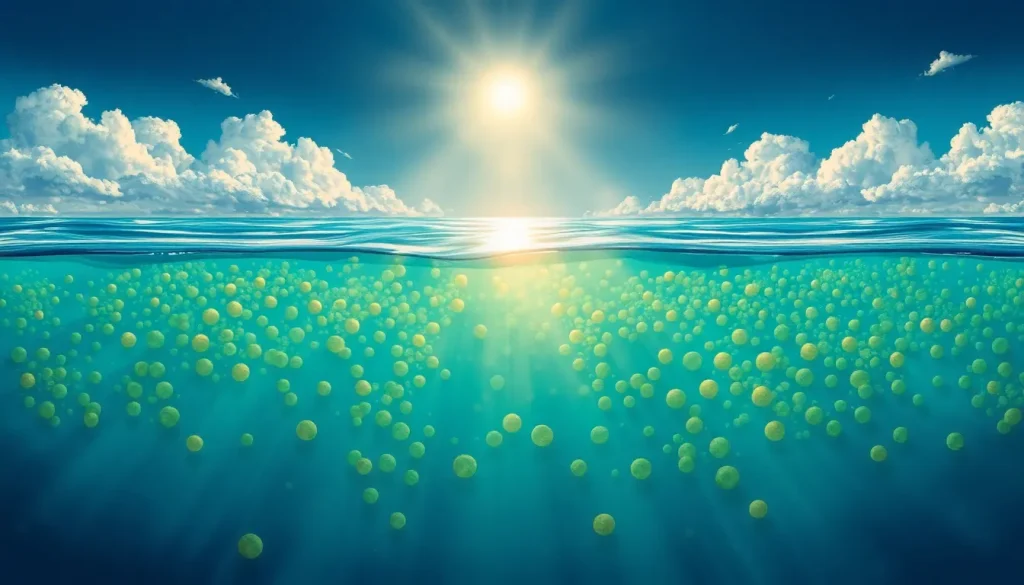
Phytoplankton are the ocean’s primary producers, responsible for approximately half of global net primary production. They inhabit the euphotic zone—the uppermost layer of water where sunlight penetrates—and their distribution spans from polar seas to tropical waters. The two main ways phytoplankton influence climate are through the biological carbon pump and the production of climate-active gases. The biological carbon pump begins with photosynthesis, which fixes dissolved CO₂ into organic carbon. When phytoplankton cells die, aggregate, or are consumed and excreted by zooplankton, a portion of this organic matter sinks into the deep ocean. Once below the thermocline, the carbon is isolated from the atmosphere for hundreds to thousands of years, effectively reducing the greenhouse effect.
Simultaneously, the emission of DMS by certain phytoplankton species represents a biogeochemical feedback loop. DMS oxidizes to sulfate aerosols that act as cloud condensation nuclei, increasing cloud droplet number and making clouds more reflective. This raises Earth’s albedo and cools the surface. The relative strength of these two mechanisms varies by region, season, and phytoplankton community composition, but together they make phytoplankton a cornerstone of Earth’s climate regulation.
How It Works
The influence of phytoplankton on climate operates through interconnected physical, chemical, and biological processes. The first major pathway is the biological carbon pump:
- Photosynthesis: Phytoplankton take up dissolved CO₂ and convert it into organic carbon compounds, releasing oxygen as a byproduct.
- Grazing and aggregation: Zooplankton consume phytoplankton, producing fecal pellets that sink rapidly. Dead cells and other organic debris also clump together into marine snow.
- Export and sequestration: A fraction of this organic material sinks below the mixed layer, where it is respired by deep-sea organisms or buried in sediments. This vertical transport removes carbon from the surface ocean and atmosphere on long timescales.
The second pathway involves the sulfur cycle and cloud formation:
- DMS production: Phytoplankton synthesize dimethylsulfoniopropionate (DMSP) as an osmolyte. When cells are damaged or grazed, DMSP breaks down into DMS, which escapes into the atmosphere.
- Aerosol formation: In the air, DMS oxidizes to form sulfate aerosols. These particles are hygroscopic and can serve as nuclei for cloud droplets.
- Albedo effect: Increased cloud droplet number leads to brighter, more reflective clouds that scatter incoming solar radiation back to space, cooling the Earth’s surface.
These mechanisms are not independent; changes in ocean temperature, circulation, and nutrient supply can alter phytoplankton species composition, affecting the balance between carbon export and DMS emissions.
Importance and Impact
Phytoplankton are fundamental to climate stability and the functioning of marine ecosystems. Their role in the carbon cycle helps regulate atmospheric CO₂ levels over geological and human timescales. Without the biological carbon pump, atmospheric CO₂ concentrations would be significantly higher, intensifying the greenhouse effect. The oxygen they produce sustains aerobic life in the ocean and contributes to the breathable atmosphere.
Beyond climate, phytoplankton underpin global fisheries and marine biodiversity. As the base of the food web, their abundance directly affects fish stocks, marine mammals, and seabirds. Changes in phytoplankton productivity can therefore have cascading effects on food security and economies that depend on marine resources. The DMS-cloud feedback also has regional climate implications, influencing monsoon patterns and storm intensity in some areas. Because phytoplankton are sensitive to environmental shifts, they serve as indicators of ocean health and climate change impacts.
Connections to Other Systems
Phytoplankton do not operate in isolation; they are tightly linked to nutrient cycles, ocean circulation, and the broader Earth system. Their growth depends on the availability of macronutrients like nitrogen and phosphorus, as well as micronutrients such as iron. These nutrients are supplied by river runoff, upwelling, atmospheric dust deposition, and recycling within the water column. Climate-driven changes in precipitation, wind patterns, and ocean stratification can alter nutrient delivery, affecting phytoplankton blooms.
The iron fertilization hypothesis illustrates one such connection: in high-nutrient, low-chlorophyll regions like the Southern Ocean, iron limitation restricts phytoplankton growth. Natural iron inputs from dust or volcanic ash can trigger blooms that enhance carbon export. This has led to proposals for deliberate iron fertilization as a geoengineering strategy, though its effectiveness and ecological risks remain debated. Phytoplankton also interact with the nitrogen and phosphorus cycles through their uptake and remineralization, and some species can fix atmospheric nitrogen, adding new bioavailable nitrogen to the ocean. These intricate links mean that any perturbation to the climate system can propagate through phytoplankton communities, creating complex feedback loops.
What the Evidence Shows
Multiple lines of evidence confirm the significant role of phytoplankton in climate. Satellite observations of ocean color since the late 20th century have provided global estimates of phytoplankton biomass and primary production, revealing seasonal and interannual variability linked to climate oscillations like El Niño. Paleoclimate records from ice cores and marine sediments show that phytoplankton productivity has fluctuated with past climate changes, and that the biological pump has influenced atmospheric CO₂ over glacial-interglacial cycles.
Laboratory and field experiments demonstrate that elevated CO₂ can affect phytoplankton physiology, sometimes enhancing growth in some species while inhibiting calcification in others like coccolithophores. Long-term monitoring programs have detected shifts in phytoplankton community structure, with potential consequences for carbon export and DMS emissions. Climate models that include marine biogeochemistry project that warming and increased stratification will reduce nutrient supply to the surface ocean, leading to a decline in global phytoplankton productivity over the 21st century. However, regional responses vary, and uncertainties remain regarding the net climate feedback.
Common Misconceptions
Misconception 1: Phytoplankton are the only source of Earth’s oxygen. While they produce roughly half of the planet’s oxygen, land plants and other photosynthetic organisms contribute the other half. The oxygen in the atmosphere is a result of both marine and terrestrial photosynthesis over millions of years.
Misconception 2: All phytoplankton affect climate in the same way. Different species have distinct roles. Diatoms, for example, are efficient at carbon export due to their heavy silica shells, while coccolithophores produce calcium carbonate plates that can release CO₂ during formation. DMS production is limited to certain groups, such as prymnesiophytes and dinoflagellates.
Misconception 3: Phytoplankton only influence climate through CO₂ absorption. The DMS-cloud-albedo effect is a separate and important pathway. In some regions, this cooling effect may rival the warming mitigation from carbon uptake.
Misconception 4: Phytoplankton are immune to climate change. They are highly sensitive to temperature, light, nutrient availability, and ocean chemistry. Warming, acidification, and altered circulation patterns are already affecting their distribution and productivity, with potential consequences for climate feedbacks.
FAQ
What are phytoplankton?
Phytoplankton are microscopic, photosynthetic organisms that live in water. They include cyanobacteria, diatoms, dinoflagellates, and other algae, and they form the base of most aquatic food webs.
How do phytoplankton affect climate?
They influence climate primarily by absorbing carbon dioxide during photosynthesis and by releasing dimethyl sulfide, which can lead to cloud formation. These processes help regulate Earth’s temperature and carbon cycle.
Why are phytoplankton important for the carbon cycle?
Phytoplankton convert CO2 into organic carbon. When they die or are consumed, some of this carbon sinks to the deep ocean, where it can remain for centuries, effectively removing it from the atmosphere.
References
- NASA Earth Observatory: The Role of Phytoplankton in the Earth System
- IPCC Special Report on the Ocean and Cryosphere in a Changing Climate (2019)
- Falkowski, P. G. (2012). Ocean Science: The power of plankton. Nature, 483(7387), S17–S20.