In brief
At a glance
Quick Facts
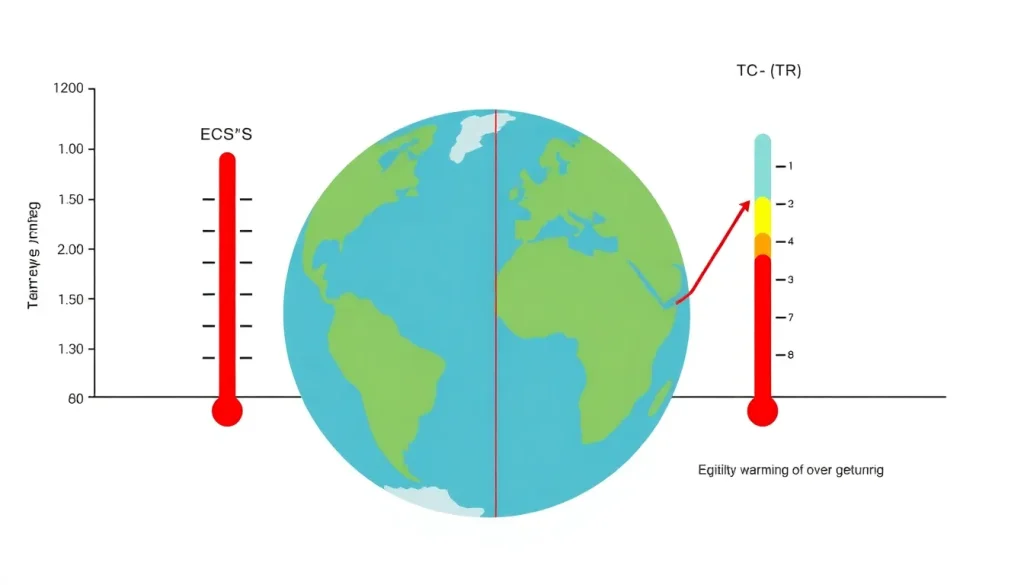
- Equilibrium Climate Sensitivity (ECS) definition
- The long-term global surface temperature increase after the climate system reaches equilibrium following a doubling of atmospheric CO₂.
- Transient Climate Response (TCR) definition
- The global surface temperature increase at the time CO₂ doubles in a scenario where concentrations rise at 1% per year.
- ECS likely range (IPCC AR6)
- 2.5°C to 4°C, with a best estimate of 3°C.
- TCR likely range (IPCC AR6)
- 1.4°C to 2.2°C, with a best estimate of 1.8°C.
- Why ECS is larger than TCR
- ECS includes slow feedbacks and full ocean heat equilibration that take centuries, while TCR reflects the response before these processes are complete.
- Primary use of TCR
- Projecting near-term warming over the next few decades and informing short-term climate policy.
- Primary use of ECS
- Determining long-term committed warming and the eventual consequences of cumulative emissions.
- Key sources of uncertainty
- Cloud feedbacks, aerosol forcing, ocean heat uptake efficiency, and paleoclimate data interpretation.
Key Takeaways
- Equilibrium Climate Sensitivity (ECS) is the long-term global surface warming after the climate system fully adjusts to a doubling of CO₂, while Transient Climate Response (TCR) is the warming at the time of doubling during a gradual increase.
- ECS is always larger than TCR because it includes slow feedbacks and full ocean heat equilibration that take centuries to manifest.
- TCR is more relevant for near-term warming projections (decades), whereas ECS determines the eventual committed warming over centuries.
- Both metrics are crucial for understanding climate risks, setting emissions targets, and informing adaptation policies.
What Is Equilibrium Climate Sensitivity vs Transient Climate Response?
Equilibrium Climate Sensitivity (ECS) and Transient Climate Response (TCR) are two fundamental metrics in climate science used to quantify the global surface temperature response to an increase in atmospheric carbon dioxide (CO₂) concentration. ECS is defined as the long-term, steady-state change in global mean surface temperature that results from a sustained doubling of CO₂ concentrations above pre-industrial levels, after the climate system has reached a new equilibrium. In contrast, TCR is the temperature change at the moment CO₂ doubles in a scenario where concentrations increase by 1% per year, capturing the near-term response before the deep ocean and slow feedbacks have fully adjusted.
These metrics serve as standardized benchmarks to compare the sensitivity of different climate models and to assess the potential magnitude of future warming. They are not predictions of actual temperature rise by a specific date, but rather indicators of the climate system’s inherent responsiveness to radiative forcing. ECS and TCR are derived from a combination of global climate models, historical observations, and paleoclimate evidence, and they remain central to understanding the risks associated with greenhouse gas emissions.
Overview
Climate sensitivity is a core concept in climate science that describes how much the Earth’s surface temperature changes in response to a given radiative forcing—an imposed change in the planet’s energy balance. The most common benchmark is a doubling of atmospheric CO₂ concentrations, which produces a radiative forcing of approximately 3.7 W/m². ECS and TCR are two distinct measures of this sensitivity, each addressing different timescales and physical processes. ECS represents the equilibrium response after all components of the climate system—atmosphere, ocean, land, and ice—have fully adjusted, which can take several centuries. TCR, on the other hand, is a transient measure that reflects the warming at the time of doubling under a specific idealized scenario, typically a 1% per year increase in CO₂. This scenario roughly approximates the pace of historical and projected human-caused emissions, making TCR particularly useful for near-term climate projections.
Both metrics are expressed in degrees Celsius (°C) and are used to characterize the uncertainty range of future warming. They are not fixed properties of the Earth system but are estimated from multiple lines of evidence, including the instrumental record, volcanic eruptions, paleoclimate reconstructions, and complex Earth system models. Understanding the distinction between ECS and TCR is essential for interpreting climate projections and for designing policies that address both immediate and long-term climate risks.
How It Works
The physical basis for ECS and TCR lies in the Earth’s energy balance and climate feedbacks. When CO₂ concentrations rise, they trap more outgoing longwave radiation, creating a positive radiative forcing that warms the planet. This initial warming triggers feedback processes that either amplify (positive feedback) or dampen (negative feedback) the temperature change. Key feedbacks include water vapor (a strong positive feedback, as warmer air holds more moisture, which is itself a greenhouse gas), clouds (whose net effect is uncertain but likely positive), ice-albedo (melting ice reduces reflectivity, causing more absorption), and the lapse rate (the change in temperature with altitude, which is a negative feedback).
The critical difference between ECS and TCR arises from the role of ocean heat uptake and the timescales of feedbacks. The ocean has an enormous heat capacity and absorbs much of the added energy, delaying surface warming. In the transient case (TCR), the ocean is still taking up heat, so the surface warms less than it would if the system were allowed to equilibrate. ECS includes the eventual warming after the ocean has fully warmed and after slow feedbacks—such as changes in ice sheets and vegetation—have fully developed. Because these slow processes can take centuries to millennia, ECS is always larger than TCR. The ratio between them depends on the efficiency of ocean heat uptake and the strength of feedbacks; a higher ECS relative to TCR indicates that a larger fraction of the eventual warming is delayed.
What the Evidence Shows
Multiple lines of evidence constrain the likely ranges of ECS and TCR. According to the Intergovernmental Panel on Climate Change (IPCC) Sixth Assessment Report, the likely range for ECS is 2.5°C to 4°C, with a best estimate of 3°C. For TCR, the likely range is 1.4°C to 2.2°C, with a best estimate of 1.8°C. These ranges reflect a synthesis of evidence from the instrumental record (e.g., observed warming since the late 19th century), satellite measurements of Earth’s energy imbalance, paleoclimate data from past periods such as the Last Glacial Maximum, and emergent constraints from climate model ensembles.
Climate models exhibit a spread in both ECS and TCR due to differences in how they represent cloud feedbacks, aerosol interactions, and ocean mixing. Observational constraints, such as the observed warming trend and ocean heat content increase, have helped narrow the TCR range more effectively than ECS, because TCR is more directly tied to recent historical data. Paleoclimate evidence, however, provides crucial information on ECS by revealing how the Earth responded to past CO₂ changes over millennia. The convergence of these independent methods has increased confidence in the assessed ranges, though substantial uncertainty remains, particularly at the high end of ECS.
Importance and Impact
ECS and TCR are not merely academic quantities; they have profound implications for climate policy and risk assessment. TCR is directly relevant to the warming expected in the coming decades under current emission trajectories. Because it captures the near-term response, TCR helps determine the pace of warming that societies and ecosystems will experience by mid-century, influencing the urgency of mitigation efforts and the scale of adaptation needed. A higher TCR means that a given emissions pathway will lead to faster warming, leaving less time to avoid critical thresholds such as the 1.5°C or 2°C targets.
ECS, on the other hand, defines the long-term committed warming that the planet will eventually reach if CO₂ concentrations are stabilized at a doubled level. This metric is essential for understanding the ultimate consequences of cumulative emissions and for setting long-term stabilization goals. A high ECS implies that even if emissions are reduced, the planet will continue to warm for centuries, with severe impacts on sea level rise, ice sheet stability, and extreme weather. Integrated assessment models use ECS and TCR to evaluate the costs and benefits of different mitigation pathways, making these sensitivity metrics foundational to the economic analysis of climate change.
Data Limitations and Uncertainties
Despite decades of research, significant uncertainties persist in estimating ECS and TCR. The primary sources of uncertainty include cloud feedbacks, which remain the largest contributor to inter-model spread. The response of low clouds to warming can either strongly amplify or dampen the initial forcing, and the physical processes governing cloud formation and dissipation are not yet fully resolved in global models. Aerosol forcing—the cooling effect of particulate pollution—also introduces uncertainty, as its magnitude and historical evolution are poorly constrained, affecting estimates of the net radiative forcing that has driven observed warming.
Ocean heat uptake efficiency varies among models and is difficult to measure directly, influencing the relationship between TCR and ECS. Additionally, paleoclimate reconstructions provide valuable constraints but come with their own uncertainties regarding past CO₂ levels and temperature proxies. The possibility of “fat-tailed” distributions, where the probability of very high ECS values declines slowly, remains a topic of active research. Ongoing efforts to reduce these uncertainties include high-resolution modeling, satellite observations, and the use of emergent constraints that link observable climate variables to sensitivity. As of the early 2020s, the assessed ranges represent the best available knowledge, but future refinements are expected.
Common Misconceptions
One common misconception is that ECS is the warming the world will experience by the year 2100. In reality, ECS is an equilibrium metric that assumes CO₂ concentrations remain fixed at double pre-industrial levels indefinitely, and the full temperature response may not be realized for centuries. The actual warming by 2100 depends on the emissions pathway and is better approximated by transient metrics like TCR or by model projections that account for the time-evolving forcing.
Another misunderstanding is that TCR is simply a faster version of ECS. While both measure warming from CO₂ doubling, they are defined under different experimental setups and capture different physical processes. TCR is not a direct subset of ECS; rather, it reflects the warming at a specific point in a transient simulation, while ECS is the final equilibrium state. Some also believe that climate sensitivity is a single, precisely known number. In fact, it is a range that reflects inherent uncertainties in the climate system, and the goal of research is to narrow that range, not to find one exact value. Finally, it is sometimes assumed that a low ECS means climate change is not a serious concern. Even at the lower end of the likely range, the projected warming would have substantial impacts, and the risks increase sharply with higher sensitivity.
FAQ
What is equilibrium climate sensitivity?
Equilibrium climate sensitivity (ECS) is the long-term increase in global mean surface temperature that would result from a sustained doubling of atmospheric CO₂ concentrations, after the climate system has fully adjusted to the new radiative forcing.
How does transient climate response differ from ECS?
Transient climate response (TCR) is the warming at the moment CO₂ doubles in a scenario where concentrations increase by 1% per year. Unlike ECS, it does not include the full adjustment of the deep ocean and slow feedbacks, so it is always smaller.
Why do ECS and TCR matter?
They are fundamental metrics for projecting future climate change. TCR helps estimate near-term warming and informs short-term policy, while ECS indicates the long-term committed warming that determines the ultimate severity of climate impacts.
References
- IPCC, 2021: Climate Change 2021: The Physical Science Basis. Contribution of Working Group I to the Sixth Assessment Report of the Intergovernmental Panel on Climate Change. Cambridge University Press.
- Knutti, R., Rugenstein, M. A. A., & Hegerl, G. C. (2017). Beyond equilibrium climate sensitivity. Nature Geoscience, 10(10), 727–736.
- National Research Council. (2015). Climate Intervention: Reflecting Sunlight to Cool Earth. The National Academies Press.