In brief
At a glance
Quick Facts
- Definition
- The co-occurrence or rapid succession of floods and droughts in the same region, amplifying their individual impacts.
- Key Driver
- Climate change intensifies the hydrological cycle, increasing the frequency of both extremes.
- Example Region
- California experienced severe drought from 2012–2016 followed by record floods in 2017.
- Management Challenge
- Traditional water infrastructure often fails to handle both extremes simultaneously.
- Projected Trend
- Compound flood-drought events are expected to become more frequent globally.
Key Takeaways
- Compound flood and drought risks involve the occurrence of both hydrological extremes in the same area within a short timeframe, magnifying their individual impacts.
- Climate change intensifies the hydrological cycle, making rapid swings between drought and flood more frequent and severe.
- Traditional water management and infrastructure are often ill-equipped to handle both extremes, leading to cascading failures.
- Integrated approaches that consider the full spectrum of water variability are critical for building long-term resilience.
What Is Compound Flood and Drought Risks?
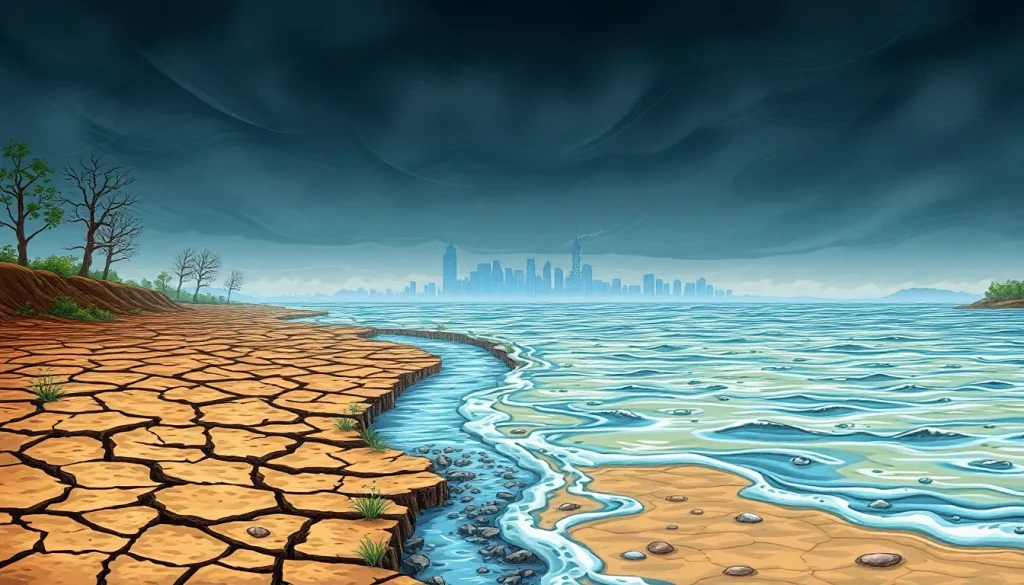
Compound flood and drought risks refer to the heightened threat posed when both floods and droughts affect the same region, either simultaneously in different parts of a basin or in rapid succession. Unlike isolated extreme events, compound events create a situation where the impacts of one hazard amplify the vulnerability to the other, or where recovery from one is interrupted by the onset of the next. This concept challenges the traditional approach of managing floods and droughts as separate, independent phenomena.
In many regions, water management systems are designed based on historical records that treat floods and droughts as distinct, alternating phases. However, a compound event can see a severe drought followed immediately by intense rainfall, leading to flash flooding on parched, impermeable soils. Alternatively, a flood may damage water supply infrastructure, triggering a water shortage crisis. Recognizing these interconnected risks is essential for developing robust adaptation strategies in a changing climate.
How It Works
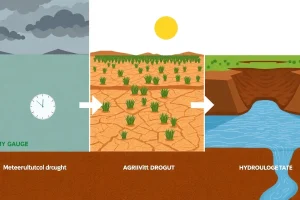
Compound flood and drought risks arise from the interplay of climatic, hydrological, and human factors. A common mechanism is the rapid transition from drought to flood. During a prolonged dry period, soils become compacted and hydrophobic, reducing their capacity to absorb water. When heavy rainfall eventually arrives, much of it runs off the surface, causing flash floods and landslides while doing little to replenish groundwater reserves. This can leave a region simultaneously dealing with flood damage and lingering water scarcity.

Another pathway involves large-scale atmospheric patterns. For example, persistent high-pressure systems can cause extended droughts, but their breakdown often triggers intense storms and flooding. Human interventions, such as reservoir operations, can also contribute: managers may keep reservoirs full to guard against drought, only to be forced into emergency releases when heavy rain arrives, exacerbating downstream flooding. The result is a whiplash effect where communities swing from one extreme to the other with little time to recover.
Main Causes or Drivers
Several factors drive the increasing occurrence of compound flood and drought risks. Climate change is a primary accelerator, as a warmer atmosphere holds more moisture, leading to more intense rainfall events, while also increasing evaporation and drying during dry spells. This intensifies both ends of the hydrological cycle. Land-use changes, such as deforestation and urbanization, reduce the landscape’s natural ability to buffer extremes by decreasing infiltration and increasing runoff.
Natural climate variability also plays a role. Phenomena like the El Niño–Southern Oscillation (ENSO) can bring drought to some regions and floods to others, and in some areas, both extremes can occur in different phases of the same cycle. Additionally, water management practices that prioritize one type of extreme—for instance, draining reservoirs to prepare for floods—can inadvertently increase drought vulnerability, and vice versa. The combination of these drivers creates a complex risk landscape.
Regional Differences
The manifestation of compound flood and drought risks varies significantly by region due to differences in climate, geography, and human systems. In Mediterranean climates, such as California and parts of southern Europe, long dry summers are often punctuated by intense winter storms, creating a natural setting for rapid drought-to-flood transitions. In monsoon regions like South Asia, the same seasonal cycle can bring both devastating floods and, if the monsoon fails or is delayed, severe drought.
In East Africa, multi-year droughts can be broken by extreme rainfall events that cause flash floods, damaging the very water infrastructure meant to alleviate water scarcity. Australia’s highly variable climate has produced sequences like the Millennium Drought, which ended with widespread flooding. Each region’s unique combination of climate patterns, topography, and water management infrastructure shapes how compound risks unfold and the strategies needed to address them.
Examples
California’s drought from 2012 to 2016 was one of the most severe on record, depleting reservoirs and groundwater. In early 2017, a series of atmospheric rivers brought record-breaking precipitation, causing catastrophic flooding and dam emergencies, while the state still grappled with long-term groundwater deficits. This sequence highlighted the challenge of managing both extremes simultaneously.
In East Africa, the 2010–2011 drought was followed by heavy rains in 2012, leading to flash floods that displaced communities already weakened by food and water shortages. Similarly, in Europe, the 2018–2019 drought was succeeded by intense rainfall in parts of central Europe, causing river flooding. These cases illustrate how compound events can undermine recovery efforts and strain emergency response systems.
Solutions
Addressing compound flood and drought risks requires a shift from single-hazard management to integrated water resource management (IWRM). This approach considers the entire water cycle and the full range of variability, from scarcity to excess. Key strategies include developing flexible infrastructure, such as multi-purpose reservoirs and green infrastructure, that can serve both flood control and water storage functions.
Improved forecasting and early warning systems that account for rapid transitions are essential. Nature-based solutions, like restoring wetlands and floodplains, enhance the landscape’s capacity to absorb extremes. Policy coordination across sectors—water, agriculture, energy, and disaster management—is also critical. By planning for both floods and droughts together, communities can build resilience to the compound risks that are likely to become more common.
Data Limitations and Uncertainties
Despite growing recognition, compound flood and drought risks remain difficult to quantify. Historical records are often too short to capture rare compound events, and many hydrological models are designed to simulate floods and droughts separately. The lack of integrated datasets that track both extremes over time hampers risk assessment.
Climate projections add further uncertainty, as the precise changes in the frequency and sequencing of extremes vary by model and region. Additionally, human interventions—such as reservoir operations and land-use changes—are hard to predict and incorporate into models. Addressing these data gaps is a priority for improving risk management and adaptation planning.
FAQ
What is compound flood and drought risk?
It is the heightened risk that arises when both floods and droughts affect the same region, either at the same time or in quick succession, making their combined impact worse than if they occurred separately.
How does climate change affect compound flood and drought events?
Climate change warms the atmosphere, allowing it to hold more moisture, which can lead to heavier rainfall and floods. At the same time, higher temperatures increase evaporation, intensifying droughts. This makes rapid swings between extremes more likely.
What can be done to manage compound flood and drought risks?
Management strategies include integrated water resource planning, flexible infrastructure that can handle both floods and droughts, improved early warning systems, nature-based solutions like wetland restoration, and cross-sector policy coordination.
References
- Intergovernmental Panel on Climate Change (IPCC) Special Report on Managing the Risks of Extreme Events and Disasters to Advance Climate Change Adaptation (SREX).
- World Meteorological Organization (WMO) Integrated Drought Management Programme.
- Zscheischler, J. et al. (2018). Future climate risk from compound events. Nature Climate Change, 8, 469–477.