In brief
At a glance
Quick Facts
- Definition
- Plant-based meat is made from plant proteins to mimic animal meat; conventional meat is animal muscle tissue.
- Primary ingredients
- Plant-based meats often use soy, pea, or wheat protein; conventional meat is animal muscle and fat.
- Environmental impact
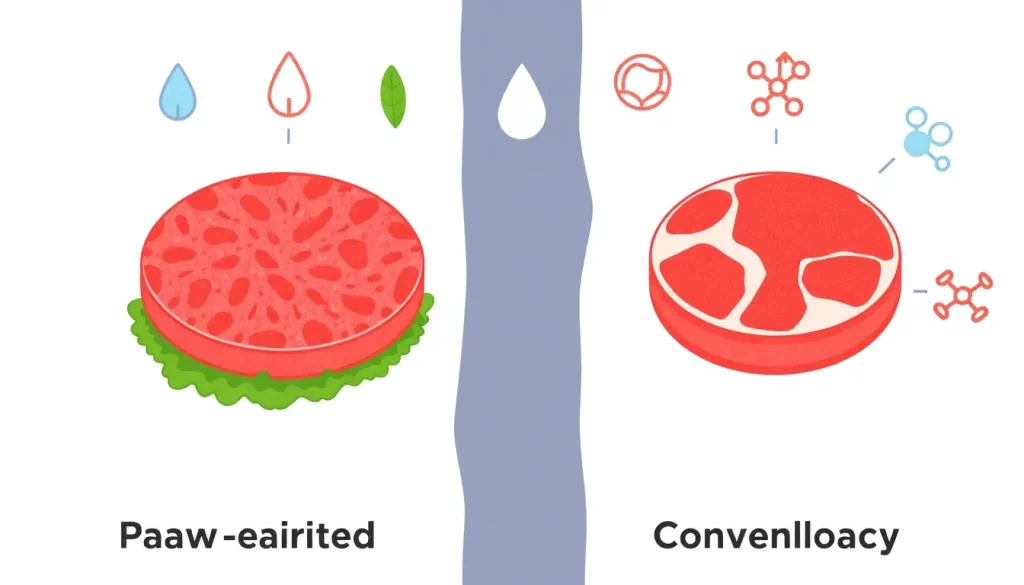
- Plant-based meats generally have lower greenhouse gas emissions, land use, and water use than conventional meat, especially beef.
- Protein quality
- Conventional meat provides complete protein with all essential amino acids; plant-based meats are formulated to be complete but may vary.
- Processing level
- Plant-based meats are highly processed; conventional meat can be minimally processed (fresh cuts) or processed (sausages).
- Saturated fat
- Both can be high in saturated fat; plant-based often uses coconut oil, conventional depends on the cut and animal.
- Cholesterol
- Conventional meat contains dietary cholesterol; plant-based meat contains none.
- Vitamin B12
- Conventional meat naturally contains B12; plant-based meat is often fortified with synthetic B12.
Key Takeaways
- Plant-based meat is designed to replicate the sensory experience of animal meat using ingredients like soy, pea, or wheat protein, while conventional meat is animal muscle tissue.
- Plant-based meat production typically uses fewer natural resources and generates lower greenhouse gas emissions than conventional meat, but it is a processed food with variable nutritional profiles.
- Conventional meat provides complete protein and essential micronutrients naturally, but its production is associated with significant environmental and animal welfare concerns.
- The choice between them involves trade-offs in health, sustainability, and ethics, and both can play a role in a balanced diet depending on individual and societal priorities.
What Is Plant-Based Meat vs Conventional Meat?
Plant-based meat is a food product engineered from plant-derived ingredients—such as soy, pea, wheat, or mycoprotein—to replicate the taste, texture, aroma, and appearance of conventional animal meat. It is designed to serve as a direct substitute for beef, pork, chicken, or fish in familiar dishes like burgers, sausages, and nuggets. Unlike traditional vegetarian staples such as tofu or tempeh, modern plant-based meats are formulated to closely mimic the fibrous texture and juiciness of animal muscle, often using techniques like extrusion and the addition of fats, binders, and flavorings. Conventional meat, by contrast, is the edible flesh of animals—primarily skeletal muscle and associated fat—obtained through the rearing and slaughter of livestock such as cattle, pigs, and poultry.
The distinction is not merely culinary but also reflects different production systems. Conventional meat relies on animal agriculture, which involves breeding, feeding, and managing animals for months or years before harvest. Plant-based meat is manufactured in a factory setting, where proteins are isolated from crops, combined with water, oils, and other ingredients, and then processed to create a meat-like matrix. Both products aim to provide a source of dietary protein, but they differ fundamentally in their origin, processing, and broader implications for health, environment, and society.
Overview
The global demand for meat has risen steadily with population growth and increasing incomes, placing pressure on agricultural systems. Conventional meat remains the dominant source of animal protein, but concerns over its environmental footprint, animal welfare, and health effects have spurred interest in alternatives. Plant-based meat has emerged as a prominent option, moving from niche health-food stores to mainstream supermarkets and fast-food chains. These products are not simply vegetable patties; they are highly processed formulations that use food science to replicate the sensory experience of eating meat. The comparison between plant-based and conventional meat is therefore not just about two food items, but about two distinct approaches to meeting protein needs, each with its own set of implications for land use, water consumption, climate change, and human health.
How It Works
Conventional meat production begins with animal husbandry: livestock are bred, raised, and fed on farms, often with specialized diets to promote growth. Once animals reach market weight, they are transported to slaughterhouses, where they are killed and processed into primal cuts. The meat may then be further processed into products like sausages or ground meat. The entire system depends on large inputs of feed, water, and energy, and generates significant waste and greenhouse gas emissions, particularly methane from ruminants like cattle.
Plant-based meat production, by contrast, starts with the extraction of protein from crops such as soybeans, yellow peas, or wheat. The protein isolate is then combined with water, fats (often coconut or canola oil), binders (like methylcellulose), flavors, and colorants. The mixture undergoes high-moisture extrusion or shear-cell technology, which aligns plant proteins into fibrous structures that mimic muscle tissue. Additional steps may include cooking, cooling, and shaping to achieve the desired texture and appearance. The final product is designed to be cooked and consumed like conventional meat, often with similar browning and juiciness due to added heme or other compounds.
Environmental and Human Impacts
Numerous life-cycle assessments indicate that plant-based meats have a significantly smaller environmental footprint than conventional meat, particularly beef. Producing plant-based meat typically requires less land, water, and energy, and generates fewer greenhouse gas emissions. For example, studies show that plant-based burgers can use up to 90% less land and water and produce up to 90% fewer greenhouse gases than beef burgers. These reductions are primarily because plants are converted into protein more efficiently than feeding plants to animals and then consuming the animals. However, the environmental benefits vary depending on the type of conventional meat being compared; poultry and pork have lower impacts than beef, so the advantage of plant-based alternatives is less pronounced.
From a human health perspective, the impacts are more nuanced. Conventional meat is a natural source of complete protein, iron, zinc, and vitamin B12, but high consumption—especially of processed red meat—has been linked to increased risks of cardiovascular disease, colorectal cancer, and other conditions. Plant-based meats can be formulated to contain less saturated fat and no cholesterol, and they often include added fiber. However, they are ultra-processed foods and may contain high levels of sodium, saturated fat from coconut oil, and various additives. The long-term health effects of regularly consuming these novel products are not yet fully understood, and they should not be considered inherently healthier than all conventional meats.
Benefits, Limitations and Trade-offs
Both plant-based and conventional meats offer distinct benefits and face limitations. Conventional meat is a nutrient-dense food that provides high-quality protein and essential micronutrients in a bioavailable form. It is deeply embedded in culinary traditions and economies worldwide. However, its production is resource-intensive, contributes to deforestation, water pollution, and biodiversity loss, and raises ethical concerns about animal welfare. The use of antibiotics in livestock also poses a risk for antimicrobial resistance.
Plant-based meat offers a way to reduce the environmental burden of food production and avoid animal slaughter while still providing a familiar eating experience. It can serve as a transitional food for those reducing meat consumption. Yet, these products are often highly processed, may contain allergens (soy, wheat), and can be high in sodium and saturated fat. Their nutritional profile is engineered rather than inherent, and they may lack certain micronutrients unless fortified. Additionally, the long-term health effects of consuming novel plant-based meat formulations are not yet well-documented, and they can be more expensive than conventional meat, though prices are gradually converging.
Common Misconceptions
What the Evidence Shows
Scientific consensus, as reflected in reports from the Intergovernmental Panel on Climate Change and the EAT-Lancet Commission, indicates that shifting diets toward more plant-based foods can significantly reduce environmental pressures and improve public health. Life-cycle assessments consistently show that plant-based meats have lower greenhouse gas emissions, land use, and water use compared to beef, and often compared to pork and chicken. Randomized controlled trials on the health effects of plant-based meat are limited, but observational studies suggest that replacing red and processed meat with plant protein sources is associated with lower risks of chronic disease. However, the evidence specifically for modern plant-based meat analogues is still emerging, and their health effects may differ from those of traditional plant proteins like legumes. Overall, the data support the view that plant-based meats can be a useful tool for reducing the environmental impact of diets, but they are not a panacea and should be considered as part of a broader shift toward sustainable food systems.
FAQ
What is plant-based meat?
Plant-based meat is a food product made from plant proteins, fats, and other ingredients, designed to look, cook, and taste like conventional animal meat.
How does plant-based meat compare to conventional meat nutritionally?
Both can provide similar amounts of protein, but conventional meat naturally contains vitamin B12, heme iron, and zinc, while plant-based meat is often fortified with these nutrients. Plant-based meat has no cholesterol but may be high in sodium and saturated fat.
Why does the choice between plant-based and conventional meat matter for the environment?
Conventional meat production, especially beef, is a major source of greenhouse gases, deforestation, and water use. Plant-based meat generally has a much lower environmental footprint, making it a tool for reducing the food system's impact on climate change and resource depletion.
References
- Food and Agriculture Organization of the United Nations (FAO). Livestock's Long Shadow: Environmental Issues and Options.
- Harvard T.H. Chan School of Public Health. The Nutrition Source: Plant-based Meat Alternatives.
- Journal of the Academy of Nutrition and Dietetics. Review on the nutritional quality and environmental impact of plant-based meat alternatives.