In brief
At a glance
Quick Facts
- Journal / venue
- The Lancet
- Authors
- Willett W, Rockström J, Loken B, et al. (37 authors)
- Publication date
- January 16, 2019
- Study type
- Modelling study / Commission report
- Peer-reviewed
- Yes
- DOI / link
- 10.1016/S0140-6736(18)31788-4
Study in one sentence
The EAT-Lancet Commission report proposed a global “planetary health diet” that could feed 10 billion people by 2050 while preventing millions of premature deaths and keeping food production within Earth’s environmental limits.
Publication and date
The report, titled “Food in the Anthropocene: the EAT–Lancet Commission on healthy diets from sustainable food systems,” was published in The Lancet on January 16, 2019. The commission comprised 37 authors from 16 countries, led by Walter Willett and Johan Rockström. It is a peer-reviewed scientific publication.
Research question
The commission set out to answer: Is it possible to feed a projected global population of nearly 10 billion people a healthy diet by 2050, while simultaneously staying within the planetary boundaries for climate change, biodiversity loss, land-system change, freshwater use, and nitrogen and phosphorus cycles?
Method
The study used a global food systems modelling approach. The researchers first defined a universal healthy reference diet based on extensive evidence linking dietary factors to non-communicable diseases and overall mortality. They then combined this with global datasets on current food consumption, agricultural production, and environmental impacts. Using a food systems model (the International Model for Policy Analysis of Agricultural Commodities and Trade, IMPACT), they projected the effects of shifting from current diets to the reference diet by 2050. The analysis considered multiple environmental outcomes: greenhouse gas emissions, cropland use, water use, nitrogen and phosphorus application, and biodiversity loss. Health impacts were estimated by applying meta-analyses of diet-disease relationships to the projected dietary changes.
Main findings
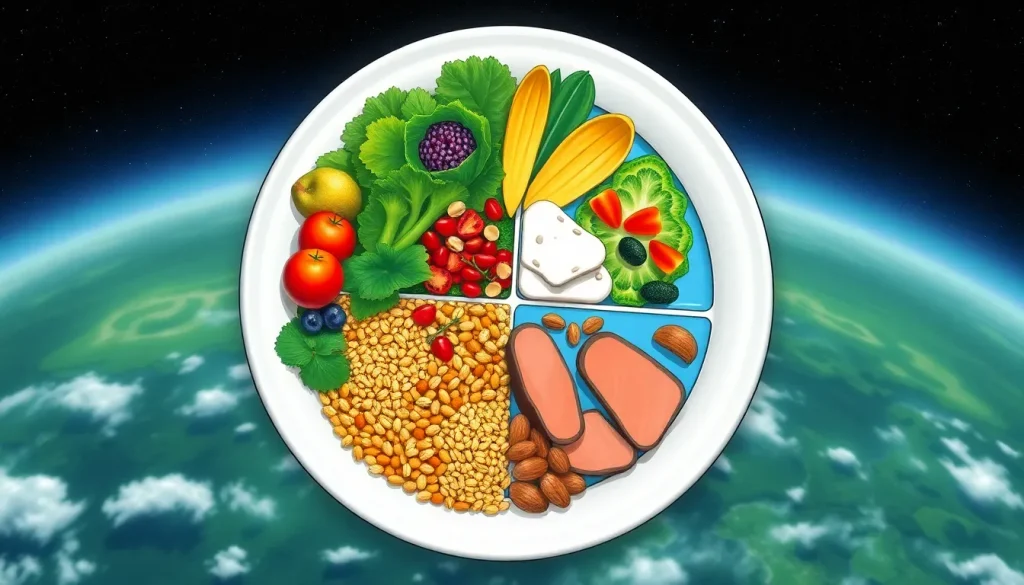
The commission proposed a “planetary health diet” that is largely plant-based, with optional modest amounts of animal-source foods. The daily reference diet (2500 kcal) includes:
- Vegetables (300 g) and fruits (200 g)
- Whole grains (232 g), tubers or starchy vegetables (50 g)
- Legumes (75 g), nuts (50 g)
- Dairy foods (250 g, whole milk equivalents)
- Protein sources: beef or lamb (14 g), pork (14 g), chicken (29 g), eggs (13 g), fish (28 g)
- Added fats: unsaturated oils (40 g), saturated oils (11.8 g), all sweeteners (31 g)
The modelling indicated that adopting this diet globally could prevent approximately 11 million premature deaths per year by 2050, mainly by reducing the incidence of diet-related diseases such as coronary heart disease, stroke, and diabetes. Environmentally, the shift would keep food production within a safe operating space: greenhouse gas emissions from food production would remain within the boundary of 5 Gt CO₂-equivalent per year; cropland use would stay within 13 million km²; freshwater use within 2,500 km³ per year; nitrogen and phosphorus application within 90 Tg N and 8 Tg P per year, respectively; and biodiversity loss rates would be reduced. The report also noted that current diets exceed several of these boundaries, and without change, the environmental impacts of the food system could increase by 50–90% by 2050.
What the findings do not prove
The study does not prove that the proposed diet is the only healthy and sustainable diet, nor that it is optimal for every individual or region. It does not demonstrate that global adoption is feasible or that the modelled health and environmental benefits would be fully realized in practice. The findings are based on modelled scenarios, not a controlled experiment, so they cannot establish causation. The report does not claim that all people must eat exactly the same foods; rather, it provides a reference framework that can be adapted to local contexts and cultures.
Limitations
The analysis has several important limitations. The dietary targets are based on global averages and do not account for regional differences in food availability, cultural preferences, or nutritional needs of specific populations (e.g., children, pregnant women). The health impact estimates rely on observational data, which can be confounded by other lifestyle factors. The environmental modelling assumes large-scale dietary shifts and does not fully address the socio-economic and political barriers to achieving such changes. The study also does not consider the potential impacts of climate change on future food production, nor does it model the economic costs of transitioning to the planetary health diet. Additionally, the reference diet provides only a single example of a healthy and sustainable eating pattern; other dietary compositions could also meet the goals.
How it compares with previous research
The EAT-Lancet report builds on a large body of previous research linking diets to health and environmental outcomes. Earlier studies, such as those by Tilman and Clark (2014) and Springmann et al. (2016), had already shown that shifting toward plant-based diets could reduce environmental pressures and improve health. The EAT-Lancet Commission integrated these findings into a comprehensive framework that simultaneously addresses multiple environmental boundaries and health targets. Unlike many previous studies that focused on single environmental dimensions (e.g., greenhouse gases), this report considered a full set of planetary boundaries. It also provided specific food-group targets, which had been lacking in earlier global dietary recommendations. The report’s conclusions align with the general direction of national dietary guidelines that encourage higher consumption of plant foods and limited intake of red and processed meats, but it goes further in quantifying environmental limits.
Why it matters
The EAT-Lancet report provides the first scientific targets for a global food system transformation that could achieve both human health and environmental sustainability. It offers a concrete, evidence-based reference diet that policymakers, industry, and civil society can use to guide food system reforms. The report has influenced international policy discussions, including the United Nations Food Systems Summit, and has spurred further research into sustainable diets. For the general public, it highlights the powerful role of dietary choices in shaping personal health and the planet’s future. However, the report also emphasizes that achieving this dietary shift requires systemic changes in food production, trade, and governance, not just individual behavior change.
Link to the primary paper
Willett W, Rockström J, Loken B, et al. Food in the Anthropocene: the EAT–Lancet Commission on healthy diets from sustainable food systems. The Lancet. 2019;393(10170):447-492. DOI: 10.1016/S0140-6736(18)31788-4.
FAQ
What is the planetary health diet?
The planetary health diet is a flexible eating pattern proposed by the EAT-Lancet Commission that emphasizes plant-based foods (vegetables, fruits, whole grains, legumes, nuts) and includes small, optional amounts of animal-source foods. It is designed to optimize human health while keeping food production within Earth's environmental limits.
How much meat does the planetary health diet allow?
The reference diet allows for modest amounts of animal protein: about 14 grams of beef or lamb per day, 14 grams of pork, 29 grams of chicken, and 28 grams of fish. This totals roughly 300 grams of meat per week, with red meat limited to about 100 grams per week. Eggs and dairy are also included in small quantities.
Is the planetary health diet suitable for everyone?
The diet is a global reference framework, not a one-size-fits-all prescription. It can be adapted to different cultural contexts, local food availability, and individual nutritional needs. However, the report acknowledges that specific populations (e.g., young children, pregnant women) may require modifications, and it does not address all micronutrient needs in detail.
References
- Willett W, Rockström J, Loken B, et al. Food in the Anthropocene: the EAT–Lancet Commission on healthy diets from sustainable food systems. The Lancet. 2019;393(10170):447-492.
- Tilman D, Clark M. Global diets link environmental sustainability and human health. Nature. 2014;515(7528):518-522.
- Springmann M, Godfray HCJ, Rayner M, Scarborough P. Analysis and valuation of the health and climate change cobenefits of dietary change. Proceedings of the National Academy of Sciences. 2016;113(15):4146-4151.
- Rockström J, Steffen W, Noone K, et al. A safe operating space for humanity. Nature. 2009;461(7263):472-475.
- Poore J, Nemecek T. Reducing food’s environmental impacts through producers and consumers. Science. 2018;360(6392):987-992.