In brief
At a glance
Quick Facts
- Atmospheric nitrogen (N₂)
- 78% of Earth's atmosphere, but unusable by most organisms.
- Key process for making nitrogen available
- Nitrogen fixation, performed by bacteria and archaea, converts N₂ to ammonia.
- Human-driven increase in reactive nitrogen
- Human activities have more than doubled the global production of reactive nitrogen compared to pre-industrial levels.
- Haber-Bosch process
- Industrial method to produce ammonia from N₂ and H₂, invented in the early 20th century, now sustains about half of global food production.
- Major greenhouse gas from nitrogen cycle
- Nitrous oxide (N₂O), with a global warming potential ~300 times that of CO₂ over 100 years.
- Primary source of N₂O emissions
- Agricultural soils, especially those receiving synthetic nitrogen fertilizers.
- Eutrophication cause
- Excess nitrogen and phosphorus runoff leading to algal blooms and oxygen-depleted dead zones.
- Denitrification
- Microbial conversion of nitrate back to N₂ gas, completing the cycle, but also producing N₂O as a byproduct.
Key Takeaways
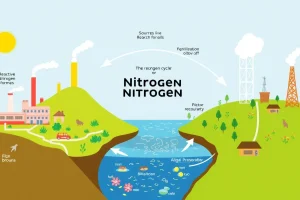
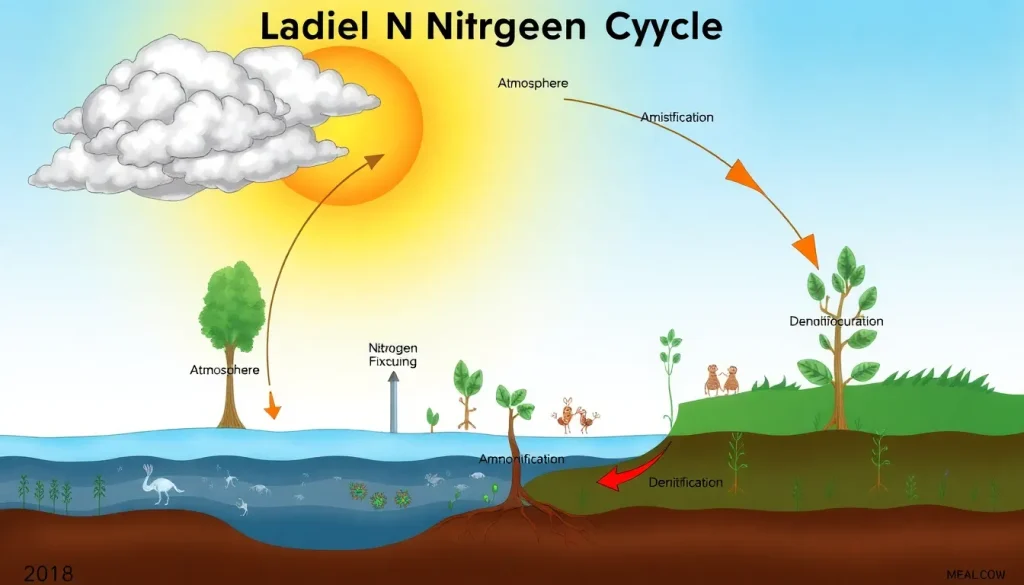
- The global nitrogen cycle is the continuous movement of nitrogen through the atmosphere, soil, water, and living organisms, involving transformations such as fixation, nitrification, assimilation, ammonification, and denitrification.
- Nitrogen is essential for all life forms as a building block of amino acids, proteins, and nucleic acids, but most organisms cannot use atmospheric nitrogen (N₂) directly.
- Human activities, particularly the industrial production of nitrogen fertilizers and the burning of fossil fuels, have doubled the amount of reactive nitrogen in the global cycle, causing severe environmental consequences.
- Excess reactive nitrogen contributes to water pollution (eutrophication), air pollution, soil acidification, ozone depletion, and climate change, making it one of the most significant human alterations of Earth’s natural systems.
What Is The Global Nitrogen Cycle Explained?
The global nitrogen cycle is the biogeochemical pathway through which nitrogen atoms circulate among the atmosphere, lithosphere, hydrosphere, and biosphere. Nitrogen is an essential element for all living organisms, as it is a fundamental component of amino acids, proteins, and nucleic acids (DNA and RNA). Despite its abundance—making up about 78% of Earth’s atmosphere—most of this nitrogen exists as inert dinitrogen gas (N₂), which is unavailable to the vast majority of organisms. The nitrogen cycle describes the natural processes that convert this inert gas into reactive forms that can be used by life, and then return it to the atmosphere, maintaining a balance that has sustained ecosystems for billions of years.
In its simplest form, the nitrogen cycle involves five main processes: nitrogen fixation, nitrification, assimilation, ammonification, and denitrification. These processes are driven by microorganisms, plants, animals, and physical phenomena such as lightning. The cycle operates on local, regional, and global scales, connecting the soil, water, and air. However, since the early 20th century, human activities have profoundly altered the nitrogen cycle, primarily through the industrial synthesis of ammonia for fertilizers and the combustion of fossil fuels. This has led to a cascade of environmental effects, making the nitrogen cycle one of the most disrupted of Earth’s fundamental biogeochemical cycles.
How It Works
The nitrogen cycle consists of several key steps that transform nitrogen from one chemical form to another, moving it through ecosystems. The primary processes are:
- Nitrogen Fixation: The conversion of inert atmospheric N₂ into ammonia (NH₃) or ammonium (NH₄⁺). This is carried out by nitrogen-fixing bacteria, either free-living in soil and water (e.g., Azotobacter) or in symbiotic relationships with plants (e.g., Rhizobium in legume root nodules). A smaller amount of fixation occurs through lightning strikes, which provide the energy to break N₂ bonds, and through industrial processes like the Haber-Bosch reaction.
- Nitrification: The biological oxidation of ammonia to nitrite (NO₂⁻) and then to nitrate (NO₃⁻) by specialized bacteria such as Nitrosomonas and Nitrobacter. Nitrate is the form most easily taken up by plants.
- Assimilation: Plants absorb nitrate (and to a lesser extent ammonium) from the soil and incorporate it into plant proteins and nucleic acids. Animals then obtain nitrogen by consuming plants or other animals.
- Ammonification: When organisms die or excrete waste, decomposers (bacteria and fungi) break down organic nitrogen compounds, releasing ammonium back into the soil.
- Denitrification: Under anaerobic conditions, denitrifying bacteria convert nitrate back into N₂ gas, returning it to the atmosphere and completing the cycle. This process is crucial for preventing the accumulation of fixed nitrogen in ecosystems.
- Anammox (Anaerobic Ammonium Oxidation): In marine and some soil environments, specialized bacteria oxidize ammonium with nitrite to produce N₂ gas, providing an alternative pathway for nitrogen removal.
These processes are interconnected and regulated by environmental factors such as oxygen availability, temperature, and pH. The balance between fixation and denitrification historically kept the global pool of reactive nitrogen relatively stable.
Importance and Impact
The nitrogen cycle is fundamental to life on Earth. Without the conversion of inert N₂ into reactive forms, primary productivity in most ecosystems would grind to a halt. Nitrogen is often the limiting nutrient in terrestrial and marine environments, meaning its availability controls the rate of plant growth and, by extension, the entire food web. Natural nitrogen fixation supplies the baseline fertility of soils and oceans, supporting wild ecosystems and traditional agriculture.
However, the massive human-driven increase in reactive nitrogen has had profound impacts. The invention of the Haber-Bosch process in the early 20th century allowed for the large-scale production of ammonia-based fertilizers, which now sustains roughly half of the global food supply. While this has enabled unprecedented population growth, it has also created a nitrogen surplus. Only a fraction of applied fertilizer is taken up by crops; the rest leaks into waterways, volatilizes into the air, or accumulates in soils. This excess reactive nitrogen cascades through the environment, causing a series of interconnected problems that affect human health, biodiversity, and climate.
Environmental and Human Impacts
The disruption of the nitrogen cycle has led to a range of environmental and human health issues:
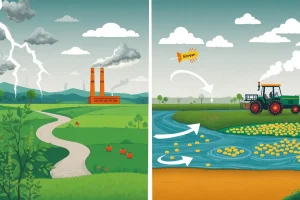
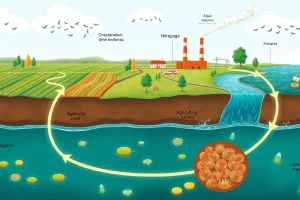
- Eutrophication: Excess nitrogen and phosphorus runoff from agricultural fields and urban areas stimulates algal blooms in lakes, rivers, and coastal waters. When these blooms die and decompose, they deplete oxygen, creating “dead zones” where aquatic life cannot survive. The Gulf of Mexico dead zone is a prominent example.
- Air Pollution: Ammonia volatilized from fertilizers and livestock waste contributes to the formation of fine particulate matter (PM2.5), which is harmful to human respiratory health. Nitrogen oxides (NOₓ) from combustion processes are precursors to ground-level ozone, a major component of smog.
- Acid Rain and Soil Acidification: NOₓ emissions react with water vapor to form nitric acid, contributing to acid deposition. Excess ammonium in soils can also lead to acidification through nitrification, harming forests and freshwater ecosystems.
- Climate Change: Nitrous oxide (N₂O) is a potent greenhouse gas, with a global warming potential nearly 300 times that of carbon dioxide over a 100-year period. It is produced naturally during nitrification and denitrification, but agricultural soils, especially those receiving nitrogen fertilizers, are the largest anthropogenic source.
- Stratospheric Ozone Depletion: N₂O is also the dominant ozone-depleting substance emitted in the 21st century, as it breaks down in the stratosphere to form nitric oxide, which catalyzes ozone destruction.
- Biodiversity Loss: Nitrogen deposition from the atmosphere can alter plant community composition, favoring nitrophilous species over those adapted to low-nitrogen conditions, leading to declines in biodiversity in sensitive habitats such as grasslands and heathlands.
Connections to Other Systems
The nitrogen cycle is tightly linked to other biogeochemical cycles, particularly the carbon, phosphorus, and water cycles. For example, nitrogen availability often limits the rate of photosynthesis and carbon sequestration in terrestrial and marine ecosystems. When excess nitrogen enters water bodies, it can stimulate algal growth that initially increases carbon uptake but ultimately leads to oxygen depletion and methane production. The phosphorus cycle is similarly intertwined, as both nitrogen and phosphorus are key limiting nutrients; their combined runoff exacerbates eutrophication. The water cycle transports nitrogen compounds through runoff, leaching, and atmospheric deposition, while soil moisture and hydrology control the redox conditions that govern nitrification and denitrification. Human alterations to one cycle inevitably ripple through others, creating complex feedback loops that are challenging to predict and manage.
Common Misconceptions
Several misconceptions about the nitrogen cycle are common:
- “The atmosphere is mostly nitrogen, so plants can use it directly.” In reality, the triple bond in N₂ makes it extremely stable and unusable by most organisms. Only nitrogen-fixing microbes possess the enzymes to break this bond.
- “Nitrogen is only a pollutant from farms.” While agriculture is a major source, fossil fuel combustion, industrial processes, and urban wastewater also contribute significantly to reactive nitrogen emissions.
- “All nitrogen in the environment is bad.” Reactive nitrogen is essential for life; the problem is the massive imbalance caused by human activities, not the element itself.
- “The nitrogen cycle is a closed loop.” While natural processes tend to balance fixation and denitrification over long timescales, human inputs have created a large surplus, and some nitrogen is buried in sediments or lost to the deep ocean, creating long-term imbalances.
Solutions
Addressing the disruption of the nitrogen cycle requires a multi-pronged approach that improves nitrogen use efficiency across agriculture, industry, and transportation. Key strategies include:
- Precision Agriculture: Using soil testing, variable-rate fertilizer application, and timing practices to match nitrogen supply with crop demand, reducing excess runoff and emissions.
- Improved Livestock Management: Better manure storage and application techniques, as well as dietary adjustments to reduce nitrogen excretion.
- Enhanced Wastewater Treatment: Upgrading treatment plants to remove nitrogen through nitrification-denitrification or anammox processes before discharge.
- Emission Controls: Installing catalytic converters on vehicles and scrubbers on industrial smokestacks to reduce NOₓ emissions.
- Dietary Shifts: Reducing overconsumption of animal protein, which has a high nitrogen footprint, can lower the demand for nitrogen-intensive feed crops.
- Policy and Regulation: Implementing nitrogen cap-and-trade systems, fertilizer taxes, or mandatory best management practices can incentivize reductions at scale.
- Restoration of Natural Sinks: Protecting and restoring wetlands, riparian buffers, and forests can enhance natural denitrification and nitrogen retention.
No single solution is sufficient; a combination of technological innovation, policy intervention, and behavioral change is needed to bring the nitrogen cycle back into a safer operating space for humanity.
FAQ
What is the global nitrogen cycle?
The global nitrogen cycle is the continuous movement of nitrogen through the atmosphere, soil, water, and living organisms, involving transformations such as fixation, nitrification, assimilation, ammonification, and denitrification. It is essential for life because nitrogen is a key component of proteins and DNA.
How does the nitrogen cycle work?
The cycle begins with nitrogen fixation, where bacteria convert atmospheric N₂ into ammonia. Nitrifying bacteria then convert ammonia to nitrite and nitrate, which plants absorb. Animals get nitrogen by eating plants or other animals. Decomposers return nitrogen to the soil as ammonium, and denitrifying bacteria convert nitrate back to N₂ gas, completing the cycle.
Why does the nitrogen cycle matter?
The nitrogen cycle is crucial because it controls the availability of a nutrient that limits plant growth in most ecosystems. Human disruption of the cycle through fertilizer use and fossil fuel burning has led to severe environmental problems, including water pollution, climate change, and biodiversity loss, making it a critical issue for sustainability.
References
- Schlesinger, W. H., & Bernhardt, E. S. (2013). Biogeochemistry: An Analysis of Global Change. Academic Press.
- Galloway, J. N., et al. (2004). Nitrogen cycles: past, present, and future. Biogeochemistry, 70(2), 153-226.
- IPCC (2013). Climate Change 2013: The Physical Science Basis. Contribution of Working Group I to the Fifth Assessment Report of the Intergovernmental Panel on Climate Change.