In brief
At a glance
Quick Facts
- Definition of genetic diversity
- The variety of genes within a species or population, including differences in DNA sequences and alleles.
- Definition of functional diversity
- The range and distribution of biological traits that influence how organisms affect ecosystem processes.
- Key difference
- Genetic diversity focuses on heritable variation, while functional diversity focuses on ecological roles and traits.
- Role in adaptation
- Genetic diversity enables populations to adapt to environmental changes through natural selection.
- Ecosystem impact
- Functional diversity is often a better predictor of ecosystem productivity and stability than species richness.
- Measurement
- Genetic diversity is measured using molecular markers; functional diversity is measured through trait-based indices.
- Conservation focus
- Modern conservation strategies increasingly emphasize preserving functional diversity to maintain ecosystem services.
- Relationship
- High genetic diversity does not always lead to high functional diversity, as many species may share similar traits.
Key Takeaways
- Genetic diversity is the variation in DNA within a species or population, while functional diversity measures the range of biological traits that affect ecosystem functioning.
- Genetic diversity provides the raw material for evolution and adaptation, whereas functional diversity directly influences ecosystem productivity, stability, and services.
- High genetic diversity does not always translate to high functional diversity, as many species may share similar functional roles.
- Conservation strategies increasingly prioritize functional diversity to maintain ecosystem processes under global change.
What Is Genetic Diversity vs Functional Diversity?
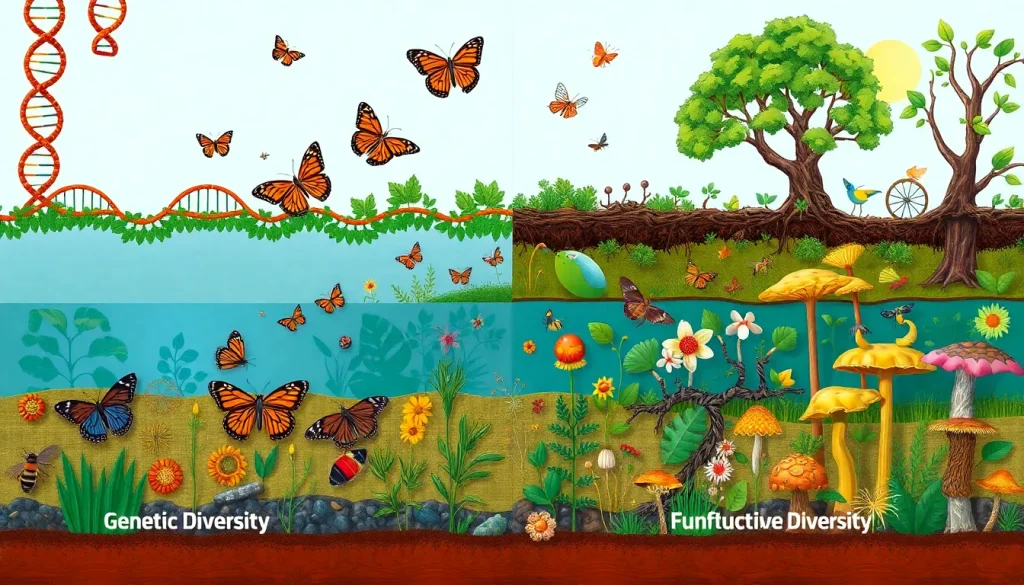
Genetic diversity and functional diversity are two distinct but interconnected concepts in biology and ecology. Genetic diversity refers to the total number of genetic characteristics in the genetic makeup of a species, population, or community. It includes variation in DNA sequences, alleles, and genes among individuals. This diversity is the foundation for natural selection and evolutionary adaptation, enabling populations to survive and thrive in changing environments. In contrast, functional diversity is a measure of the range and distribution of biological traits—such as morphological, physiological, or behavioral characteristics—that influence how organisms interact with their environment and contribute to ecosystem processes. Functional diversity focuses on what organisms do, rather than their taxonomic identity or genetic makeup.
While genetic diversity is often studied at the population or species level, functional diversity is typically assessed at the community or ecosystem level. For example, a forest may contain many tree species (high species richness), but if all trees have similar leaf traits, root depths, and growth rates, the functional diversity could be low. Conversely, a community with fewer species but a wide array of functional traits—such as nitrogen-fixing plants, deep-rooted shrubs, and fast-growing grasses—may exhibit high functional diversity. Understanding the distinction and relationship between these two types of diversity is critical for ecology, conservation biology, and ecosystem management.
Overview
Genetic diversity and functional diversity represent two complementary dimensions of biodiversity. Genetic diversity is the heritable variation within and between populations of organisms, encoded in the DNA. It is the ultimate source of biological diversity at all levels, from individual differences to species formation. Functional diversity, on the other hand, is a more recent concept that emerged from the recognition that species’ ecological roles—rather than their taxonomic identities—often determine ecosystem properties. It quantifies the diversity of functional traits, which are measurable characteristics that influence an organism’s performance, such as leaf nitrogen content, body size, or reproductive rate.
Both concepts are essential for understanding how biodiversity supports ecosystem functioning and resilience. Genetic diversity underpins the adaptive capacity of populations to environmental stressors like climate change, disease, and habitat fragmentation. Functional diversity, meanwhile, directly affects ecosystem processes such as nutrient cycling, primary productivity, and decomposition. While genetic diversity is often considered a prerequisite for functional diversity, the relationship is not always straightforward. A genetically diverse population may exhibit limited functional variation if all individuals share similar traits, and conversely, high functional diversity can arise from a few species with very different ecological strategies.
How It Works
Genetic diversity arises through mutations, gene flow, sexual reproduction, and genetic recombination. These processes introduce new alleles and combinations of genes, creating variation within a population. Natural selection then acts on this variation, favoring traits that enhance survival and reproduction in a given environment. Over time, genetic diversity can lead to speciation and the evolution of new functional traits. For example, genetic mutations in a plant population may produce individuals with deeper roots, allowing them to access water during droughts. If this trait is heritable, it can spread, increasing the population’s functional diversity in terms of drought tolerance.
Functional diversity is measured by identifying key functional traits and quantifying their distribution within a community. Traits are chosen based on their relevance to specific ecosystem processes. For instance, in plant communities, traits like specific leaf area, seed mass, and plant height are commonly used because they correlate with resource acquisition, growth, and competition. Functional diversity indices—such as functional richness, evenness, and divergence—capture different aspects of trait variation. These indices can then be linked to ecosystem functions like biomass production or nutrient retention. Unlike genetic diversity, which is often assessed using molecular markers, functional diversity relies on direct measurements of organismal traits.
Importance and Impact
Genetic diversity is crucial for the long-term survival of species. It enables populations to adapt to changing environmental conditions, resist diseases, and avoid inbreeding depression. In agriculture, genetic diversity within crop species and their wild relatives provides the raw material for breeding programs aimed at improving yield, pest resistance, and climate resilience. Loss of genetic diversity, often due to habitat destruction and overexploitation, can increase extinction risk and reduce the ability of species to cope with global change.
Functional diversity has a more immediate impact on ecosystem functioning and the services ecosystems provide to humanity. Ecosystems with high functional diversity tend to be more productive, stable, and resilient to disturbances. For example, a grassland with a mix of shallow- and deep-rooted plants can better capture water and nutrients, leading to higher overall productivity. Functional diversity also enhances ecosystem multifunctionality—the ability to simultaneously support multiple processes like carbon sequestration, pollination, and pest control. Declines in functional diversity can impair these services, with direct consequences for human well-being.
Examples
Coral reefs illustrate the interplay between genetic and functional diversity. Within a single coral species, genetic diversity can confer resistance to bleaching events caused by warming waters. At the community level, functional diversity among different coral species and associated organisms—such as herbivorous fish that control algae—maintains reef health and resilience. A reef with high functional diversity is better able to recover from disturbances and continue providing habitat and coastal protection.
In agricultural systems, genetic diversity within crop varieties is essential for breeding disease-resistant strains. However, functional diversity at the farm scale—achieved through intercropping, agroforestry, or maintaining pollinator habitats—can enhance pest control, soil fertility, and yield stability. For instance, planting a mix of legumes (which fix nitrogen) and cereals (which use that nitrogen) increases functional diversity and reduces the need for synthetic fertilizers. These examples show that both types of diversity are needed for sustainable ecosystems and food production.
Benefits, Limitations and Trade-offs
One benefit of focusing on genetic diversity is that it provides a direct measure of adaptive potential. Conservation programs often prioritize genetically distinct populations to preserve evolutionary heritage. However, genetic diversity can be expensive and time-consuming to measure, requiring molecular tools and large sample sizes. Moreover, high genetic diversity does not always translate into high functional diversity or ecosystem benefits, as many genes may be neutral or have no direct ecological effect.
Functional diversity offers a more mechanistic link to ecosystem processes, making it a powerful tool for ecosystem management and restoration. By targeting key functional traits, managers can design communities that deliver desired services, such as erosion control or water purification. However, functional diversity assessments depend on the choice of traits, which may not capture all relevant ecological functions. There is also a trade-off: maximizing functional diversity might sometimes conflict with preserving rare species that have unique genetic lineages but redundant functional roles. Balancing these two aspects is a key challenge in conservation planning.
Connections to Other Systems
Genetic and functional diversity are closely linked to other biodiversity concepts, such as species diversity and phylogenetic diversity. Species diversity—the number and abundance of species—often correlates with functional diversity, but the relationship can be weak if many species are functionally similar. Phylogenetic diversity, which measures the evolutionary history of a community, can serve as a proxy for both genetic and functional diversity, as distantly related species tend to have different traits. However, convergent evolution can lead to similar traits in unrelated species, complicating this relationship.
These diversity measures are also connected to ecosystem services and human well-being. For example, genetic diversity in wild crop relatives supports food security, while functional diversity of soil organisms drives nutrient cycling and soil fertility. Understanding these connections helps policymakers design integrated strategies for biodiversity conservation and sustainable development, such as the Convention on Biological Diversity’s targets and the United Nations Sustainable Development Goals.
FAQ
What is the difference between genetic diversity and functional diversity?
Genetic diversity is the variation in DNA within a species or population, while functional diversity is the variation in biological traits that affect ecosystem processes. Genetic diversity is about heredity and adaptation; functional diversity is about ecological roles.
Why is functional diversity important?
Functional diversity directly influences ecosystem functions like productivity, nutrient cycling, and resilience. It helps ecosystems maintain services even when species composition changes.
Can you have high genetic diversity but low functional diversity?
Yes. A population may have many genetic variants, but if all individuals share similar traits (e.g., same leaf shape or feeding habit), functional diversity can be low. Conversely, a few species with very different traits can create high functional diversity.
References
- Convention on Biological Diversity (CBD). Article 2: Use of Terms. https://www.cbd.int/convention/articles/?a=cbd-02
- Tilman, D. (2001). Functional diversity. In Encyclopedia of Biodiversity, Academic Press.
- Díaz, S., & Cabido, M. (2001). Vive la différence: plant functional diversity matters to ecosystem processes. Trends in Ecology & Evolution, 16(11), 646-655.