In brief
At a glance
Quick Facts
- Definition
- The use of sound recordings to monitor animal species and ecosystem health for conservation purposes.
- Key Technology
- Autonomous recording units (ARUs) and hydrophones that capture audio continuously or on a schedule.
- Primary Applications
- Species inventory, population monitoring, habitat assessment, and detecting human impacts like noise pollution.
- Commonly Monitored Taxa
- Birds, amphibians, insects, bats, and marine mammals.
- Analysis Methods
- Manual listening, spectrogram analysis, acoustic indices, and machine learning classification.
- Major Advantage
- Non-invasive, cost-effective, and capable of long-term, large-scale data collection.
- Key Limitation
- Cannot detect silent species; identification accuracy depends on reference call libraries.
- Data Output
- Audio files, spectrograms, species occurrence records, and acoustic diversity metrics.
Key Takeaways
- Bioacoustic monitoring uses sound recordings to non-invasively survey and track wildlife, providing a powerful tool for biodiversity conservation.
- It enables continuous, large-scale data collection across diverse habitats, often detecting species that are difficult to observe visually.
- Automated acoustic sensors and machine learning algorithms can process vast amounts of audio data, identifying species and monitoring ecosystem changes over time.
- While highly effective, bioacoustic monitoring faces challenges such as data storage, species identification accuracy, and the need for complementary methods to fully assess biodiversity.
What Is Bioacoustic Monitoring for Biodiversity Conservation?
Bioacoustic monitoring for biodiversity conservation is the systematic use of sound recordings to study and protect the variety of life in a given area. It involves capturing the acoustic signals produced by animals—such as bird songs, frog calls, insect stridulations, and marine mammal vocalizations—as well as the broader soundscape that includes geophysical (wind, rain) and anthropogenic (human-made) sounds. By analyzing these recordings, scientists can identify which species are present, estimate their abundance, track changes in behavior or distribution, and assess the overall health of an ecosystem.
This method falls under the broader field of ecoacoustics or soundscape ecology, which interprets acoustic patterns as indicators of ecological processes. Bioacoustic monitoring is particularly valuable for conservation because it is non-invasive, can operate continuously over long periods, and covers large or inaccessible areas. It provides a permanent record of the acoustic environment, allowing for repeated analysis and comparison across time, which is essential for detecting trends and evaluating the effectiveness of conservation interventions.
Overview
Bioacoustic monitoring has emerged as a vital tool in the conservation biologist’s toolkit, complementing traditional field surveys and remote sensing technologies. It leverages the fact that many animals produce species-specific sounds for communication, mating, territorial defense, and navigation. By deploying autonomous recording units (ARUs) in the field, researchers can collect thousands of hours of audio data without the constant presence of human observers, minimizing disturbance to wildlife and reducing survey costs. The resulting data can be analyzed manually, but increasingly, automated detection algorithms and machine learning models are used to process the recordings efficiently, identifying species and even individual animals.
The approach is used across terrestrial, freshwater, and marine environments. In forests, it helps monitor bird and primate populations; in wetlands, it tracks amphibian communities; in oceans, it records whale songs and dolphin clicks. Beyond species detection, bioacoustic monitoring can reveal information about ecosystem dynamics, such as the timing of breeding seasons, the impact of human noise pollution, and the recovery of habitats following restoration efforts. As technology advances, bioacoustic monitoring is becoming more accessible, enabling community-based conservation projects and large-scale biodiversity assessments.
How It Works
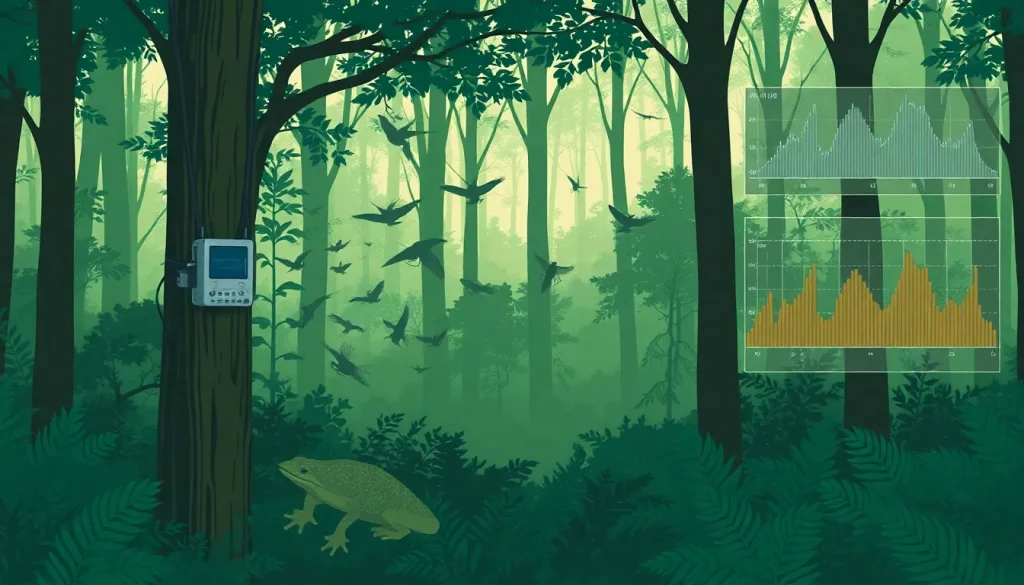
Bioacoustic monitoring typically involves three main stages: recording, processing, and analysis. In the recording stage, autonomous acoustic sensors or hydrophones are deployed in the field. These devices are programmed to record on a schedule, often capturing audio for a few minutes each hour to balance data collection with battery life and storage. The recordings are stored on memory cards and later retrieved, or in some advanced setups, transmitted wirelessly to a central database. The placement of recorders is strategic, considering factors like habitat type, target species, and the need to avoid overlapping coverage.
In the processing stage, the raw audio files are prepared for analysis. This may involve filtering out noise, segmenting long recordings into shorter clips, and converting audio into spectrograms—visual representations of sound frequencies over time. Analysis can be performed manually by experts who listen to recordings and identify species, but this is time-consuming. Increasingly, automated methods are used: acoustic indices (mathematical summaries of soundscape properties) provide rapid assessments of biodiversity, while machine learning models trained on labeled datasets can detect and classify specific sounds with high accuracy. The final output is a dataset of species occurrences, acoustic activity patterns, or indices of acoustic diversity that inform conservation decisions.
Importance and Impact
Bioacoustic monitoring has become indispensable for conservation because it addresses key limitations of traditional survey methods. Visual surveys are often labor-intensive, weather-dependent, and limited to diurnal species. In contrast, acoustic monitoring can operate day and night, in dense vegetation, and in remote or dangerous locations. It also provides a permanent, verifiable record that can be re-analyzed as new questions arise or as identification skills improve. This is especially important for monitoring cryptic or nocturnal species that are rarely seen.
The impact of bioacoustic monitoring is evident in its ability to detect rare and elusive species, track population trends, and assess the effectiveness of protected areas. For example, passive acoustic monitoring has been used to confirm the presence of critically endangered species like the Javan rhino and the ivory-billed woodpecker. It also plays a crucial role in monitoring the impacts of habitat fragmentation, climate change, and human disturbance on wildlife communities. By providing robust, long-term data, bioacoustic monitoring supports evidence-based conservation planning and policy-making.
Benefits, Limitations and Trade-offs
Bioacoustic monitoring offers several distinct benefits. It is non-invasive, reducing stress on animals and avoiding the need for capture or direct observation. It can cover large spatial scales and operate continuously, capturing data on rare or sporadic events that might be missed during periodic surveys. The method also generates a permanent audio archive that can be revisited for future studies, and automated analysis tools are increasingly making it cost-effective for long-term monitoring programs.
However, the approach has limitations. Not all species produce sounds, and some vocalize infrequently or at frequencies outside the range of standard equipment. Background noise from wind, rain, or human activities can mask target signals. Automated species identification, while improving, still requires extensive training data and may misidentify species with similar calls. Additionally, acoustic monitoring alone cannot provide information on population density, sex ratios, or individual health without supplementary methods. Data storage and management also present logistical challenges, as a single recorder can generate terabytes of audio over a year.
Examples
Bioacoustic monitoring has been applied successfully in diverse conservation contexts. In tropical forests, autonomous recording units have been used to monitor primate populations, detecting species like chimpanzees and howler monkeys through their loud calls. In temperate regions, passive acoustic monitoring tracks bird migration patterns and breeding phenology, providing early warnings of population declines. Marine bioacoustics uses hydrophone arrays to study whale songs and dolphin clicks, helping to map critical habitats and assess the impact of shipping noise.
One notable example is the use of acoustic monitoring in amphibian conservation. Frogs and toads are highly vocal and sensitive to environmental changes, making them excellent bioindicators. Large-scale projects like the North American Amphibian Monitoring Program rely on volunteer-collected audio recordings to track population trends across the continent. Similarly, in tropical rainforests, acoustic sensors have been deployed to monitor the recovery of biodiversity in regenerating forests, revealing that vocalizing species return relatively quickly after restoration efforts.
Data Limitations and Uncertainties
Despite its promise, bioacoustic monitoring faces significant data challenges. The accuracy of species identification depends on the quality of reference call libraries, which are incomplete for many regions and taxa. Automated classifiers may produce false positives or miss rare species, leading to biased biodiversity estimates. Acoustic indices, while useful for rapid assessment, can be influenced by non-biological sounds and do not always correlate strongly with traditional measures of species richness.
There is also uncertainty in interpreting acoustic data in terms of population size or density. A single vocalizing individual may be recorded multiple times, and some species call more frequently than others, skewing activity indices. Furthermore, the relationship between acoustic diversity and overall biodiversity is not always straightforward, as many organisms (e.g., plants, insects, soil fauna) do not produce detectable sounds. Thus, bioacoustic monitoring is best used as part of a multi-faceted monitoring strategy that includes visual surveys, camera traps, and environmental DNA sampling.
FAQ
What is bioacoustic monitoring?
Bioacoustic monitoring is a method that uses sound recordings to study wildlife and ecosystems. It involves placing microphones or hydrophones in the environment to capture animal vocalizations and other sounds, which are then analyzed to identify species, track populations, and assess habitat health.
How does bioacoustic monitoring work?
Autonomous recording devices are deployed in the field to capture audio on a set schedule. The recordings are processed—often using software to create spectrograms—and analyzed either manually by experts or automatically with machine learning algorithms that can detect and classify species-specific sounds. The results provide data on species presence, activity patterns, and acoustic diversity.
Why does bioacoustic monitoring matter for conservation?
It provides a non-invasive, cost-effective way to monitor biodiversity over large areas and long time periods. This helps conservationists detect rare species, track population changes, evaluate the success of protected areas, and understand the impacts of human activities like habitat loss and noise pollution, ultimately guiding better conservation decisions.
References
- Sueur, J., Farina, A., Gasc, A., Pieretti, N., & Pavoine, S. (2014). Acoustic indices for biodiversity assessment and landscape investigation. Acta Acustica united with Acustica, 100(4), 772-781.
- Browning, E., Gibb, R., Glover-Kapfer, P., & Jones, K. E. (2017). Passive acoustic monitoring in ecology and conservation. WWF Conservation Technology Series, 1(2).
- Krause, B., & Farina, A. (2016). Using ecoacoustic methods to survey the impacts of climate change on biodiversity. Biological Conservation, 195, 245-254.