In brief
At a glance
Quick Facts
- Definition
- Degrowth is a planned reduction of resource and energy use to achieve sustainability and well-being.
- Origin
- The term 'décroissance' emerged in France in the 1970s as a critique of consumer society.
- Key Thinkers
- Nicholas Georgescu-Roegen, Serge Latouche, and Tim Jackson are prominent degrowth advocates.
- Core Principle
- Degrowth challenges the GDP growth imperative, advocating for a steady-state economy.
- Proposals
- Common proposals include work-time reduction, universal basic income, and local currencies.
- Criticism
- Critics argue degrowth could lead to economic collapse and ignores technological solutions.
- Environmental Goal
- Degrowth aims to reduce material throughput to stay within planetary boundaries.
- Social Goals
- It emphasizes well-being, equity, and democratic decision-making over consumption.
Key Takeaways
- Degrowth is a planned reduction of material and energy throughput to achieve ecological sustainability and enhance human well-being, challenging the paradigm of perpetual economic growth.
- It is rooted in ecological economics and critiques the GDP growth imperative, arguing that infinite growth is impossible on a finite planet.
- Proposals include reducing working hours, implementing a universal basic income, promoting local production, and shifting from consumerism to sufficiency.
- Critics contend that degrowth could lead to economic instability, unemployment, and reduced living standards, and that technological innovation can decouple growth from environmental harm.
What Is Degrowth: Principles, Proposals and Criticism?
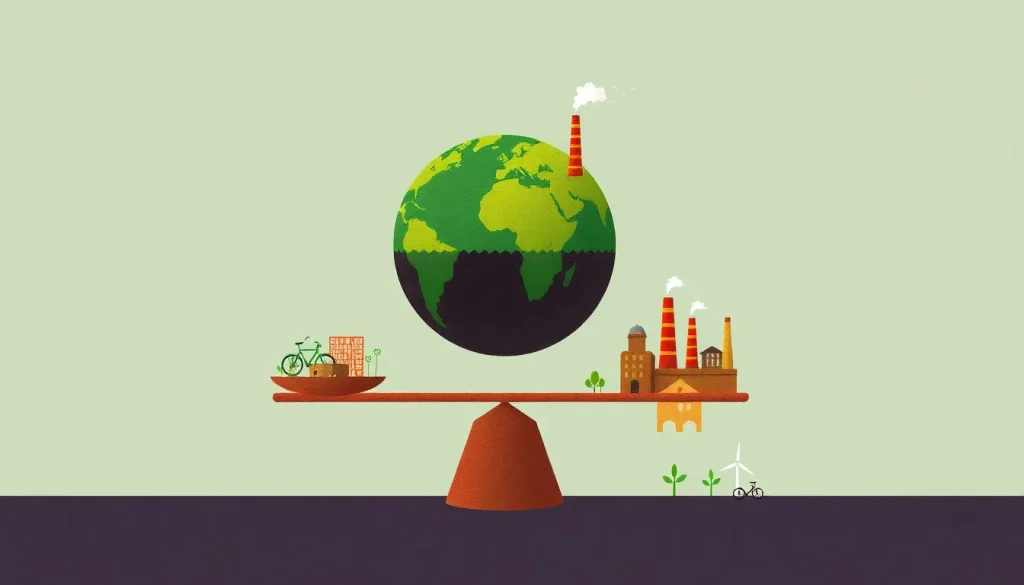
Degrowth is a socio-economic and political concept that advocates for a deliberate, equitable, and democratic reduction of material and energy throughput in wealthy nations, with the aim of achieving ecological sustainability, social justice, and improved well-being. It challenges the core assumption of modern economies—that continuous economic growth, as measured by Gross Domestic Product (GDP), is both necessary and desirable. Instead, degrowth proposes that societies in the Global North must downscale their production and consumption to remain within planetary boundaries, while simultaneously redistributing resources to ensure a good life for all within the Earth’s limits.
The term “degrowth” (from the French “décroissance”) is not merely a call for economic contraction; it is a comprehensive framework that integrates ecological, social, cultural, and political dimensions. It critiques the growth imperative as ecologically destructive, socially unjust, and ultimately unsustainable. Degrowth is not a recession—an unplanned and harmful economic downturn—but a planned, selective, and equitable reduction of resource use, coupled with a shift in values away from consumerism and towards sufficiency, conviviality, and care. The concept has gained traction in academic and activist circles as a response to the intertwined crises of climate change, biodiversity loss, resource depletion, and social inequality.
Overview
Degrowth is both a critical analysis and a constructive vision. As a critique, it targets the ideology of growthism—the belief that economic growth is always good, necessary, and the solution to all societal problems. Proponents argue that growth, as measured by GDP, conflates beneficial activities (like healthcare and education) with harmful ones (like pollution cleanup and arms production), and ignores the depletion of natural capital. Moreover, they point to evidence that beyond a certain threshold, further GDP growth does not increase subjective well-being in wealthy countries (the Easterlin paradox). As a vision, degrowth outlines a transition to a society that is smaller in terms of material and energy use but richer in terms of relationships, leisure, and democratic participation.
The degrowth movement is diverse, encompassing various strands such as anti-capitalism, eco-feminism, anti-utilitarianism, and grassroots democracy. It draws on ecological economics, which recognizes that the economy is a subsystem of the finite biosphere and must respect its limits. Key principles include: reducing the overall material and energy throughput of the economy; redistributing wealth and resources more equitably within and between countries; and reorganizing society around values of conviviality, autonomy, and care, rather than consumerism and productivity. Degrowth is not a one-size-fits-all blueprint but a call for a democratic debate on how to achieve a prosperous life without growth.
History
The intellectual roots of degrowth can be traced back to the 1970s, particularly to the work of Romanian economist Nicholas Georgescu-Roegen, who applied the laws of thermodynamics to economics and argued that the economy inevitably consumes low-entropy matter and energy, producing high-entropy waste. His 1971 book “The Entropy Law and the Economic Process” laid the foundation for ecological economics and the concept of a steady-state economy. The term “décroissance” (degrowth) was first used in a political context by French intellectuals in the early 1970s, notably by André Gorz, who questioned whether a growth-based economy was compatible with ecological balance. The 1972 report “The Limits to Growth” by the Club of Rome, which used computer modeling to project the consequences of exponential growth on a finite planet, further fueled the debate.
The degrowth movement gained momentum in the early 2000s, particularly in France, Italy, and Spain, with the formation of activist networks and academic conferences. The first international degrowth conference was held in Paris in 2008, and subsequent conferences have expanded the discourse globally. Key figures include Serge Latouche, who popularized the term in France with his book “Farewell to Growth,” and Tim Jackson, whose “Prosperity Without Growth” brought the debate to a wider English-speaking audience. The movement has since diversified, incorporating insights from political ecology, environmental justice, and post-development theory, and has influenced policy discussions on well-being indicators and green transitions.
How It Works
Degrowth operates on multiple levels: theoretical, practical, and political. Theoretically, it deconstructs the growth paradigm and proposes alternative metrics of progress, such as the Genuine Progress Indicator (GPI) or the Happy Planet Index, which account for environmental and social factors. Practically, it involves a set of concrete proposals aimed at reducing resource use while improving quality of life. These proposals are often categorized into three pillars: reduction, redistribution, and reorganization.
Reduction entails scaling down ecologically harmful and socially unnecessary production and consumption. This includes measures like planned obsolescence bans, advertising restrictions, and caps on resource extraction. Redistribution involves sharing work and wealth more equitably, for example through work-time reduction (e.g., a four-day work week), job guarantees, and progressive taxation. Reorganization focuses on transforming the economic system from the ground up, promoting local and cooperative enterprises, community currencies, food sovereignty, and the commons. A key mechanism is the concept of “selective degrowth,” where certain sectors (like fossil fuels, fast fashion, and industrial agriculture) are deliberately shrunk, while others (like renewable energy, public transit, care work, and education) are expanded. The process is envisioned as a democratic and participatory transition, not a top-down imposition.
Environmental and Human Impacts
The primary environmental goal of degrowth is to reduce humanity’s ecological footprint to within planetary boundaries. By lowering material and energy throughput, degrowth directly addresses climate change, biodiversity loss, deforestation, and pollution. Research suggests that absolute decoupling—separating economic growth from environmental impact at the required scale and speed—has not been achieved historically and is unlikely to be feasible in the future. Therefore, degrowth advocates argue that a planned reduction in resource use is necessary to avoid ecological collapse. This would involve a significant decrease in carbon emissions, material extraction, and waste generation, particularly in high-income countries.
On the human side, degrowth aims to improve well-being by shifting the focus from material consumption to non-material sources of satisfaction, such as community, leisure, and meaningful work. Studies in happiness economics indicate that beyond a certain income level, additional wealth contributes little to subjective well-being. By reducing working hours, people would have more time for family, civic engagement, and personal development. A universal basic income or services could provide security and reduce the need for resource-intensive growth to maintain employment. However, the transition could also have negative impacts if not managed carefully, such as job losses in declining sectors and potential social unrest. Proponents emphasize the need for a just transition with strong social safety nets.
Benefits, Limitations and Trade-offs
The potential benefits of degrowth are substantial. Ecologically, it offers a pathway to sustainability that does not rely on uncertain technological breakthroughs. Socially, it could reduce inequality, improve work-life balance, and foster stronger communities. Economically, it could increase resilience by reducing dependence on global supply chains and volatile resource markets. By prioritizing care work and the commons, degrowth could also address gender and social inequities. Furthermore, it encourages a cultural shift away from consumerism, which is linked to mental health issues and social isolation.
However, degrowth faces significant limitations and trade-offs. The most common criticism is that it could lead to economic instability, rising unemployment, and a decline in living standards, particularly if implemented abruptly or without international coordination. Critics argue that in a growth-dependent capitalist system, degrowth would trigger a downward spiral of falling investment, tax revenues, and public services. There is also the challenge of political feasibility: degrowth policies are often unpopular because they challenge deeply held aspirations for material prosperity. Additionally, degrowth in wealthy countries could have negative spillover effects on developing economies that rely on exports to these markets. Proponents counter that these risks can be mitigated through careful planning, international cooperation, and a focus on well-being rather than GDP. Another trade-off is the potential tension between individual freedoms and collective goals; degrowth may require restrictions on certain choices (like flying or meat consumption) that could be perceived as authoritarian.
Common Misconceptions
One common misconception is that degrowth is synonymous with recession or economic collapse. In reality, degrowth is a planned and selective reduction, not an uncontrolled downturn. It aims to improve well-being while reducing throughput, whereas a recession typically increases suffering and inequality. Another misconception is that degrowth advocates for a return to pre-industrial living standards or a rejection of all technology. Most degrowth proponents support appropriate technology and innovation, but they prioritize technologies that reduce resource use and enhance conviviality, such as renewable energy and public transit, over those that fuel consumerism.
Some critics claim that degrowth ignores the needs of the Global South, where economic growth is still necessary to lift people out of poverty. Degrowth advocates clarify that the call for degrowth is primarily directed at wealthy, overconsuming nations, and that it must be accompanied by a global redistribution of resources and a recognition of ecological debt. The goal is not to halt development in poorer countries but to allow them to develop sustainably while the North reduces its excessive consumption. Finally, degrowth is sometimes dismissed as utopian or unrealistic. While the political and economic barriers are formidable, proponents argue that the current growth-dependent system is itself unrealistic in the long term, as it undermines the ecological conditions for human civilization. They point to grassroots experiments and policy proposals that demonstrate the viability of degrowth principles on a smaller scale.
FAQ
What is degrowth?
Degrowth is a planned, equitable reduction of material and energy use in wealthy nations to achieve ecological sustainability and improve well-being, challenging the idea that endless economic growth is necessary or possible.
How does degrowth differ from a recession?
A recession is an unplanned economic contraction that typically causes hardship and inequality. Degrowth is a deliberate, selective, and democratic process aimed at reducing resource throughput while enhancing quality of life, not a crash.
Why is degrowth considered necessary by its proponents?
Proponents argue that infinite growth on a finite planet is impossible, and that current levels of consumption in wealthy countries exceed planetary boundaries. Degrowth is seen as a way to avoid ecological collapse and create a more just and sustainable society.
References
- D'Alisa, G., Demaria, F., & Kallis, G. (Eds.). (2014). Degrowth: A Vocabulary for a New Era. Routledge.
- Jackson, T. (2009). Prosperity Without Growth: Economics for a Finite Planet. Earthscan.
- Meadows, D. H., Meadows, D. L., Randers, J., & Behrens III, W. W. (1972). The Limits to Growth. Universe Books.