In brief
At a glance
Quick Facts
- Definition
- Net difference between absorbed solar energy and emitted thermal energy.
- Current imbalance
- Approximately 0.5–1.0 W/m² (positive, meaning Earth gains heat).
- Primary cause
- Increased greenhouse gases from human activities.
- Measurement
- Via satellite radiometers (e.g., CERES) and ocean heat content.
- Ocean storage
- Over 90% of excess heat is absorbed by the ocean.
- Consequence
- Drives global warming, sea level rise, and climate extremes.
Key Takeaways
- Earth’s energy imbalance (EEI) is the net difference between the solar energy absorbed by the Earth system and the thermal energy radiated back to space.
- A persistent positive imbalance, currently estimated at 0.5–1.0 watts per square meter, means the planet is accumulating heat, which is the fundamental driver of global warming.
- Over 90% of this excess energy is stored in the ocean, leading to ocean warming, thermal expansion, and sea level rise.
- Monitoring EEI is essential for understanding past climate change, projecting future warming, and evaluating the effectiveness of climate mitigation efforts.
What Is Earth’s Energy Imbalance?
Earth’s energy imbalance is the net difference between the amount of incoming solar radiation absorbed by the Earth system and the amount of outgoing longwave (thermal) radiation emitted back to space. In a stable climate, these two energy flows are equal, and the planet’s average temperature remains constant. When the balance is disrupted—such as by an increase in greenhouse gases—the system retains more energy than it loses, resulting in a positive imbalance and a warming planet.
This concept is central to climate science because it quantifies the rate at which the Earth is heating up. The imbalance is expressed in watts per square meter (W/m²) of the Earth’s surface. A positive value indicates net energy gain; a negative value would indicate net cooling. Since at least the mid-20th century, satellite and ocean measurements have consistently shown a positive imbalance, confirming that the Earth system is accumulating energy due to human activities. The imbalance is not static; it varies with natural phenomena like volcanic eruptions and solar cycles, but the long-term trend is clearly upward.
How It Works
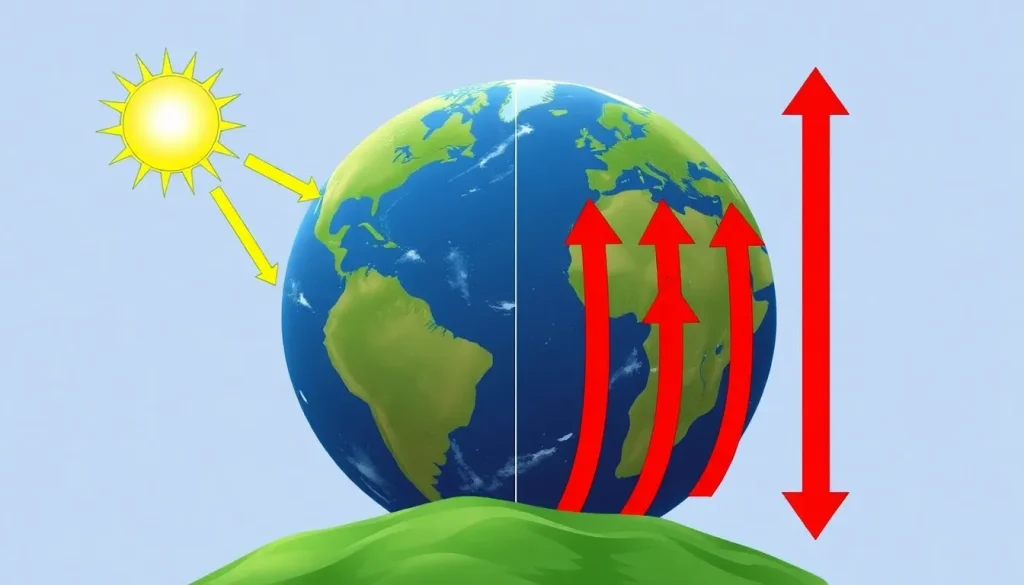
The Earth’s energy budget is governed by the laws of physics. The Sun delivers energy primarily as visible and ultraviolet light. About 30% of this incoming solar radiation is reflected back to space by clouds, atmospheric particles, and bright surfaces (the albedo effect). The remaining 70% is absorbed by the atmosphere, land, and oceans. To maintain equilibrium, the Earth must radiate an equal amount of energy back to space in the form of infrared radiation.
Greenhouse gases in the atmosphere—such as carbon dioxide, methane, and water vapor—absorb some of the outgoing infrared radiation and re-emit it in all directions, including back toward the surface. This natural greenhouse effect keeps Earth habitable. However, human activities have increased the concentration of these gases, enhancing the trapping of heat. As a result, less heat escapes to space, and the planet warms until a new, higher-temperature equilibrium is reached. The energy imbalance is the temporary gap between absorbed and emitted radiation while the climate system adjusts.
Measuring the imbalance directly is challenging because the net flux is a small residual of two large numbers (incoming ~340 W/m², outgoing ~339.5 W/m²). Scientists use satellite radiometers to measure top-of-atmosphere radiation and ocean heat content measurements to track where the excess energy goes. The ocean absorbs over 90% of the excess heat, with smaller fractions going into melting ice, warming the land, and heating the atmosphere.
Main Causes or Drivers
The primary driver of the current positive energy imbalance is the increase in atmospheric greenhouse gas concentrations due to human activities. Burning fossil fuels, deforestation, and industrial processes release carbon dioxide (CO₂), methane (CH₄), nitrous oxide (N₂O), and other heat-trapping gases. These gases enhance the natural greenhouse effect, reducing the amount of outgoing infrared radiation and causing a net energy gain.
Other factors also influence the imbalance. Changes in solar irradiance have a minor effect compared to greenhouse gases. Aerosols (tiny particles from pollution and volcanic eruptions) can reflect sunlight and cool the planet, partially offsetting the warming. However, as aerosol emissions are reduced for air quality reasons, their masking effect diminishes, potentially revealing more of the underlying greenhouse gas warming. Land-use changes, such as deforestation, alter surface reflectivity and can contribute to the imbalance. Overall, the net radiative forcing from human activities is strongly positive, driving the energy imbalance.
What the Evidence Shows
Multiple independent lines of evidence confirm a persistent positive Earth energy imbalance. Satellite instruments, such as the Clouds and the Earth’s Radiant Energy System (CERES) on NASA’s Terra and Aqua satellites, have measured top-of-atmosphere radiation fluxes since the early 2000s. These measurements show that Earth is absorbing more energy than it emits, with the imbalance growing over time as greenhouse gas concentrations rise.
Ocean heat content measurements provide complementary evidence. A global network of Argo floats, along with ship-based observations, has documented a steady increase in ocean heat content from the surface to depths of 2,000 meters. This ocean warming accounts for the vast majority of the excess energy. Additionally, rising global surface temperatures, melting glaciers and ice sheets, and increasing sea levels all corroborate the existence of a sustained energy imbalance. Paleoclimate records show that such imbalances have occurred in the past, but the current rate of change is unprecedented in recent Earth history.
Environmental and Human Impacts
The consequences of Earth’s energy imbalance are far-reaching. As the planet accumulates heat, global average temperatures rise, leading to more frequent and intense heatwaves, altered precipitation patterns, and shifts in climate zones. The warming ocean expands, contributing to sea level rise, while melting ice sheets and glaciers add further water to the oceans. This threatens coastal communities, ecosystems, and infrastructure.
Ocean warming also affects marine life, causing coral bleaching, disrupting fisheries, and altering ocean circulation. The extra energy in the climate system intensifies storms and increases the likelihood of extreme weather events. On land, heat stress impacts agriculture, water resources, and human health. Even if greenhouse gas emissions were to cease immediately, the existing energy imbalance would continue to warm the planet for decades due to the thermal inertia of the oceans, committing the world to further climate change.
Solutions
Addressing Earth’s energy imbalance requires reducing the net radiative forcing, primarily by lowering greenhouse gas concentrations. The most direct solution is to drastically cut emissions of CO₂ and other heat-trapping gases through a transition to renewable energy, energy efficiency, electrification of transport, and sustainable land use. Carbon dioxide removal (CDR) techniques, such as reforestation, soil carbon sequestration, and direct air capture, can help draw down atmospheric CO₂ and reduce the imbalance over time.
Some proposed geoengineering approaches, like solar radiation management (SRM), aim to temporarily offset the imbalance by reflecting more sunlight back to space—for example, by injecting aerosols into the stratosphere. However, these methods do not address the root cause (greenhouse gas accumulation) and carry significant risks and uncertainties, including potential disruptions to regional weather patterns and the possibility of rapid warming if deployment is halted. Therefore, mitigation through emission reductions remains the primary and safest long-term solution.
FAQ
What is Earth’s energy imbalance?
It is the difference between the amount of solar energy Earth absorbs and the amount of heat it radiates back to space.
How does Earth’s energy imbalance work?
Incoming sunlight is absorbed by the surface and atmosphere; Earth emits infrared radiation. Greenhouse gases trap some outgoing heat, causing a net energy gain.
Why does Earth’s energy imbalance matter?
It is the direct driver of global warming, ocean heating, ice melt, and sea level rise, making it a key indicator of climate change.
References
- IPCC Sixth Assessment Report, Working Group I: The Physical Science Basis (2021)
- Trenberth, K. E., Fasullo, J. T., & Balmaseda, M. A. (2014). Earth’s energy imbalance. Journal of Climate.
- NASA Earth Observatory: Earth’s Energy Budget