In brief
At a glance
Quick Facts
- Journal / venue
- Ecosystem Services
- Authors
- Wood et al. (2018)
- Publication date
- February 2018
- Study type
- Conceptual framework / review
- Peer-reviewed
- Yes
- DOI / link
- 10.1016/j.ecoser.2017.12.003
Study in one sentence
This study proposes a conceptual framework that positions healthy ecosystems as a form of public health infrastructure, systematically linking ecosystem services to health outcomes and advocating for their integration into public health policy and planning.
Publication and date
The paper was published in the peer-reviewed journal Ecosystem Services in 2018. The authors are Wood, S.L.R., Jones, S.K., Johnson, J.A., Brauman, K.A., Chaplin-Kramer, R., Fremier, A., Girvetz, E., Gordon, L.J., Kappel, C.V., Mandle, L., Mulligan, M., O’Farrell, P., Smith, W.K., Willemen, L., Zhang, W., and DeClerck, F.A.
Research question
The study set out to answer: How can ecosystem services be systematically integrated into public health frameworks, and what are the pathways through which healthy ecosystems function as public health infrastructure?
Method
This is a conceptual framework paper. The authors conducted a synthesis of existing literature on ecosystem services and public health, drawing on the Millennium Ecosystem Assessment classification and the World Health Organization’s definition of health. They developed a logic model that maps ecosystem services (provisioning, regulating, cultural, and supporting) to health determinants and health outcomes. The framework was refined through expert consultation and iterative discussion among the interdisciplinary author team, which included ecologists, public health researchers, and policy experts. No primary data collection or quantitative analysis was performed.
Main findings
The paper presents a framework that categorizes the contributions of healthy ecosystems to public health into four main pathways:
- Provisioning services – supply of food, fresh water, and medicinal resources, which directly affect nutrition and physical health.
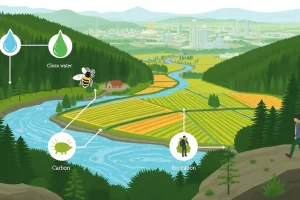
- Regulating services – control of infectious diseases, air quality regulation, water purification, and climate regulation, which reduce exposure to harmful agents and mitigate health risks.
- Cultural services – recreational opportunities, spiritual enrichment, and aesthetic benefits that support mental and social well-being.
- Supporting services – soil formation, nutrient cycling, and primary production that underpin all other services and long-term health resilience.
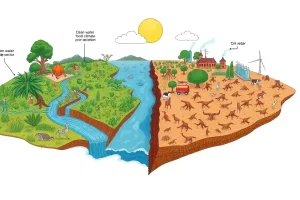
The framework emphasizes that these services collectively function as a form of infrastructure, analogous to built infrastructure like hospitals and water treatment plants, but often unrecognized in public health budgets and planning. The authors argue that maintaining and restoring ecosystems can be a cost-effective public health investment.
What the findings do not prove
This study does not provide empirical evidence of specific health improvements from ecosystem interventions, nor does it quantify the magnitude of health benefits. It does not establish causal relationships between particular ecosystem changes and health outcomes. The framework is a conceptual tool and does not prove that treating ecosystems as infrastructure will lead to better health outcomes in all contexts. It also does not address the economic valuation of health benefits or compare the cost-effectiveness of ecosystem-based approaches to traditional public health interventions.
Limitations
As a conceptual paper, the study does not include empirical validation or case studies. The framework is broad and may oversimplify complex ecological and social interactions. The pathways from ecosystem services to health outcomes are often indirect and influenced by many confounding factors (e.g., socioeconomic status, access to healthcare), which the framework acknowledges but does not fully model. The paper is based on existing literature and expert opinion, which may introduce bias. The framework’s applicability may vary across different geographic and cultural contexts, and it does not provide specific implementation guidelines.
How it compares with previous research
The study builds on earlier work linking ecosystems and human health, such as the Millennium Ecosystem Assessment (2005) and the World Health Organization’s reports on environmental health. It extends the concept of “ecological public health” by explicitly framing ecosystems as infrastructure, a term more familiar to policy-makers and planners. Unlike many previous studies that focus on single ecosystem services or health outcomes, this framework provides a comprehensive, multi-pathway model. It aligns with the growing literature on nature-based solutions and planetary health but is distinct in its emphasis on integrating ecosystem services into public health systems rather than treating them as separate environmental interventions.
Why it matters
This framework offers a practical tool for public health officials, urban planners, and conservationists to recognize and incorporate the health benefits of ecosystems into policy and investment decisions. By framing ecosystems as infrastructure, it encourages cross-sectoral collaboration and funding mechanisms that have traditionally been siloed. The study highlights that protecting and restoring ecosystems can be a proactive public health strategy, potentially reducing disease burdens and healthcare costs while also addressing environmental degradation. It provides a foundation for future empirical research and for integrating ecosystem health indicators into public health surveillance systems.
Link to the primary paper
Wood, S. L. R., Jones, S. K., Johnson, J. A., Brauman, K. A., Chaplin-Kramer, R., Fremier, A., Girvetz, E., Gordon, L. J., Kappel, C. V., Mandle, L., Mulligan, M., O’Farrell, P., Smith, W. K., Willemen, L., Zhang, W., & DeClerck, F. A. (2018). Healthy ecosystems as public health infrastructure: A framework for integrating ecosystem services into public health. Ecosystem Services, 29, 70-82. https://doi.org/10.1016/j.ecoser.2017.12.003
FAQ
What does it mean to treat ecosystems as public health infrastructure?
It means recognizing that natural systems like forests, wetlands, and parks provide essential services—clean air, water filtration, disease regulation—that directly support human health, similar to built infrastructure like hospitals and water treatment plants. This framing encourages investment in ecosystem conservation and restoration as a public health strategy.
Is this framework based on real-world data?
No, this paper is a conceptual framework, not an empirical study. It synthesizes existing knowledge to propose a model for integrating ecosystem services into public health planning. It does not present new data or quantitative health outcomes.
How can this framework be used in practice?
Public health officials and urban planners can use the framework to identify which ecosystem services are most relevant to local health priorities, incorporate green spaces into health impact assessments, and justify funding for ecosystem restoration as a health intervention. It also provides a common language for cross-sector collaboration.
References
- Wood, S. L. R., et al. (2018). Healthy ecosystems as public health infrastructure: A framework for integrating ecosystem services into public health. Ecosystem Services, 29, 70-82.
- Millennium Ecosystem Assessment (2005). Ecosystems and Human Well-being: Synthesis. Island Press.
- World Health Organization (2016). Preventing disease through healthy environments: a global assessment of the burden of disease from environmental risks.
- Frumkin, H., et al. (2017). Nature contact and human health: A research agenda. Environmental Health Perspectives, 125(7), 075001.
- Raymond, C. M., et al. (2017). A framework for assessing and implementing the co-benefits of nature-based solutions in urban areas. Environmental Science & Policy, 77, 15-24.