In brief
At a glance
Quick Facts
- Definition
- EROI is the ratio of usable energy obtained from a resource to the energy expended to obtain it.
- Formula
- EROI = Energy Output / Energy Input.
- Break-even point
- An EROI of 1:1 means no net energy gain; below 1 is an energy sink.
- Historical oil EROI
- Early 20th century oil had an EROI of about 100:1; today it is often 10–20:1.
- Renewable EROI
- Wind and solar PV typically have EROIs between 8 and 20, depending on technology and location.
- Net energy cliff
- As EROI declines below about 5–10, the energy surplus for society shrinks dramatically.
- Key metric
- EROI is a physical metric, not a financial one.
- Boundary issue
- Different methodologies (standard vs. extended EROI) can yield different results for the same source.
Key Takeaways
- Energy Return on Investment (EROI) is a ratio that compares the amount of usable energy obtained from a resource to the energy expended to obtain it.
- A higher EROI indicates a more efficient energy source, providing more net energy to society for non-energy activities.
- The EROI of fossil fuels has generally declined over time as the most accessible reserves are depleted, raising concerns about future energy availability.
- Understanding EROI is essential for evaluating the long-term viability and economic impact of different energy sources, including renewables.
What Is Energy Return on Investment?
Energy Return on Investment (EROI) is a dimensionless ratio that quantifies the relationship between the amount of usable energy delivered by an energy source and the amount of energy used to obtain, process, and deliver that energy. In simple terms, it answers the question: “How much energy do we get back for every unit of energy we invest?” Also known as Energy Returned on Energy Invested (EROEI), this metric is a cornerstone of net energy analysis, providing a physical—rather than financial—measure of an energy system’s efficiency.
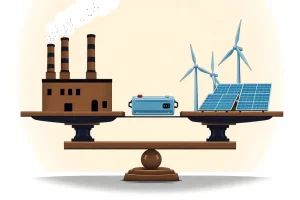
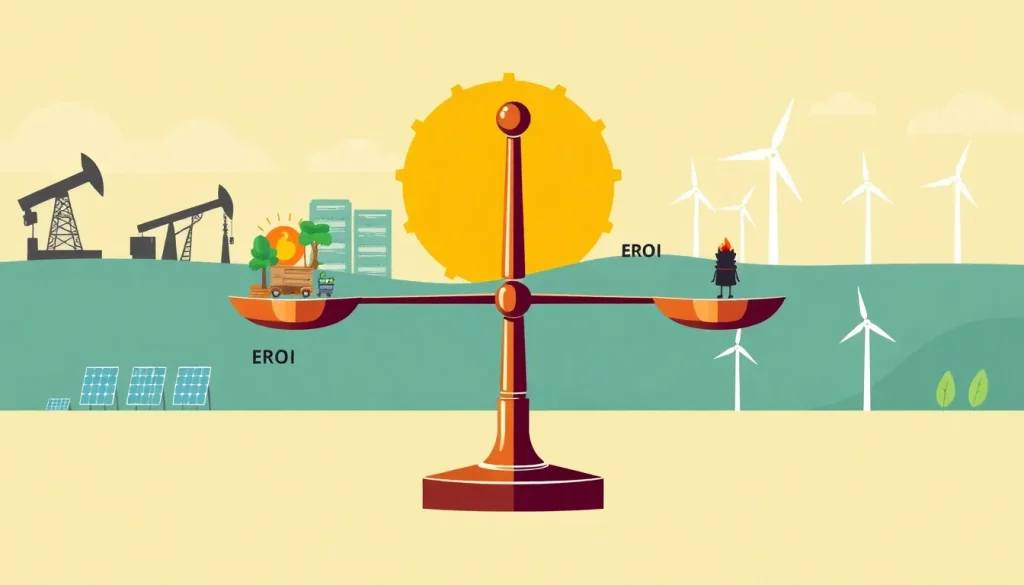
EROI belongs to the broader field of energy analysis and is used to compare the viability of different energy resources, from fossil fuels like oil and coal to renewable sources such as solar and wind. Its purpose is to reveal the net energy surplus available to society after accounting for the energy costs of extraction, processing, and distribution. A high EROI means that a large amount of energy is gained relative to the energy invested, leaving a substantial surplus for other economic activities. Conversely, an EROI of 1:1 represents the break-even point where no net energy is gained, and values below 1 indicate an energy sink—more energy is consumed than produced. Understanding EROI is crucial for assessing the long-term sustainability of energy systems and the potential for economic growth.
How It Works
The calculation of EROI is straightforward in principle: divide the total energy output by the total energy input over the life cycle of an energy system. The formula is:

EROI = Energy Output / Energy Input
However, defining the boundaries of what constitutes “energy input” is a critical and often debated aspect. Inputs can include direct energy, such as the fuel used to power drilling equipment or to manufacture solar panels, as well as indirect energy, like the energy embodied in materials, labor, and infrastructure. The choice of system boundaries leads to different EROI variants:
- Standard EROI: Considers only the direct energy inputs at the point of extraction or generation.
- Point-of-Use EROI: Includes energy costs for processing, refining, and transportation to the end user.
- Extended EROI: Incorporates additional indirect energy costs, such as environmental remediation or the energy required to maintain the supporting infrastructure.
These methodological differences mean that EROI values for the same energy source can vary significantly depending on the boundaries chosen. For example, the EROI of oil at the wellhead is higher than the EROI of gasoline delivered to a vehicle. A high EROI indicates a large net energy surplus, while an EROI approaching 1 signals that the energy source is barely worth exploiting. The concept of the “net energy cliff” illustrates that as EROI declines, the proportion of energy available to society drops sharply, especially when EROI falls below about 10:1.
History
The concept of EROI emerged in the 1970s, primarily through the work of ecologist Charles A. S. Hall. Hall was studying energy flows in natural ecosystems and recognized that the same principles could be applied to human energy systems. In a seminal 1979 paper, Hall and his colleagues introduced the term “Energy Return on Investment” to analyze the energy efficiency of oil and gas extraction in the United States. They found that the EROI of oil had been declining for decades as easily accessible reserves were depleted and more energy-intensive extraction methods became necessary.
During the energy crises of the 1970s and the subsequent peak oil discussions, EROI gained traction as a tool for understanding the physical limits of fossil fuel dependence. Early studies showed that conventional oil in the early 20th century had an EROI of 100:1 or more, meaning that for every barrel of oil equivalent invested, 100 barrels were returned. By the early 21st century, that ratio had fallen to roughly 10–20:1 for many conventional sources, and even lower for unconventional sources like oil sands. The concept has since been extended to renewable energy technologies, providing a common framework for comparing the net energy performance of all energy systems.
Importance and Impact
EROI is a fundamental metric because it determines the net energy available to power a society. Energy is the lifeblood of modern economies, and a high EROI allows for the development of complex infrastructure, healthcare, education, and other non-energy sectors. When EROI is high, a small fraction of society’s total energy output is needed to secure more energy, leaving a large surplus for everything else. As EROI declines, an increasing share of energy must be reinvested into the energy sector itself, leaving less for other uses and potentially constraining economic growth.
The impact of declining EROI is often described by the “net energy cliff.” When EROI drops from 100:1 to 10:1, the net energy available falls from 99% to 90% of total output—a relatively modest decline. But when EROI falls from 10:1 to 5:1, net energy drops from 90% to 80%, and the effect accelerates as EROI approaches 1:1. This nonlinear relationship means that even small declines in EROI at low levels can have severe economic consequences. Policymakers and energy analysts use EROI to evaluate the long-term viability of energy transitions, ensuring that new energy sources can provide sufficient net energy to sustain modern societies.
Examples
EROI values vary widely across different energy sources and are influenced by technology, geography, and methodology. The following are typical ranges based on peer-reviewed literature, though exact figures can differ between studies:
- Conventional oil and gas (historical): 100:1 in the early 20th century, declining to 10–20:1 in the 21st century.
- Coal: 40–80:1, depending on mining method and transportation distance.
- Oil sands (tar sands): 3–5:1, due to the energy-intensive extraction and upgrading processes.
- Hydropower: Often exceeds 100:1 for large-scale installations with long operational lifetimes.
- Wind power: 18–20:1 on average, with onshore wind generally higher than offshore.
- Solar photovoltaic (PV): 8–12:1 for utility-scale systems in favorable locations; lower for residential rooftop systems.
- Corn ethanol: 1–1.5:1, meaning it provides little to no net energy gain and is often considered an energy sink when all inputs are accounted for.
- Nuclear power: Estimates range from 5:1 to 15:1, with large uncertainties due to the energy costs of plant construction, fuel enrichment, and decommissioning.
These examples illustrate that while some renewables have EROIs comparable to or higher than current fossil fuels, others—particularly biofuels—struggle to achieve a meaningful net energy surplus. It is important to note that EROI is not static; technological improvements can increase the EROI of renewables over time, while depletion tends to decrease the EROI of finite resources.
Benefits, Limitations and Trade-offs
EROI offers several benefits as an analytical tool. It provides a physical, non-monetary measure of energy efficiency that is independent of market fluctuations, making it useful for long-term planning. It allows for direct comparisons across diverse energy sources, from fossil fuels to renewables, on a common energy basis. Additionally, EROI highlights the biophysical constraints of energy systems, complementing economic and environmental assessments.
However, EROI has notable limitations. The choice of system boundaries can dramatically affect results, and there is no universally accepted standard, leading to inconsistent comparisons. EROI does not account for the quality or form of energy—electricity is more versatile than heat, for example—nor does it consider environmental impacts, intermittency, or energy storage requirements. A high EROI source like coal may have severe environmental consequences, while a lower EROI source like solar PV may be more sustainable in the long run. Trade-offs also exist: pursuing the highest EROI might lead to overreliance on finite resources, while accepting lower EROI renewables may require societal adjustments. Therefore, EROI is best used in conjunction with other metrics, such as life cycle assessment and carbon footprint analysis, to inform energy policy.
Common Misconceptions
FAQ
What is Energy Return on Investment (EROI)?
EROI is the ratio of the amount of usable energy acquired from a particular energy resource to the amount of energy expended to obtain that energy. It measures the net energy gain.
How is EROI calculated?
EROI is calculated by dividing the total energy output (e.g., electricity, heat) by the total energy input (e.g., energy used for extraction, processing, transportation) over the life cycle of the energy system.
Why does EROI matter?
EROI matters because it indicates the net energy available to power economic activities. A declining EROI can signal increasing energy costs and potential economic challenges, making it crucial for energy policy and sustainability assessments.
References
- Hall, C. A. S., Lambert, J. G., & Balogh, S. B. (2014). EROI of different fuels and the implications for society. Energy Policy, 64, 141-152.
- Murphy, D. J., & Hall, C. A. S. (2010). Year in review—EROI or energy return on (energy) invested. Annals of the New York Academy of Sciences, 1185(1), 102-118.
- International Energy Agency (IEA). (2020). Net Zero by 2050: A Roadmap for the Global Energy Sector.