In brief
At a glance
Quick Facts
- Verdict
- Mixed
- Problem addressed
- Biodiversity loss from development
- Evidence strength
- Moderate
- Potential scale
- Global
- Relative cost
- Moderate to High
- Time to impact
- Years to Decades
Quick verdict
The mitigation hierarchy is a widely endorsed conceptual framework for managing the environmental impacts of development projects. It provides a logical sequence—avoid, reduce, restore, offset—that, if rigorously applied, can help achieve no net loss or even net gain of biodiversity. In practice, however, implementation is often weak, particularly at the avoidance and offset stages. The hierarchy is promising in principle but its real-world track record is mixed, with credible evidence of successful net-positive outcomes remaining scarce.
Problem addressed
The mitigation hierarchy targets the direct and indirect loss of biodiversity and ecosystem services caused by development activities such as infrastructure construction, mining, agriculture, and urban expansion. These activities can destroy habitats, fragment landscapes, pollute water and soil, and disrupt ecological processes. The hierarchy aims to ensure that such impacts are systematically addressed so that development does not result in a net loss of biodiversity, and ideally contributes to a net gain. This is critical because biodiversity loss undermines ecosystem resilience, threatens species survival, and erodes the natural capital on which human well-being depends.
How the solution works
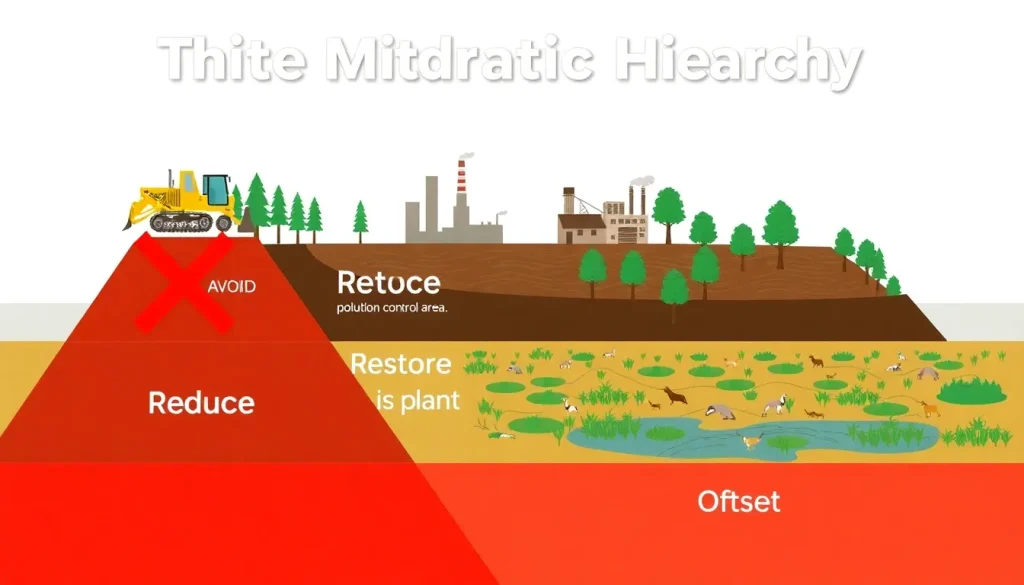
The mitigation hierarchy is a sequential decision-making process, often embedded in environmental impact assessment (EIA) procedures and required by international lenders such as the International Finance Corporation (IFC) through Performance Standard 6. The four steps are applied in strict order:
- Avoid: Measures taken to prevent impacts from occurring in the first place, such as selecting an alternative project site, rerouting a road, or changing the timing of construction to avoid sensitive breeding seasons.
- Reduce: Actions that minimize the duration, intensity, or extent of impacts that cannot be completely avoided. Examples include installing pollution control equipment, reducing the project footprint, or implementing noise barriers.
- Restore: Rehabilitation of degraded ecosystems or habitats affected by the project after the impact has occurred. This can involve replanting vegetation, restoring hydrological regimes, or removing invasive species.
- Offset: Compensatory measures taken to address any residual, unavoidable impacts after the first three steps have been exhausted. Offsets typically involve creating, enhancing, or protecting similar ecosystems elsewhere, with the goal of achieving at least no net loss and preferably a net gain of biodiversity.
The hierarchy is intended to be applied iteratively, with offsets considered only as a last resort. The overarching objective is to maintain the overall value and functionality of biodiversity in the landscape.
Evidence strength
The conceptual foundation of the mitigation hierarchy is well supported by conservation biology and environmental planning principles. However, the empirical evidence for its effectiveness is uneven and often contested. Avoidance and reduction measures are standard components of EIA, but their implementation is frequently poorly documented and weakly enforced. Restoration ecology has a substantial body of research, yet many restoration projects fail to fully recover original species composition or ecosystem functions, especially in complex tropical systems. The evidence base for biodiversity offsets is particularly weak. A 2016 review by Maron and colleagues found that most offset projects do not achieve no net loss due to inadequate design, insufficient monitoring, and a lack of transparent accounting. A 2013 study by Bull et al. highlighted that offsets often suffer from additionality problems (protecting areas that would have been conserved anyway) and time lags between impact and offset maturation. While some well-designed offset programs have shown positive results, the overall evidence remains limited and suggests that the hierarchy’s promise is rarely fully realized in practice.
Potential scale
The mitigation hierarchy has been adopted globally through international standards and national regulations. The IFC Performance Standards apply to all projects financed by the World Bank Group and are mirrored by the Equator Principles, which cover over 100 financial institutions. Many countries have incorporated the hierarchy into their EIA laws, and it is a cornerstone of the European Union’s biodiversity strategy. In theory, the hierarchy could be applied to every development project worldwide. In practice, its application is often restricted to large-scale projects in environmentally sensitive areas, and even then, enforcement is inconsistent. Scaling up the hierarchy to achieve meaningful global biodiversity outcomes would require significant strengthening of regulatory frameworks, monitoring capacity, and political will, particularly in developing countries where biodiversity is richest and governance is weakest.
Cost considerations
Costs vary widely depending on the project and the steps taken. Avoidance can be the most cost-effective measure if integrated early in planning, though it may involve higher upfront costs if it requires relocating a project or adopting more expensive technologies. Reduction measures typically add moderate costs to project budgets. Restoration and offsets can be expensive and uncertain: restoring a hectare of tropical forest can cost from a few thousand to tens of thousands of dollars, while offset programs may require long-term management funds and endowments. Overall, the hierarchy internalizes environmental costs that would otherwise be externalized, but critics argue that offsets can be a relatively cheap way for developers to obtain a “license to operate,” potentially undermining the incentive to avoid impacts. Cost-effectiveness analyses are rare, but some studies suggest that avoidance and reduction often provide greater biodiversity return per dollar than offsets.
Implementation time
Avoidance and reduction measures are typically implemented during the project design and construction phases and can yield immediate benefits by preventing impacts. Restoration can take years to decades before ecosystems recover functionality and biodiversity. Offsets often require long timeframes—commonly 30 years or more—to ensure that the compensatory gains are sustained and that no net loss is achieved over the project’s lifetime. The full hierarchy thus demands a long-term commitment from developers and regulators, which can be challenging in contexts of political and economic instability.
Environmental benefits
When properly applied, the mitigation hierarchy can reduce habitat loss, maintain connectivity, protect endangered species, and preserve ecosystem services such as water purification, carbon sequestration, and pollination. Quantified benefits are highly project-specific. For example, a well-designed offset might protect a forest area that would otherwise be cleared, resulting in measurable carbon storage and species habitat. However, global-scale benefits are difficult to attribute directly to the hierarchy, and many claimed benefits are based on projections rather than verified outcomes. The net environmental benefit is often overstated, particularly when offsets fail to deliver promised gains.
Social and economic co-benefits
Restoration and offset projects can generate local employment, support traditional livelihoods, and enhance community access to natural resources. They may also improve corporate reputation and secure social license to operate. In some cases, offset programs have funded community-based conservation initiatives, providing alternative income sources. However, these co-benefits are not automatic. Poorly designed offsets can lead to land-use conflicts, displacement of local communities, and restrictions on access to resources, sometimes referred to as “green grabbing.” The distribution of costs and benefits is often uneven, with local communities bearing the brunt of project impacts while benefits accrue elsewhere.
Risks and unintended consequences
The most significant risk is that the mitigation hierarchy becomes a “license to trash,” where developers and regulators treat offsets as a routine way to compensate for impacts that should have been avoided. This can lead to the destruction of irreplaceable habitats. Restoration efforts frequently fail to achieve their goals due to technical challenges, insufficient funding, or lack of long-term management. Offsets can suffer from “paper park” syndrome, where protected areas exist on paper but lack effective enforcement. There is also a risk of leakage, where offsetting activities simply displace the damaging activity to another location. Socially, offsets can exacerbate inequalities if they restrict indigenous peoples’ access to traditional lands without adequate consultation or compensation.
Where it works best
The mitigation hierarchy is most effective in contexts with strong environmental governance, clear legal frameworks, and robust monitoring and enforcement. It works well for projects with well-defined, localized impacts that can be accurately quantified and for which suitable offset sites are available. It is particularly suited to countries with established biodiversity offset policies, such as Australia, Germany, and the United States (under wetland mitigation banking). The hierarchy also performs better when applied to ecosystems that are relatively well understood and where restoration techniques are proven, such as temperate wetlands or grasslands.
Where it may not work
The hierarchy is a poor fit for projects that affect unique or irreplaceable biodiversity, such as primary forests, critical habitats for endangered species, or sites of high cultural value. In such cases, avoidance is the only acceptable option, and offsets cannot truly compensate for the loss. The hierarchy also fails in settings with weak governance, corruption, or a lack of technical capacity to design and monitor offsets. In many developing countries, the institutional infrastructure needed to implement the hierarchy effectively is absent, leading to paper-based compliance rather than real environmental outcomes. Additionally, for cumulative impacts from multiple small projects, the project-by-project application of the hierarchy may be inadequate without strategic landscape-level planning.
Comparison with alternatives
The mitigation hierarchy is often contrasted with a strict “no-go” approach, which prohibits development in certain areas entirely. While the hierarchy allows for development to proceed under conditions, a no-go policy provides stronger protection for critical habitats but may be politically and economically unfeasible. Strategic environmental assessment (SEA) operates at a broader scale and can help identify where development should be avoided altogether, complementing the project-level hierarchy. Market-based mechanisms such as biodiversity banking and habitat exchanges are sometimes used to implement offsets more efficiently, but they share the same fundamental challenges. Compared to ad hoc mitigation, the hierarchy provides a structured, transparent process, but its effectiveness ultimately depends on the rigor of its application and the priority given to avoidance.
Case studies
Ambatovy Nickel Mine, Madagascar: This large-scale mining project implemented a biodiversity offset program to protect and restore forest corridors for lemurs and other species. The offset included the creation of a 6,000-hectare conservation area and support for community-based forest management. While the program has been recognized for its ambitious design, independent reviews have noted challenges in demonstrating additionality and achieving no net loss, with ongoing debates about the offset’s long-term success.
Crossrail, United Kingdom: The Crossrail railway project in London applied the mitigation hierarchy extensively. Avoidance was achieved through tunneling under sensitive areas; reduction measures included noise and vibration controls; restoration involved creating new habitats at construction sites; and offsets included the creation of new wetlands and woodlands. Monitoring reports indicate that the project largely met its biodiversity targets, though some critics argue that the offset sites were not fully equivalent to the habitats lost.
Oyu Tolgoi Mine, Mongolia: This copper-gold mine in the Gobi Desert developed an offset strategy to compensate for impacts on desert ecosystems and water resources. The offset program has faced significant challenges, including difficulties in finding suitable offset sites in an arid environment, disputes over water use, and concerns about the adequacy of community engagement. The case illustrates the limitations of the hierarchy in unique ecosystems where restoration is uncertain and offsets are hard to design.
Final assessment
The mitigation hierarchy is a necessary but insufficient tool for reconciling development with biodiversity conservation. Its logical structure provides a valuable framework for decision-making, but its real-world impact is often undermined by weak implementation, particularly the failure to prioritize avoidance and the reliance on unproven offsets. For the hierarchy to fulfill its potential, it must be backed by strong regulatory oversight, transparent monitoring, and genuine commitment from developers and governments. Offsets should be treated as a last resort, not a routine compliance mechanism. In critical habitats, avoidance remains the only credible option. The hierarchy is most promising when embedded in a broader landscape-level planning approach and when all stakeholders, including local communities, are meaningfully engaged. Without these conditions, the mitigation hierarchy risks becoming little more than a bureaucratic exercise that legitimizes continued environmental degradation.
FAQ
What is the mitigation hierarchy?
The mitigation hierarchy is a sequential framework for managing the environmental impacts of development projects. It consists of four steps: avoid, reduce, restore, and offset. The goal is to achieve no net loss of biodiversity, and ideally a net gain.
Why is avoidance the most important step?
Avoidance is the most effective and often the most cost-efficient way to prevent environmental damage. It ensures that impacts do not occur in the first place, which is always preferable to trying to repair or compensate for them later. If avoidance is not prioritized, the hierarchy can become a justification for damaging sensitive areas.
Do biodiversity offsets really work?
The evidence is mixed. Some well-designed offset projects have successfully protected or restored habitats, but many fail to achieve no net loss due to poor design, inadequate monitoring, and a lack of additionality. Offsets are particularly challenging for unique or irreplaceable ecosystems.
Is the mitigation hierarchy legally required?
In many countries, elements of the hierarchy are embedded in environmental impact assessment laws. Additionally, international lenders such as the World Bank Group require adherence to the hierarchy through the IFC Performance Standards. However, the rigor of legal requirements varies widely.
References
- IFC (2012) Performance Standard 6: Biodiversity Conservation and Sustainable Management of Living Natural Resources.
- BBOP (2012) Standard on Biodiversity Offsets. Business and Biodiversity Offsets Programme.
- Maron, M., et al. (2016) 'The many meanings of no net loss in environmental policy.' Nature Sustainability.
- Bull, J.W., et al. (2013) 'Biodiversity offsets in theory and practice.' Oryx.
- IUCN (2016) 'Biodiversity offsets: Policy options for governments.' International Union for Conservation of Nature.