In brief
At a glance
Quick Facts
- Definition
- Soil compaction is the compression of soil particles that reduces pore space, increasing bulk density and restricting air, water, and root movement.
- Primary cause
- Heavy machinery, repeated tillage, and livestock trampling on wet soils are the main causes of agricultural soil compaction.
- Effect on roots
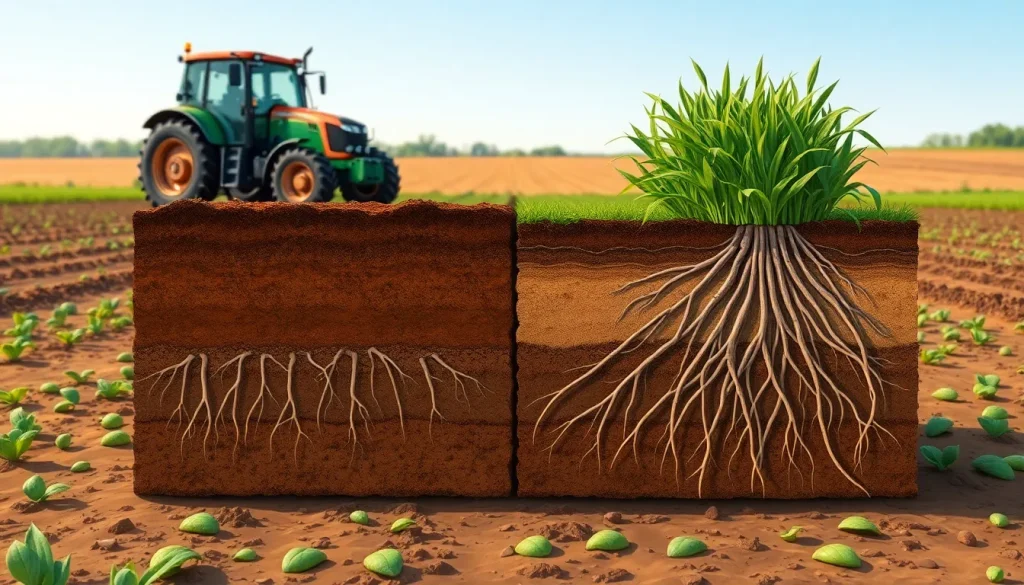
- Compacted soil physically restricts root penetration, limiting access to water and nutrients and reducing crop yields.
- Water infiltration
- Compaction reduces water infiltration rates, leading to increased runoff, erosion, and poor subsoil moisture recharge.
- Persistence
- Subsoil compaction can persist for decades if not actively remediated, as natural recovery processes are very slow.
- Yield impact
- Crop yield losses from compaction can range from 10% to over 50% depending on severity, crop type, and growing conditions.
- Soil biology
- Compaction reduces soil aeration, impairing microbial activity, earthworm populations, and nutrient cycling.
- Prevention
- Controlled traffic farming, reduced tillage, and avoiding field operations on wet soils are key preventive measures.
- Remediation
- Deep ripping can temporarily fracture compacted layers, but long-term solutions require building soil organic matter and structure.
- Environmental impact
- Compacted soils contribute to increased runoff, erosion, and greenhouse gas emissions, and reduce carbon storage capacity.
Key Takeaways
- Soil compaction is the densification of soil that reduces pore space, impairing root growth, water movement, and aeration, which directly lowers agricultural productivity.
- Compacted soils restrict root penetration, limit water infiltration and drainage, and reduce the availability of oxygen and nutrients to plants.
- Heavy machinery, repeated tillage, livestock trampling, and working wet soils are the primary causes of agricultural soil compaction.
- Managing compaction through practices like reduced tillage, controlled traffic, cover cropping, and targeted soil loosening can restore productivity and improve long-term soil health.
What Is Soil Compaction and Agricultural Productivity?
Soil compaction is the process by which soil particles are pressed together, reducing the pore spaces between them. This increases the soil’s bulk density and decreases its porosity, making it harder for air, water, and roots to move through the soil. In agriculture, compaction occurs primarily in the root zone due to the weight of machinery, tillage implements, or livestock, and it can extend deep into the subsoil. Agricultural productivity refers to the efficiency with which crops convert inputs—such as water, nutrients, and sunlight—into harvestable yield. When soil becomes compacted, the physical environment that roots depend on is degraded, leading to reduced crop growth and lower yields.
Soil compaction is a form of physical soil degradation, distinct from chemical or biological degradation, though it often triggers secondary problems in those areas. It is a widespread issue in modern agriculture, particularly in mechanized farming systems where heavy equipment is used repeatedly. The problem can be surface-level, forming a crust or a shallow hardpan, or it can occur deeper in the soil profile as a result of repeated loading at depth. Because compacted layers can persist for years, they represent a long-term constraint on agricultural productivity that requires deliberate management to correct.
Overview
Soil compaction is a major factor limiting crop yields worldwide. It alters the soil’s physical structure, which in turn affects nearly every process that supports plant growth. The most immediate effect is the restriction of root elongation: roots cannot penetrate dense soil layers, so they remain shallow and have access to a smaller volume of soil for water and nutrients. Compaction also reduces the rate at which water can infiltrate the soil surface, leading to increased runoff, erosion, and poor recharge of subsoil moisture. At the same time, drainage is impeded, which can cause waterlogging and oxygen deficiency in the root zone.

The problem is not limited to crop roots. Soil organisms, from earthworms to microbes, require pore spaces for movement and gas exchange. Compaction reduces biological activity, slowing the decomposition of organic matter and the cycling of nutrients. Over time, compacted soils tend to lose organic matter and structural stability, creating a feedback loop that worsens compaction. The economic impact is significant: farmers may need to apply more fertilizer and water to compensate for reduced root efficiency, while still facing yield penalties. In rainfed systems, compaction can make crops more vulnerable to drought because roots cannot access deep moisture.
How It Works
Soil is composed of mineral particles (sand, silt, clay), organic matter, water, and air. The spaces between solid particles—pores—are essential for storing and transmitting water and air. In a healthy, uncompacted soil, about half the volume is pore space, with a balance of large pores (macropores) that drain quickly and allow air entry, and small pores (micropores) that retain water for plant use. Compaction occurs when external pressure forces particles closer together, collapsing macropores first. This increases bulk density and reduces total porosity, especially the large pores critical for aeration and drainage.
When soil is compacted, several physical changes occur simultaneously. The soil becomes stronger and more resistant to root penetration; roots must exert greater pressure to elongate, and many simply cannot grow through dense layers. Water infiltration rates drop dramatically because the large, connected pores that conduct water downward are destroyed. This leads to surface ponding, increased runoff, and less water stored in the subsoil. At the same time, the loss of air-filled pores limits oxygen diffusion, which is essential for root respiration and microbial activity. Under wet conditions, compacted soils can become anaerobic, leading to denitrification and the production of substances toxic to roots. The combined effect is a root environment that is physically restrictive, poorly aerated, and often either too dry or too wet.
Main Causes or Drivers
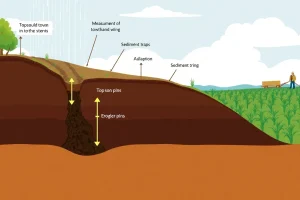
The primary cause of soil compaction in agriculture is the use of heavy machinery. Tractors, combines, and tillage equipment exert high pressures on the soil surface, and the stress is transmitted downward, especially when soils are moist. Repeated passes in the same wheel tracks create compacted zones that can extend 30 cm or more below the surface. Tillage itself, while intended to loosen soil, can cause compaction if performed when the soil is too wet or if implements create a smeared layer—a tillage pan—just below the depth of cultivation.
Livestock trampling is another significant driver, particularly in intensive grazing systems or around feeding and watering areas. The repeated hoof pressure compacts the surface soil and can destroy soil structure. Natural processes, such as raindrop impact on bare soil, can also form a surface crust that impedes seedling emergence and water entry. Soil texture plays a role: soils with a mixture of particle sizes, such as loams, are more susceptible to compaction than sandy soils because smaller particles can fill the voids between larger ones. Moisture content is critical; wet soils are far more prone to compaction because water lubricates particle rearrangement and reduces soil strength. Working or grazing on wet soil is one of the fastest ways to cause severe compaction.
Importance and Impact
Soil compaction directly reduces agricultural productivity by limiting the fundamental resources plants need: water, nutrients, and oxygen. Yield losses vary by crop, soil type, and severity, but compaction can reduce yields by 10–50% or more in severe cases. The impact is often most visible during dry periods, when compacted crops wilt sooner because their roots cannot access deep moisture, or during wet periods, when waterlogging damages roots. Beyond yield, compaction increases production costs because farmers may need to apply more irrigation water and fertilizer to compensate for reduced root efficiency, while also spending on fuel and equipment to remediate the compaction.
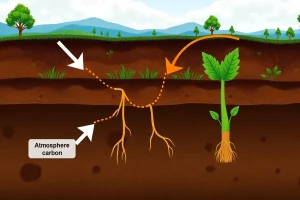
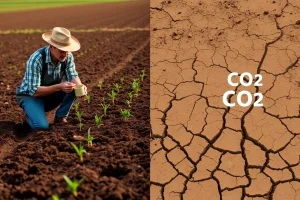
The environmental impacts are also substantial. Compacted soils have lower infiltration rates, which increases surface runoff and the risk of erosion. This runoff can carry sediment, nutrients, and pesticides into waterways, contributing to water quality problems. Reduced aeration in compacted soils can lead to increased emissions of nitrous oxide, a potent greenhouse gas, through denitrification. Compaction also diminishes the soil’s ability to store carbon, as restricted root growth and reduced microbial activity slow the incorporation of organic matter. Over large areas, these effects can undermine the sustainability of agricultural systems and the ecosystem services they provide.
Solutions
Addressing soil compaction requires a combination of preventive and remedial strategies. Prevention is the most effective and economical approach. Key preventive practices include reducing the number of passes with heavy machinery, using controlled traffic farming to confine wheel traffic to permanent lanes, and avoiding field operations when soils are wet. Maintaining or increasing soil organic matter through cover crops, crop rotations, and the addition of compost or manure improves soil structure and resilience to compaction. Using lighter equipment or vehicles with lower tire inflation pressures can also reduce surface pressure.
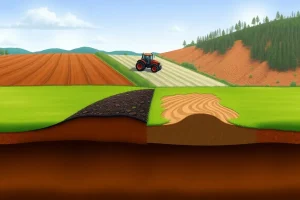
When compaction already exists, mechanical loosening may be necessary. Deep ripping or subsoiling can fracture compacted layers, but it is energy-intensive and the effects may be temporary if the underlying causes are not addressed. Biological methods, such as planting deep-rooted cover crops (e.g., radish, alfalfa), can create channels that improve water movement and gradually break up compacted zones. In grazing systems, rotational grazing and maintaining adequate ground cover help prevent surface compaction. Combining these approaches with long-term soil health management offers the best chance of restoring productivity and preventing recurrence.
Benefits, Limitations and Trade-offs
The benefits of managing soil compaction are clear: improved root growth, better water infiltration and storage, enhanced nutrient cycling, and higher crop yields. Soils with good structure are more resilient to drought and heavy rainfall, and they support more diverse biological communities. Reduced compaction also lowers the need for excessive tillage, saving fuel and labor while protecting soil organic matter. Over time, these improvements contribute to more stable and sustainable agricultural production.
However, solutions come with limitations and trade-offs. Mechanical loosening, such as deep ripping, requires high horsepower and fuel, and it can bring rocks or infertile subsoil to the surface. If the soil is not managed carefully afterward, recompaction can occur quickly. Controlled traffic farming requires investment in guidance systems and may not be feasible on small or irregularly shaped fields. Cover crops and organic amendments take time to build soil structure and may compete with cash crops for water in dry regions. There is no single universal fix; effective management depends on soil type, climate, cropping system, and economic context. Balancing short-term costs with long-term gains is a central challenge for farmers.
FAQ
What is soil compaction?
Soil compaction is the process by which soil particles are pressed together, reducing the space between them. This increases soil density and decreases porosity, making it difficult for air, water, and roots to move through the soil.
How does soil compaction affect agricultural productivity?
Compaction restricts root growth, limits water infiltration and drainage, and reduces oxygen availability. This leads to stunted plants, lower nutrient uptake, and ultimately reduced crop yields. It also increases the need for irrigation and fertilizer, raising production costs.
Why does managing soil compaction matter?
Managing compaction is essential for maintaining long-term soil health and agricultural sustainability. Unchecked compaction degrades soil structure, increases erosion and runoff, and can cause persistent yield losses. Preventive and remedial practices help restore productivity and protect environmental quality.
References
- FAO Soils Portal: Soil Compaction. Food and Agriculture Organization of the United Nations.
- USDA Natural Resources Conservation Service. Soil Quality Indicators: Bulk Density.
- Brady, N.C. and Weil, R.R. The Nature and Properties of Soils. Pearson.