In brief
At a glance
Quick Facts
- Status
- Transgressed (climate change boundary in zone of increasing risk)
- Control variable
- Atmospheric CO2 concentration (ppm) and radiative forcing (W/m²)
- Proposed boundary
- 350 ppm CO2, +1.0 W/m² radiative forcing
- Current value
- ~419 ppm CO2, ~2.91 W/m² (2023)
- Pre-industrial baseline
- ~280 ppm CO2, 0 W/m² radiative forcing
Current status
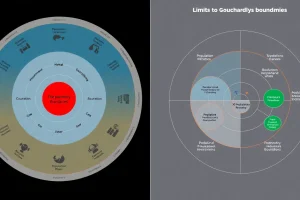
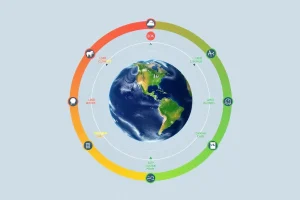
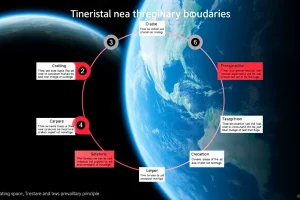
As of the 2023 update by Richardson et al., six of the nine planetary boundaries have been transgressed, indicating that Earth is moving outside the safe operating space for humanity. The transgressed boundaries include climate change, biosphere integrity (both genetic and functional diversity), land-system change, freshwater change, biogeochemical flows (nitrogen and phosphorus), and novel entities. At the same time, scientific assessments of Earth-system tipping elements suggest that several are approaching critical thresholds, with some possibly already activated. The interplay between boundary transgression and tipping point dynamics is a central concern for Earth-system stability, as crossing boundaries increases the likelihood of triggering irreversible, large-scale changes.
Control variable
In the planetary boundaries framework, each boundary is defined by one or more control variables—measurable quantities that capture the state of the Earth-system process. For example, the climate change boundary uses atmospheric CO2 concentration and radiative forcing as control variables. For tipping elements, the analogous concept is the tipping point or threshold parameter, such as global mean temperature increase for the Greenland ice sheet or Amazon rainforest dieback. The control variable for the overall framework is the level of anthropogenic pressure, often represented by the number of boundaries transgressed or the magnitude of transgression. The relationship between the two concepts is that control variables track the proximity to thresholds that could activate tipping elements.
Proposed boundary or threshold
The planetary boundaries framework proposes a “safe operating space” defined by boundaries for each process. For climate change, the proposed boundary is an atmospheric CO2 concentration of 350 parts per million (ppm) and a radiative forcing of +1.0 W/m² relative to pre-industrial levels. For tipping elements, thresholds are often expressed in terms of global warming: many are estimated to lie between 1.5°C and 2°C above pre-industrial temperatures, though some may have lower or higher thresholds. The interaction between the two concepts is that staying within planetary boundaries is intended to avoid triggering tipping points. However, the exact thresholds for many tipping elements remain uncertain, with some possibly already at risk within the current boundary transgression levels.
Current measured value
As of 2023, the atmospheric CO2 concentration is approximately 419 ppm, and radiative forcing is about 2.91 W/m², both well beyond the proposed climate boundary. Global mean temperature has risen by about 1.2°C above pre-industrial levels. Observations indicate that some tipping elements, such as the Amazon rainforest (showing signs of reduced resilience), the West Antarctic Ice Sheet (accelerated mass loss), and warm-water coral reefs (repeated bleaching events), may be approaching or have already crossed critical thresholds. The current status of the planetary boundaries framework shows that humanity is operating outside the safe space for multiple processes, increasing the risk of triggering tipping points.
How the boundary is calculated
Planetary boundaries are quantified using Earth-system models, observational data, and expert elicitation. For each boundary, a control variable is selected and a safe limit is proposed based on the Holocene baseline and the risk of triggering non-linear changes. Tipping elements are identified through paleoclimate records, model simulations, and early-warning signals such as critical slowing down. The risk of crossing tipping points is assessed by mapping the distance of current forcing to estimated critical thresholds, often using global warming levels as a proxy. The interaction is calculated by analyzing how transgression of one boundary affects the stability of tipping elements, using coupled Earth-system models and network analysis.
Historical trend
Since the Industrial Revolution, human pressures on the Earth system have increased exponentially. The Holocene epoch provided a stable environment, but from the mid-20th century onward, multiple planetary boundaries have been pushed beyond their safe limits. Atmospheric CO2 has risen from ~280 ppm to over 419 ppm, biodiversity loss rates have accelerated to 100–1,000 times the background rate, and nitrogen fixation has more than doubled. The rate of change in key control variables has accelerated, bringing the Earth closer to potential tipping points. Paleoclimate records show that past abrupt changes were often preceded by gradual forcing that crossed critical thresholds, suggesting that current trends could lead to similar non-linear responses.
What is driving the change
The primary drivers are human activities: fossil fuel combustion, deforestation, agricultural intensification, industrial production, and resource extraction. These activities increase greenhouse gas emissions, alter biogeochemical cycles, reduce biosphere integrity, and introduce novel entities. The cumulative effect of these pressures pushes the Earth system toward multiple boundaries and increases the likelihood of triggering tipping elements. For example, deforestation in the Amazon reduces its resilience as a carbon sink and moisture recycler, making it more susceptible to a tipping point where it transitions to a savanna-like state.
What crossing the boundary means
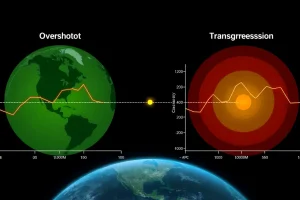
Transgressing planetary boundaries does not necessarily cause an immediate tipping point, but it increases the risk of crossing critical thresholds that can lead to abrupt, irreversible changes. For example, exceeding the climate change boundary raises the probability of triggering ice sheet collapse, Amazon dieback, or permafrost thaw. Once a tipping element is activated, it can set off feedback loops that further amplify warming and ecosystem degradation, potentially pushing other boundaries further beyond their safe limits. The loss of resilience in one part of the Earth system can cascade, leading to a global tipping point that fundamentally alters the state of the planet.
Regional variations
While planetary boundaries are defined at the global scale, many operate regionally. For instance, freshwater use and land-system change boundaries are assessed at sub-global levels. Tipping elements are inherently regional: the Amazon rainforest, the West Antarctic Ice Sheet, the Atlantic Meridional Overturning Circulation (AMOC), and coral reefs are specific geographic features. The transgression of regional boundaries can directly trigger local tipping points, which may have global consequences through teleconnections. For example, deforestation in the Amazon affects regional rainfall patterns and could disrupt the South American monsoon, with implications for global climate.
Interaction with other boundaries
The planetary boundaries framework emphasizes that boundaries are interconnected. Transgressing the climate change boundary exacerbates biosphere integrity loss, ocean acidification, and freshwater change. Similarly, tipping elements can interact: melting of the Greenland ice sheet could slow the AMOC, affecting rainfall patterns in the Amazon and increasing the risk of Amazon dieback. Such cascading tipping dynamics could lead to a global tipping point, fundamentally altering the Earth system. The interaction between boundaries and tipping elements creates a complex web of feedbacks that can amplify human pressures and reduce the safe operating space.
Impacts on people and ecosystems
Crossing planetary boundaries and triggering tipping points would have severe consequences: sea-level rise from ice sheet loss, disruption of monsoon systems, collapse of fisheries, loss of biodiversity, and reduced agricultural productivity. These changes threaten food security, water availability, human health, and economic stability, with the most vulnerable populations being disproportionately affected. Ecosystem services such as pollination, carbon sequestration, and water purification would be degraded, undermining the foundation of human well-being.
Possible pathways back toward the safe zone
Returning to a safe operating space requires rapid, systemic transformations: decarbonizing the global economy, protecting and restoring ecosystems, adopting sustainable agricultural practices, and implementing circular economy principles. International cooperation, strong policy frameworks, and technological innovation are essential. For tipping elements, early intervention is critical to avoid crossing irreversible thresholds; some tipping points may already be unavoidable, necessitating adaptation strategies. Pathways include achieving net-zero emissions, reforestation, and reducing nutrient pollution to bring control variables back within boundaries.
Scientific uncertainty
Both frameworks involve significant uncertainties. For planetary boundaries, the exact position of boundaries, the interaction between them, and the time lags in Earth-system responses are not fully understood. For tipping elements, the precise threshold values, the reversibility of tipping, and the potential for cascading effects are areas of active research. The precautionary principle underpins both concepts, urging action despite incomplete knowledge. Some boundaries, like novel entities, lack a quantified global threshold, while tipping element thresholds are often based on model ensembles with wide ranges.
Criticism and alternative frameworks
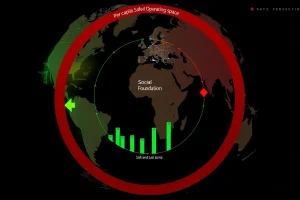
Critics argue that the planetary boundaries framework oversimplifies complex Earth-system dynamics and that some boundaries are not truly global. The concept of tipping elements has been debated regarding the abruptness and irreversibility of certain changes. Alternative frameworks include “planetary opportunities” and “social-ecological resilience” approaches that emphasize transformative change and adaptive governance. Some scientists propose focusing on “Earth-system boundaries” that integrate social and ecological dimensions, while others advocate for a “doughnut economics” model that combines planetary boundaries with social foundations.
FAQ
What is the difference between a planetary boundary and a tipping point?
A planetary boundary defines a safe limit for a specific Earth-system process, intended to keep the planet in a stable Holocene-like state. A tipping point is a critical threshold within a system (often a component of the Earth system) beyond which a small change can trigger a large, often irreversible shift. Transgressing a planetary boundary increases the risk of crossing tipping points.
How many planetary boundaries have been crossed?
According to the 2023 assessment by Richardson et al., six of the nine planetary boundaries have been transgressed: climate change, biosphere integrity (genetic and functional diversity), land-system change, freshwater change, biogeochemical flows (nitrogen and phosphorus), and novel entities.
Can tipping points be reversed once crossed?
Some tipping points may be irreversible on human timescales, such as the collapse of large ice sheets or the dieback of the Amazon rainforest. Others might be reversible but only with very large and sustained reductions in forcing. The precautionary principle suggests avoiding crossing tipping points altogether, as the consequences are severe and the reversibility is uncertain.
References
- Rockström, J., Steffen, W., Noone, K., et al. (2009). A safe operating space for humanity. Nature, 461, 472–475.
- Steffen, W., Richardson, K., Rockström, J., et al. (2015). Planetary boundaries: Guiding human development on a changing planet. Science, 347(6223), 1259855.
- Richardson, K., Steffen, W., Lucht, W., et al. (2023). Earth beyond six of nine planetary boundaries. Science Advances, 9(37), eadh2458.
- Lenton, T. M., Held, H., Kriegler, E., et al. (2008). Tipping elements in the Earth's climate system. Proceedings of the National Academy of Sciences, 105(6), 1786–1793.
- Lenton, T. M., Rockström, J., Gaffney, O., et al. (2019). Climate tipping points — too risky to bet against. Nature, 575, 592–595.