In brief
At a glance
Quick Facts
- Journal / venue
- Proceedings of the National Academy of Sciences (PNAS)
- Authors
- Steven C. Sherwood and Matthew Huber
- Publication date
- May 2010
- Study type
- Modeling study (human energy balance + climate projections)
- Peer-reviewed
- Yes
- DOI / link
- 10.1073/pnas.0913352107
Study in one sentence
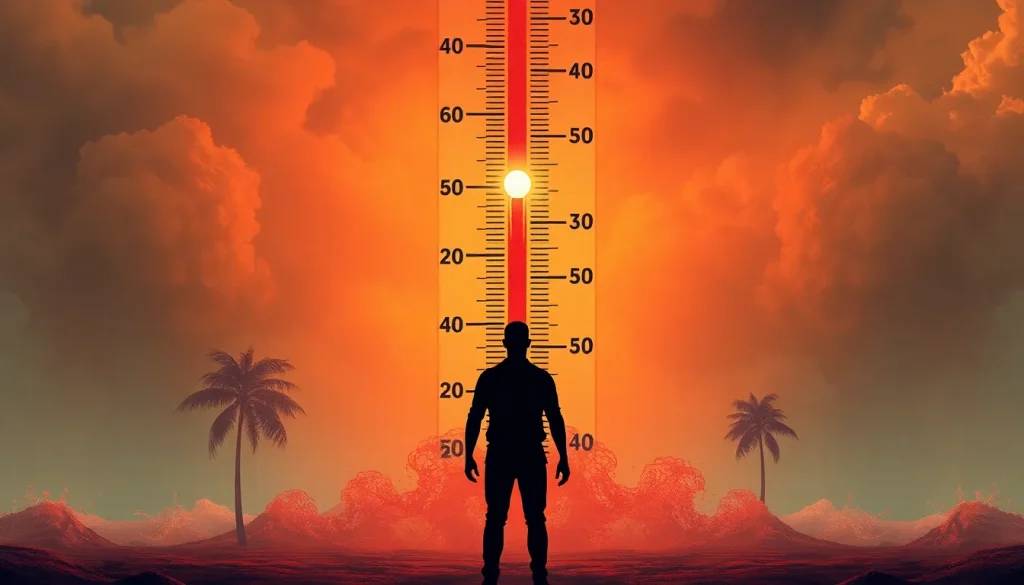
A 2010 modeling study by Sherwood and Huber established that a wet-bulb temperature of 35°C represents a critical physiological limit for human survival, and projected that with continued global warming, some regions could regularly exceed this threshold within the century.
Publication and date
The study, titled “An adaptability limit to climate change due to heat stress,” was published in the peer-reviewed journal Proceedings of the National Academy of Sciences (PNAS) in May 2010 by authors Steven C. Sherwood and Matthew Huber.
Research question
The researchers sought to determine the maximum wet-bulb temperature at which the human body can maintain a stable core temperature, and to assess whether future climate change could cause this limit to be exceeded in any inhabited regions.
Method
Sherwood and Huber used a human energy balance model to calculate the highest sustainable wet-bulb temperature for a resting, healthy human in the shade with unlimited water. They then applied this threshold to global climate model simulations under various warming scenarios to identify when and where such conditions might occur.
Main findings
The study found that a wet-bulb temperature of 35°C is the theoretical upper limit for human thermoregulation; above this, even a naked, resting person in shade with unlimited water would experience a dangerous rise in core body temperature. Climate model projections indicated that with a global-mean warming of about 10–12°C above pre-industrial levels, some regions—particularly in the subtropics—could experience wet-bulb temperatures exceeding 35°C. Even with lower warming, heat stress would become severe, though not necessarily lethal, in many areas.
What the findings do not prove
The findings do not imply that all people will die immediately at a wet-bulb temperature of 35°C. The limit applies to idealized conditions; in reality, factors such as clothing, physical activity, acclimatization, and access to shelter or cooling can alter individual vulnerability. The study also does not predict exact dates or locations of such events, as climate models have inherent uncertainties.
Limitations
The study’s physiological model assumes a naked, resting, healthy adult in shade with unlimited water and full ventilation—conditions rarely met in real life. It does not account for variations in age, health, clothing, or behavior. The climate model projections are based on scenarios that may not capture all regional climate dynamics, and the coarse resolution of global models may miss local extremes. Additionally, the 35°C threshold is for a sustained period (several hours) and does not consider short-term exposure or acclimatization.
How it compares with previous research
Prior to this study, heat stress research focused on dry-bulb temperature or heat index, which do not fully capture the effect of humidity on human thermoregulation. Sherwood and Huber’s work highlighted the critical role of wet-bulb temperature. Subsequent studies have refined the threshold, suggesting that even lower wet-bulb temperatures (e.g., 31°C) can be dangerous for vulnerable populations or during physical activity. Observational studies have recorded wet-bulb temperatures approaching 35°C in some regions, confirming the plausibility of the limit.
Why it matters
This study provides a clear physiological benchmark for assessing the risks of extreme heat events under climate change. It underscores the importance of limiting global warming to prevent regions from becoming uninhabitable without artificial cooling, and it has informed public health planning and climate policy discussions worldwide.
Link to the primary paper
Sherwood, S. C., & Huber, M. (2010). An adaptability limit to climate change due to heat stress. Proceedings of the National Academy of Sciences, 107(21), 9552-9555. DOI: 10.1073/pnas.0913352107
FAQ
What is wet-bulb temperature?
Wet-bulb temperature is the reading from a thermometer covered in a wet cloth and exposed to airflow. It represents the lowest temperature that can be achieved through evaporative cooling. Unlike standard air temperature, it accounts for humidity, making it a key measure of heat stress because high humidity reduces the effectiveness of sweating.
Why is 35°C wet-bulb considered a survival limit?
At a wet-bulb temperature of 35°C, the air is so hot and humid that sweat no longer evaporates efficiently. Even a healthy, resting person in the shade with unlimited water cannot dissipate metabolic heat, causing core body temperature to rise to dangerous levels. This threshold is based on a human energy balance model and represents a theoretical upper limit for thermoregulation.
Has any place on Earth reached a wet-bulb temperature of 35°C?
As of the study's publication, no sustained wet-bulb temperature of 35°C had been recorded. However, subsequent observational studies have documented brief, localized occurrences approaching this value in parts of South Asia and the Middle East, particularly during extreme heatwaves. Climate projections suggest such events could become more frequent and widespread with continued warming.
References
- Sherwood, S. C., & Huber, M. (2010). An adaptability limit to climate change due to heat stress. Proceedings of the National Academy of Sciences, 107(21), 9552-9555.
- Raymond, C., Matthews, T., & Horton, R. M. (2020). The emergence of heat and humidity too severe for human tolerance. Science Advances, 6(19), eaaw1838.
- Pal, J. S., & Eltahir, E. A. (2016). Future temperature in southwest Asia projected to exceed a threshold for human adaptability. Nature Climate Change, 6(2), 197-200.
- Mora, C., et al. (2017). Global risk of deadly heat. Nature Climate Change, 7(7), 501-506.
- Buzan, J. R., & Huber, M. (2020). Moist heat stress on a warmer Earth. Annual Review of Earth and Planetary Sciences, 48, 623-655.