In brief
At a glance
Quick Facts
- Journal / venue
- PLOS Neglected Tropical Diseases
- Authors
- Morin CW, Comrie AC, Ernst K
- Publication date
- September 2018
- Study type
- Systematic review
- Peer-reviewed
- Yes
- DOI / link
- 10.1371/journal.pntd.0006431
Study in one sentence
A 2018 systematic review synthesizes evidence from multiple studies to show that the effect of rainfall on mosquito-borne disease outbreaks is highly variable, with both increases and decreases in rainfall potentially elevating or suppressing disease risk depending on local ecological and social factors.
Publication and date
The study, titled “Rainfall variability and mosquito-borne disease outbreaks: a systematic review,” was published in PLOS Neglected Tropical Diseases in 2018. The authors are Cory W. Morin, Andrew C. Comrie, and Kacey Ernst.
Research question
The review aimed to answer: How does rainfall variability—including changes in amount, timing, and intensity—affect the occurrence of mosquito-borne disease outbreaks? The authors sought to identify consistent patterns across different diseases, mosquito species, and geographic regions.
Method
The researchers conducted a systematic review of peer-reviewed literature published between 1980 and 2015. They searched multiple databases for studies that quantitatively linked rainfall variables (e.g., total precipitation, number of rainy days, drought indices) to mosquito-borne disease outbreaks (e.g., dengue, malaria, chikungunya, Zika, West Nile virus). After screening over 1,500 articles, 48 studies met the inclusion criteria. The team extracted data on study location, disease, mosquito vector, rainfall metrics, and reported relationships, then synthesized findings narratively due to heterogeneity in study designs.
Main findings
The review found no single, universal relationship between rainfall and disease outbreaks. Instead, the effect depended on local context. Key patterns included:
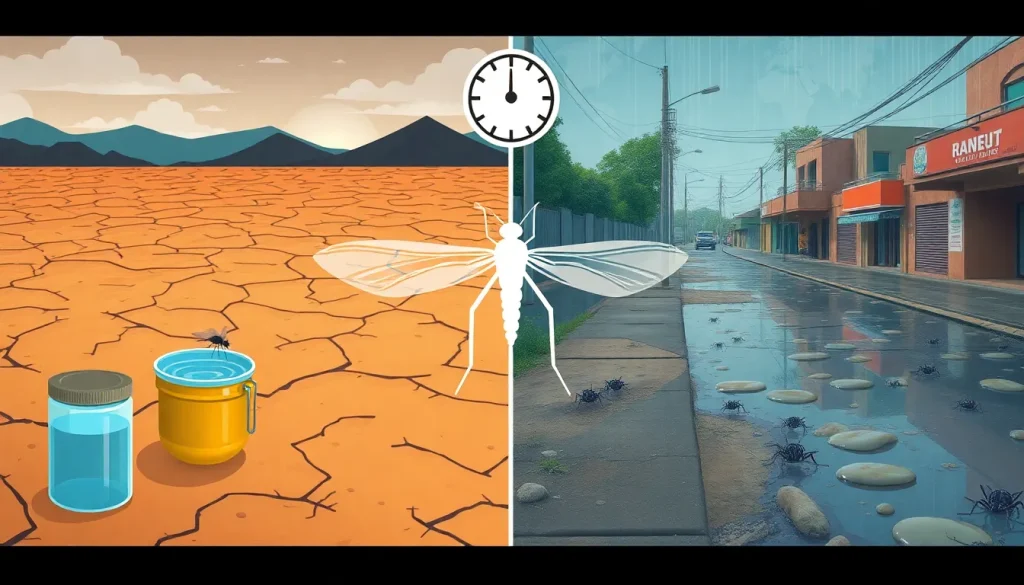
- Heavy rainfall often increased disease risk by creating new breeding sites for container-breeding mosquitoes (e.g., Aedes aegypti for dengue), but excessive rainfall could flush out larvae and reduce vector populations.
- Drought sometimes increased risk because people stored water in open containers, providing breeding habitats for mosquitoes like Aedes.
- Moderate rainfall was generally associated with higher malaria transmission in many settings, but the relationship varied with local hydrology and mosquito species.
- The timing of rainfall relative to temperature and the mosquito life cycle was critical; for example, rainfall after a dry spell could trigger a surge in vector populations.
- Urban and rural areas showed different responses due to variations in water storage practices and drainage infrastructure.
The review highlighted that simple linear correlations are insufficient to capture the complex dynamics.
What the findings do not prove
The review does not establish causation between specific rainfall patterns and disease outbreaks. It identifies associations and patterns across studies, but cannot predict outbreaks for a given location without considering local conditions. The findings do not imply that all heavy rainfall events will lead to outbreaks, nor that drought uniformly increases risk. The study also does not provide a quantitative model for forecasting; it is a qualitative synthesis of existing research.
Limitations
The review’s conclusions are limited by the quality and scope of the included studies. Most research focused on malaria and dengue, with fewer studies on other diseases. Geographic coverage was uneven, with many studies from Africa and Asia but fewer from the Americas. The heterogeneity of study designs, rainfall metrics, and disease outcomes prevented a formal meta-analysis. Additionally, many studies did not account for confounding factors such as temperature, humidity, and socioeconomic conditions, which also influence mosquito-borne disease transmission.
How it compares with previous research
This systematic review aligns with earlier narrative reviews and modeling studies that emphasized the nonlinear and context-dependent nature of rainfall-disease relationships. It extends previous work by providing a comprehensive, structured synthesis of quantitative evidence across multiple diseases and regions. The findings reinforce the notion that climate change impacts on mosquito-borne diseases cannot be predicted solely from changes in average precipitation; instead, changes in rainfall variability and extreme events are likely to be more influential.
Why it matters
Understanding the link between rainfall and mosquito-borne diseases is crucial for public health planning, especially as climate change alters precipitation patterns globally. The review underscores the need for local-scale, integrated surveillance systems that combine meteorological, entomological, and epidemiological data. It also highlights the importance of water management and infrastructure in disease prevention. For researchers, the study identifies gaps in knowledge, such as the need for more studies on under-researched diseases and regions, and the value of standardizing methodologies to enable cross-study comparisons.
Link to the primary paper
Morin CW, Comrie AC, Ernst K. Rainfall variability and mosquito-borne disease outbreaks: a systematic review. PLOS Neglected Tropical Diseases. 2018;12(9): e0006431. https://doi.org/10.1371/journal.pntd.0006431
FAQ
Does more rainfall always mean more mosquitoes?
No. While rainfall can create breeding sites, very heavy rainfall can flush out larvae and reduce mosquito populations. The effect depends on the mosquito species, local drainage, and the timing of rainfall.
Can drought increase mosquito-borne disease risk?
Yes. During droughts, people often store water in open containers, which can become breeding sites for mosquitoes like Aedes aegypti, the vector for dengue and Zika. This can lead to increased disease transmission despite dry conditions.
How does climate change affect this relationship?
Climate change is expected to alter rainfall patterns, making some regions wetter and others drier, and increasing the frequency of extreme events. These changes can shift the geographic range of mosquitoes and the timing of disease outbreaks, but the exact impact varies by location and disease.
References
- Morin CW, Comrie AC, Ernst K. Rainfall variability and mosquito-borne disease outbreaks: a systematic review. PLOS Neglected Tropical Diseases. 2018;12(9): e0006431.
- Campbell-Lendrum D, Manga L, Bagayoko M, et al. Climate change and vector-borne diseases: what are the implications for public health research and policy? Philos Trans R Soc Lond B Biol Sci. 2015;370(1665):20130552.
- Paaijmans KP, Wandago MO, Githeko AK, Takken W. Unexpected high losses of Anopheles gambiae larvae due to rainfall. PLOS One. 2007;2(11):e1146.
- Chaves LF, Morrison AC, Kitron U, Scott TW. Nonlinear impacts of climatic variability on the density‐dependent regulation of an insect vector of disease. Glob Chang Biol. 2012;18(2):457-468.
- Lowe R, Gasparrini A, Van Meerbeeck CJ, et al. Nonlinear and delayed impacts of climate on dengue risk in Barbados: a modelling study. PLOS Med. 2018;15(7):e1002613.