In brief
At a glance
Quick Facts
- Definition
- The degree to which a landscape facilitates or impedes movement of organisms and ecological processes among habitat patches.
- Key Components
- Structural connectivity (physical arrangement) and functional connectivity (actual movement of species).
- Scale
- Operates from local corridors (e.g., hedgerows) to continental networks (e.g., migratory flyways).
- Primary Threat
- Habitat fragmentation caused by roads, agriculture, urbanization, and dams.
- Conservation Tools
- Wildlife corridors, ecological networks, protected area systems, and restoration projects.
- Climate Change Role
- Connectivity enables species to shift ranges in response to changing climate conditions.
- Marine Connectivity
- Includes larval dispersal, migratory routes, and linkages between mangroves, seagrasses, and coral reefs.
- Economic Value
- Connected ecosystems provide services like flood control, pollination, and fisheries worth billions annually.
Key Takeaways
- Ecosystem connectivity refers to the unimpeded movement of organisms, nutrients, and energy across habitats within a landscape or seascape.
- It operates at multiple scales, from local wildlife corridors to continent-spanning migration routes, and includes both structural and functional dimensions.
- Maintaining connectivity is critical for genetic diversity, species survival, and ecosystem resilience in the face of climate change and habitat loss.
- Human activities such as urbanization, agriculture, and infrastructure development are the primary drivers of fragmentation, which disrupts connectivity.
- Conservation strategies like protected area networks, wildlife corridors, and ecological restoration can restore and sustain connectivity.
What Is Ecosystem Connectivity?
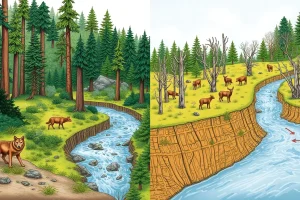
Ecosystem connectivity is the extent to which a landscape or seascape facilitates the movement of organisms, the flow of genetic material, and the transfer of energy and nutrients between different habitat patches. It is a fundamental property of healthy ecosystems, ensuring that species can access the resources they need to survive, reproduce, and adapt to changing conditions. Connectivity can be structural—the physical arrangement of habitat patches and corridors—or functional—the actual movement of individuals and genes across the landscape. A well-connected ecosystem allows animals to migrate, plants to disperse seeds, and aquatic species to travel along river networks or ocean currents without insurmountable barriers.
This concept applies across terrestrial, freshwater, and marine environments. In a forest, connectivity might mean that a squirrel can travel from one woodland patch to another via hedgerows or tree lines. In a river system, it means that fish can swim upstream to spawn without being blocked by dams. At a global scale, connectivity includes the migratory routes of birds and marine mammals that span continents and oceans. When connectivity is lost—through habitat fragmentation, roads, dams, or other human-made barriers—ecosystems become isolated, leading to reduced genetic diversity, local extinctions, and diminished ecological functions.
How It Works
Ecosystem connectivity operates through a combination of structural and functional elements. Structural connectivity refers to the physical arrangement of habitat patches and the corridors that link them. This can be measured by the distance between patches, the presence of linear features like rivers or hedgerows, and the permeability of the surrounding matrix (the non-habitat land cover). Functional connectivity, on the other hand, describes how an organism actually moves through the landscape, which depends on its behavior, mobility, and perception of the environment. A road may be a complete barrier to a small amphibian but only a minor obstacle to a bird.
Connectivity is often scale-dependent. For a soil microorganism, a few meters of unsuitable substrate may represent a barrier, while for a large carnivore, a highway or agricultural field may be the critical obstacle. Ecological networks—systems of core habitat areas connected by corridors and stepping stones—are a common framework for understanding and managing connectivity. These networks support gene flow, which maintains genetic diversity and reduces the risk of inbreeding. They also enable species to shift their ranges in response to climate change, a process known as climate-induced range shift, which is essential for long-term survival.
Importance and Impact
Ecosystem connectivity is vital for biodiversity conservation. It allows animals to access food, water, mates, and breeding sites, and it enables plants to disperse seeds and pollen. Without connectivity, populations become isolated, leading to reduced genetic diversity and increased vulnerability to disease, inbreeding, and local extinction. For migratory species—such as wildebeest, salmon, and monarch butterflies—connectivity along their entire migratory route is non-negotiable; a single barrier can cause population collapse.
Connectivity also underpins ecosystem services that benefit humans. Connected floodplains absorb and slow floodwaters, reducing downstream damage. Mangrove forests connected to seagrass beds and coral reefs provide coastal protection and support fisheries. Pollinator connectivity ensures that bees and other insects can move between natural habitats and agricultural fields, enhancing crop yields. When connectivity is disrupted, these services degrade, often with costly consequences for communities and economies.
Main Causes or Drivers of Fragmentation
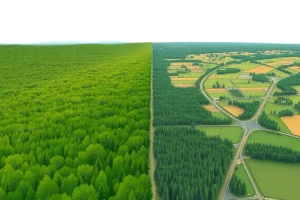
The primary driver of reduced ecosystem connectivity is habitat fragmentation caused by human activities. Urban expansion, road construction, and infrastructure development slice continuous habitats into smaller, isolated patches. Agricultural intensification replaces diverse landscapes with monocultures, removing the hedgerows, woodlots, and wetlands that once served as corridors. In aquatic systems, dams, culverts, and water diversions block the movement of fish and other organisms, while coastal development disrupts the connectivity between mangroves, seagrasses, and coral reefs.
Climate change acts as an indirect driver by shifting suitable habitat ranges faster than many species can migrate, making existing corridors insufficient. Invasive species can also alter connectivity by changing habitat structure or outcompeting native species that rely on specific corridors. Additionally, light and noise pollution from roads and cities can create behavioral barriers, deterring animals from using otherwise physically connected habitats.
Examples
One of the most celebrated examples of connectivity conservation is the Yellowstone to Yukon Conservation Initiative (Y2Y), which aims to maintain a continuous network of wildlands and waters across 3,200 kilometers of the Rocky Mountains, from Yellowstone National Park in the United States to the Yukon in northern Canada. This large-scale effort protects migration routes for grizzly bears, wolves, and elk, while also accommodating human land uses through wildlife overpasses and underpasses.
In Central America, the Mesoamerican Biological Corridor connects protected areas from Mexico to Panama, safeguarding the movements of jaguars, tapirs, and countless bird species. In marine environments, networks of marine protected areas (MPAs) are designed to ensure larval dispersal and connectivity between coral reefs, seagrass beds, and mangroves. The Great Barrier Reef is managed as a connected system of zones that allow for the movement of fish and coral larvae, enhancing resilience to bleaching events.
Solutions
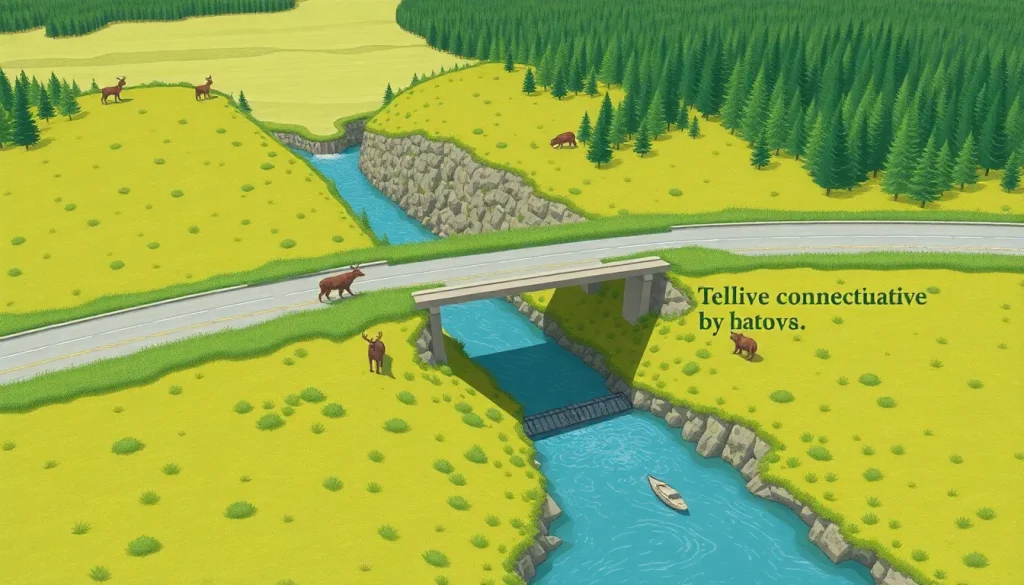
Restoring and maintaining ecosystem connectivity requires a combination of spatial planning, policy, and on-the-ground interventions. Establishing ecological networks of core protected areas linked by corridors and buffer zones is a foundational strategy. These networks can be designed using geographic information systems (GIS) and species movement data to identify critical linkages. Wildlife crossings, such as overpasses and underpasses on highways, have proven highly effective in reducing animal-vehicle collisions and reconnecting fragmented habitats.
In agricultural landscapes, agroecological approaches like hedgerow planting, riparian buffer strips, and maintaining field margins can enhance connectivity for pollinators and small mammals. Dam removal and the installation of fish ladders restore river connectivity, allowing migratory fish to reach spawning grounds. At the policy level, land-use planning that incorporates connectivity goals, such as green infrastructure and conservation easements, can prevent further fragmentation. International cooperation is essential for transboundary connectivity, as seen in the European Union’s Natura 2000 network, which links protected areas across member states.
Benefits, Limitations and Trade-offs
Enhancing ecosystem connectivity yields clear benefits: increased biodiversity, improved ecosystem resilience, and sustained ecosystem services. Connected landscapes are better able to recover from disturbances like fires or storms, and they support larger, more viable populations of wildlife. For humans, connectivity can reduce crop damage from pests by supporting natural predators, improve water quality through connected wetlands, and provide recreational opportunities.
However, connectivity is not without limitations and trade-offs. Corridors can sometimes facilitate the spread of invasive species, diseases, or fire. For example, a wildlife corridor might allow a pathogen to move between previously isolated populations. There are also economic trade-offs: setting aside land for corridors may compete with agriculture or development. In some cases, promoting connectivity for one species may inadvertently harm another—a corridor designed for large carnivores could increase predation pressure on livestock or endangered prey. Effective connectivity planning must weigh these factors and often requires a multi-species, ecosystem-based approach to minimize negative outcomes.
FAQ
What is ecosystem connectivity?
Ecosystem connectivity is the ability of a landscape or seascape to allow the movement of organisms, genes, and ecological processes between habitat patches. It ensures that species can access resources, migrate, and adapt to environmental changes.
How does ecosystem connectivity work?
It works through structural elements like corridors and stepping stones, and functional aspects like species' movement behavior. Connected habitats allow gene flow, dispersal, and migration, which maintain healthy populations and ecosystem functions.
Why does ecosystem connectivity matter?
It matters because it sustains biodiversity, supports ecosystem services like pollination and flood control, and helps species survive climate change by allowing them to shift their ranges. Loss of connectivity leads to population declines and ecosystem degradation.
References
- Hilty, J. A., Lidicker, W. Z., & Merenlender, A. M. (2006). Corridor Ecology: The Science and Practice of Linking Landscapes for Biodiversity Conservation. Island Press.
- Bennett, A. F. (2003). Linkages in the Landscape: The Role of Corridors and Connectivity in Wildlife Conservation. IUCN.
- Crooks, K. R., & Sanjayan, M. (Eds.). (2006). Connectivity Conservation. Cambridge University Press.