In brief
At a glance
Quick Facts
- Definition
- Land subsidence is the gradual sinking of the ground surface due to the compaction of aquifer sediments when groundwater is removed.
- Primary cause
- Excessive groundwater extraction reduces pore pressure, increasing effective stress and causing sediment compaction.
- Irreversibility
- Most subsidence is permanent because clay compaction is inelastic; the land surface does not rebound even if water levels recover.
- Global impact
- Affects many major cities and agricultural regions, including Mexico City, Jakarta, and California's Central Valley.
- Measurement
- Can be detected with GPS, satellite-based InSAR, and ground-based extensometers with millimeter accuracy.
- Mitigation
- Managed aquifer recharge and reduced pumping can slow or halt subsidence, but reversal is rare.
Key Takeaways
- Land subsidence from groundwater extraction is the gradual sinking of the ground surface due to the compaction of aquifer sediments when water is removed.
- It is often irreversible because the compaction of fine-grained sediments (clays and silts) is inelastic, leading to permanent loss of aquifer storage capacity.
- Subsidence can cause severe infrastructure damage, increased flooding, and reduced effectiveness of water management systems.
- Effective solutions include reducing groundwater extraction, artificial recharge of aquifers, and integrated water resource management.
What Is Land Subsidence Caused by Groundwater Extraction?
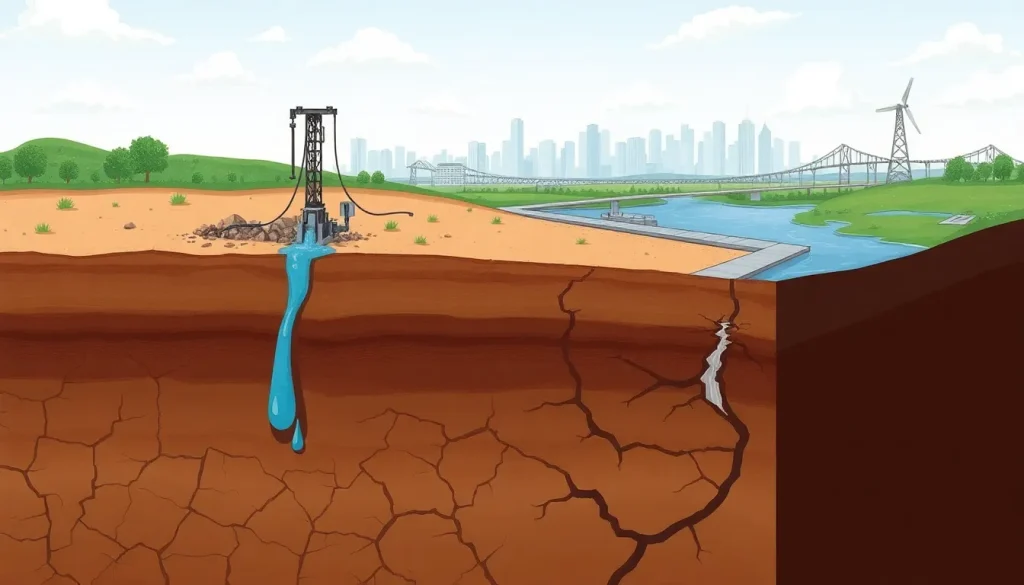
Land subsidence caused by groundwater extraction is the downward settling of the Earth’s surface that occurs when large volumes of water are pumped from underground aquifers. This phenomenon is a type of ground failure that results from the compaction of aquifer systems, particularly in regions underlain by unconsolidated sediments such as sand, silt, and clay. As water is removed, the pore pressure that once helped support the weight of overlying material decreases, causing the sediment grains to rearrange and pack more tightly. The result is a reduction in the overall volume of the aquifer, which manifests at the surface as a gradual sinking or, in some cases, sudden collapse.
This process is distinct from other types of subsidence, such as those caused by mining, oil and gas extraction, or natural compaction of sediments. Groundwater-induced subsidence is a global issue that affects many heavily populated and agricultural regions. It is often slow and imperceptible on a daily basis, but over years and decades it can lead to cumulative vertical displacements of several meters. Once subsidence occurs, the loss of aquifer storage is typically permanent, making it a critical concern for long-term water security and land stability.
How It Works
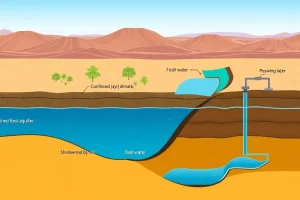
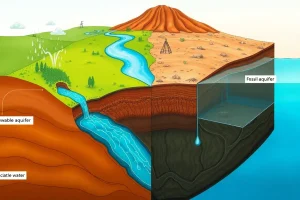
Aquifers are underground layers of permeable rock or sediment that hold water. In a natural state, the water in the pore spaces exerts an upward pressure that partially counteracts the weight of the overlying material. This is known as pore pressure or neutral stress. When groundwater is extracted, the water table drops and pore pressure decreases. The effective stress—the portion of the total weight borne by the sediment skeleton—increases, causing the grains to compress and the pore spaces to shrink. This compaction is the direct cause of land subsidence.
The response of an aquifer system to stress depends on the sediment type. Coarse-grained materials like sand and gravel typically undergo elastic compaction: they compress when stress is applied but can rebound if the stress is removed (i.e., if water levels recover). Fine-grained sediments such as clay and silt, however, often experience inelastic compaction. These materials have a “preconsolidation stress”—the maximum effective stress they have experienced in their geological history. When groundwater extraction pushes the effective stress beyond this threshold, the clay particles rearrange permanently, and the compaction is irreversible. Because clays have low permeability, water drains from them slowly, so compaction can continue for decades even after pumping stops—a phenomenon known as residual subsidence.
Modern monitoring techniques, including GPS networks, satellite-based Interferometric Synthetic Aperture Radar (InSAR), and ground-based extensometers, allow scientists to measure subsidence with millimeter-scale precision. These tools reveal that subsidence often occurs in localized “hotspots” that correlate with pumping centers and the distribution of compressible sediments.
Main Causes or Drivers
The primary driver of land subsidence is excessive groundwater extraction, but the susceptibility of a region depends heavily on its geology. Aquifers that contain thick sequences of compressible clay and silt are most vulnerable. Human activities that lead to over-extraction include agricultural irrigation, municipal water supply, and industrial use. In many regions, groundwater is pumped at rates that exceed natural recharge, causing a persistent decline in water levels and pore pressure.
Underlying factors often include population growth, expansion of irrigated agriculture, and inadequate water management policies. In coastal areas, over-extraction can also induce saltwater intrusion, which further degrades water quality. While groundwater extraction is the direct cause, other human activities such as oil and gas extraction, mining, and drainage of organic soils can also cause subsidence, but these are distinct processes. The focus here remains on subsidence driven by the removal of water from aquifer systems.
Environmental and Human Impacts
Land subsidence has far-reaching consequences for both natural environments and human infrastructure. One of the most significant impacts is the permanent loss of aquifer storage capacity. As pore spaces collapse, the aquifer can no longer hold as much water, reducing its ability to serve as a buffer during droughts. This exacerbates water scarcity and undermines long-term water security.
Subsidence also increases flood risk, particularly in coastal and low-lying areas. As the land surface sinks, relative sea level rises, making communities more vulnerable to storm surges and tidal flooding. Inland, altered topography can disrupt drainage patterns, leading to localized flooding and standing water. Infrastructure such as buildings, roads, bridges, pipelines, and well casings can be damaged by differential settlement—uneven sinking that causes cracking and structural failure. The economic costs are substantial, including repair and retrofitting expenses, reduced property values, and lost agricultural productivity. In some cases, subsidence can trigger earth fissures—large cracks in the ground that pose direct hazards to people and property.
Regional Differences
Subsidence patterns vary widely across the globe, reflecting differences in geology, climate, and water use. In the San Joaquin Valley of California, decades of intensive agricultural pumping have caused subsidence of more than 9 meters in some locations, damaging canals and reducing the capacity of water conveyance systems. Mexico City, built on the drained bed of an ancient lake, has sunk over 10 meters as water is extracted from the underlying aquifer, leading to severe damage to historic buildings and modern infrastructure alike.
In Asia, several megacities face critical subsidence challenges. Jakarta, Indonesia, is one of the fastest-sinking cities in the world, with some areas subsiding at rates of several centimeters per year due to unregulated groundwater extraction. Bangkok, Shanghai, and Ho Chi Minh City have also experienced significant subsidence. In Europe, Venice has long grappled with subsidence compounded by sea-level rise. Coastal regions are particularly vulnerable because subsidence magnifies the effects of climate change. In contrast, some areas have successfully slowed or halted subsidence through strict groundwater management and artificial recharge, demonstrating that the problem is not inevitable.
Solutions
Addressing land subsidence requires a combination of engineering, policy, and management strategies. The most direct approach is to reduce groundwater extraction by shifting to alternative water sources, such as surface water, desalination, or recycled wastewater. Improving water use efficiency in agriculture and urban settings can also lower demand. Managed aquifer recharge (MAR) involves intentionally replenishing aquifers with excess surface water or treated wastewater during wet periods, helping to restore pore pressure and slow or halt compaction.
Regulatory measures are essential. Groundwater extraction permits, pumping limits, and well spacing rules can prevent over-exploitation. Effective monitoring systems—using satellite InSAR, GPS, and groundwater level measurements—provide the data needed to detect subsidence early and adjust management practices. In some cases, engineering solutions such as raising levees, reinforcing foundations, or constructing sea walls can mitigate the effects of subsidence, but these are often costly and do not address the root cause. Long-term success depends on integrated water resource management that balances human needs with the sustainability of aquifer systems.
Common Misconceptions
One common misconception is that land subsidence is always reversible. In reality, the compaction of clay layers is largely permanent because the rearrangement of clay particles is inelastic. Even if water levels recover, the land surface does not rebound to its original elevation. Another misconception is that subsidence only occurs in arid or semi-arid regions. While it is common in dry areas with heavy agricultural pumping, it can happen anywhere with compressible sediments and excessive groundwater extraction, including humid coastal cities.
Some people believe that subsidence is a slow, harmless process. Although rates may be only a few centimeters per year, cumulative subsidence over decades can cause severe damage to infrastructure and permanently reduce aquifer storage. Additionally, there is a misconception that stopping groundwater extraction immediately halts subsidence. In fact, residual compaction can continue for years or decades because water drains slowly from low-permeability clay layers, and the system may take a long time to reach a new equilibrium.
FAQ
What is land subsidence caused by groundwater extraction?
It is the gradual sinking of the Earth's surface that occurs when large volumes of water are pumped from underground aquifers, causing the aquifer sediments to compact and the land above to settle.
How does groundwater extraction cause land subsidence?
Extraction lowers water pressure in the aquifer's pores. This increases the effective stress on the sediment skeleton, causing grains to rearrange and pack more tightly, which reduces the aquifer's volume and leads to surface sinking.
Why does land subsidence matter?
It permanently reduces groundwater storage capacity, increases flood risk, damages infrastructure, and can lead to costly economic losses. In coastal areas, it accelerates relative sea-level rise, worsening the impacts of climate change.
References
- United States Geological Survey (USGS) – Land Subsidence from Groundwater Withdrawal
- UNESCO – Groundwater and Land Subsidence: A Global Review
- Journal of Hydrology – Mechanisms and Management of Land Subsidence due to Groundwater Extraction