In brief
At a glance
Quick Facts
- Core stages of a product life cycle
- Raw material extraction, manufacturing, distribution, use, and end-of-life (disposal or recycling).
- Key international standard
- ISO 14040 and 14044 provide the framework for Life Cycle Assessment (LCA).
- Commonly assessed impacts
- Carbon footprint, water use, energy consumption, toxicity, and resource depletion.
- Origin of the concept
- Emerged from industrial ecology and systems thinking in the 1960s and 1970s.
- Difference from traditional thinking
- Considers upstream and downstream impacts, not just direct manufacturing costs.
- Business benefits
- Cost savings, risk reduction, innovation, brand enhancement, and regulatory compliance.
- Typical hotspot
- For many appliances, the use phase accounts for the majority of life-cycle energy consumption.
- Relation to circular economy
- Life-cycle thinking is foundational to designing out waste and keeping materials in use.
Key Takeaways
- Life-cycle thinking expands the scope of business decisions beyond the point of sale to include raw material extraction, manufacturing, distribution, use, and end-of-life management.
- It helps businesses uncover hidden environmental and social costs, reduce risks, and identify opportunities for innovation and efficiency.
- The approach is foundational to methodologies like Life Cycle Assessment (LCA), which quantifies impacts such as carbon footprint and water use.
- Adopting life-cycle thinking can enhance brand reputation, ensure regulatory compliance, and drive long-term profitability by aligning with circular economy principles.
What Is Life-Cycle Thinking for Business Decisions?
Life-cycle thinking is a decision-making framework that considers the full lifespan of a product, service, or process—from raw material extraction and manufacturing to distribution, use, and end-of-life disposal or recycling. In a business context, it means evaluating environmental, social, and economic impacts at every stage, rather than focusing narrowly on immediate costs and benefits. This holistic perspective helps companies avoid shifting burdens from one life-cycle phase to another and supports the design of genuinely sustainable solutions.
Unlike traditional business models that often prioritize short-term financial gains and overlook externalities, life-cycle thinking encourages a systems view. It is closely linked to concepts such as the circular economy, industrial ecology, and sustainable supply chain management. By applying this approach, businesses can make more resilient decisions that account for resource scarcity, evolving regulations, and changing consumer expectations, ultimately leading to products and services that are both profitable and responsible over the long term.
How It Works
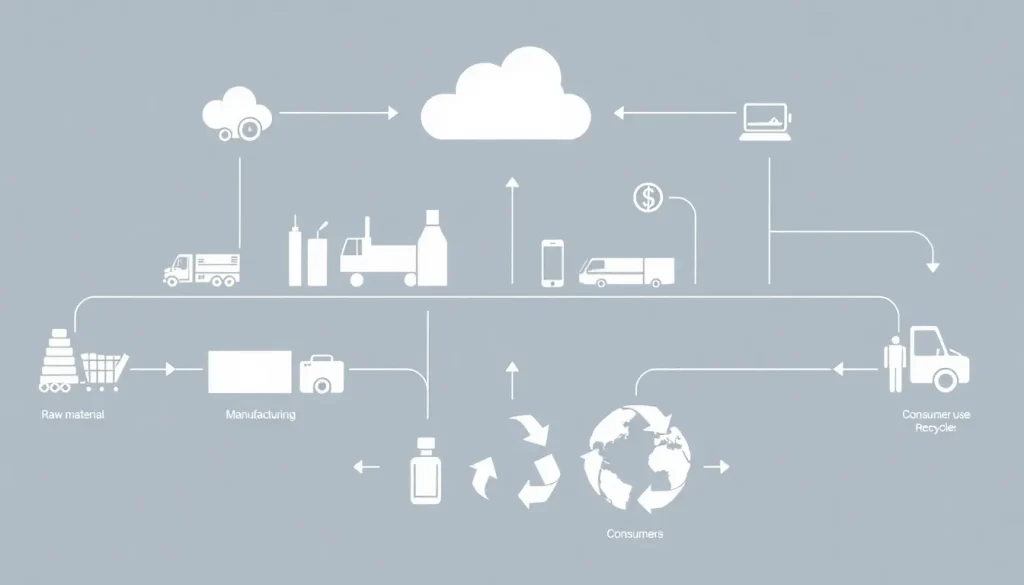
Life-cycle thinking involves mapping all stages of a product’s life and assessing their impacts. The typical stages include:
- Raw material extraction: Sourcing of materials, including mining, harvesting, and associated land use changes.
- Manufacturing: Processing, assembly, and packaging, along with energy and water consumption.
- Distribution: Transportation and logistics, including warehousing and retail operations.
- Use: Consumer or industrial use, maintenance, and repair, which often dominate energy and water impacts.
- End-of-life: Disposal, recycling, or repurposing, including waste management and potential material recovery.
Businesses apply life-cycle thinking through tools like Life Cycle Assessment (LCA), which quantifies environmental impacts such as greenhouse gas emissions, water use, and toxicity. The process involves defining a goal and scope, compiling an inventory of inputs and outputs, assessing potential impacts, and interpreting results. Even without a full LCA, companies can use life-cycle thinking qualitatively to identify hotspots, compare design alternatives, or inform procurement policies. For example, a furniture manufacturer might discover that the highest carbon emissions occur not in production but in the sourcing of wood from deforested areas, prompting a switch to certified sustainable timber.
Importance and Impact
Life-cycle thinking is critical for businesses aiming to manage risk, reduce costs, and build long-term resilience. By revealing impacts across the value chain, it helps companies anticipate regulatory changes, such as carbon taxes or extended producer responsibility laws. It also mitigates reputational risks associated with unsustainable sourcing or waste practices. For instance, a food company that ignores water use in its agricultural supply chain may face operational disruptions during droughts, while a proactive life-cycle approach can secure water-efficient sourcing and strengthen stakeholder trust.
On a broader scale, life-cycle thinking drives innovation and competitive advantage. It encourages the redesign of products and processes to minimize waste, use renewable materials, and enable circular business models like product-as-a-service. This not only reduces environmental footprints but also opens new revenue streams and improves customer loyalty. Governments and international bodies increasingly embed life-cycle principles in policies and standards, making the approach essential for market access and compliance.
Benefits
Adopting life-cycle thinking offers businesses a range of tangible and intangible benefits:
- Cost savings: Identifying inefficiencies in material and energy use can lower operational expenses. For example, reducing packaging weight cuts both material costs and transportation emissions.
- Risk reduction: Understanding supply chain vulnerabilities—from resource scarcity to regulatory shifts—enables proactive mitigation.
- Innovation: A life-cycle perspective often reveals opportunities for product redesign, new service models, or alternative materials that differentiate a brand.
- Enhanced reputation: Transparent communication about life-cycle impacts builds trust with consumers, investors, and regulators.
- Regulatory readiness: Early alignment with emerging standards like the EU’s Product Environmental Footprint avoids last-minute compliance costs.
- Stakeholder engagement: It provides a common language for collaborating with suppliers, customers, and NGOs on sustainability goals.
Limitations and Trade-offs
Despite its advantages, life-cycle thinking has practical challenges. Data availability and quality can be significant barriers, especially for complex global supply chains. Collecting primary data from every supplier is time-consuming and expensive, leading many companies to rely on industry averages or proxy data that may not reflect specific conditions. Additionally, defining system boundaries—what to include or exclude—requires judgment and can influence results. For example, should a company account for the energy used by consumers to charge its electronic device? Such choices can alter conclusions.
There are also trade-offs between comprehensiveness and practicality. A full LCA can be resource-intensive, making it less accessible for small and medium enterprises. Simplified tools and screening assessments offer a middle ground but may miss important nuances. Furthermore, life-cycle thinking often focuses on environmental impacts, while social and economic dimensions are harder to quantify. Businesses must balance the depth of analysis with decision-making speed and cost, and they should be transparent about assumptions and limitations to avoid greenwashing.
Common Misconceptions
Misconception 1: Life-cycle thinking is only about the environment. While environmental impacts are a core focus, the approach also encompasses social and economic dimensions, such as labor conditions, community impacts, and total cost of ownership.
Misconception 2: It is too expensive and complex for most businesses. Many tools and databases exist to streamline the process, and even qualitative life-cycle thinking can yield valuable insights without a full LCA. Small businesses can start with hotspot analysis or use sector-specific calculators.
Misconception 3: Life-cycle thinking is the same as Life Cycle Assessment (LCA). LCA is a specific, standardized methodology for quantifying environmental impacts, while life-cycle thinking is a broader philosophy that can be applied qualitatively or through other tools like carbon footprinting or material flow analysis.
Misconception 4: It always leads to higher costs. While initial investments may be needed, life-cycle thinking often reveals cost-saving opportunities through material efficiency, energy reduction, and waste minimization that improve the bottom line over time.
What Businesses and Governments Can Do
Businesses can integrate life-cycle thinking into their operations through several practical steps:
- Conduct a screening LCA or hotspot analysis to identify the most significant impacts across the value chain.
- Incorporate life-cycle criteria into product design and procurement policies, such as requiring suppliers to disclose environmental data or selecting materials with lower footprints.
- Train employees and engage leadership to embed life-cycle thinking in corporate strategy and innovation processes.
- Communicate transparently with stakeholders through environmental product declarations (EPDs) or sustainability reports that reference life-cycle results.
- Collaborate with industry peers to share data and develop sector-wide benchmarks, reducing the burden on individual companies.
Governments and regulatory bodies can support life-cycle thinking by:
- Developing standardized methodologies and databases to lower the cost and complexity of assessments.
- Incentivizing life-cycle-based practices through tax breaks, subsidies, or preferential procurement for products with verified lower impacts.
- Implementing policies that require life-cycle information, such as mandatory carbon labeling or extended producer responsibility schemes.
- Funding research and education to advance life-cycle assessment methods and build capacity in the private sector.
FAQ
What is life-cycle thinking?
Life-cycle thinking is a holistic approach that considers the environmental, social, and economic impacts of a product or service from raw material extraction through manufacturing, use, and disposal or recycling.
How does life-cycle thinking differ from traditional business decision-making?
Traditional decision-making often focuses on immediate costs and benefits within a single stage, like manufacturing. Life-cycle thinking expands the view to include upstream supply chains and downstream use and end-of-life, revealing hidden impacts and opportunities.
Why does life-cycle thinking matter for businesses?
It helps businesses reduce risks, cut costs, innovate, comply with regulations, and build a stronger brand by understanding and managing their full value chain impacts.
References
- ISO 14040:2006 Environmental management — Life cycle assessment — Principles and framework
- UNEP/SETAC Life Cycle Initiative, 'Global Guidance for Life Cycle Impact Assessment Indicators'
- European Commission, 'Product Environmental Footprint (PEF) Guide'