In brief
At a glance
Quick Facts
- Definition of capacity factor
- Ratio of actual energy output to maximum possible output if the plant ran at full nameplate capacity continuously over a period.
- Definition of efficiency
- Ratio of useful energy output to total energy input, measuring conversion effectiveness.
- Typical nuclear capacity factor
- Around 90%, due to baseload operation and high reliability.
- Typical solar PV capacity factor
- 10–25%, depending on location and weather.
- Highest thermal efficiency
- Combined-cycle gas turbines can exceed 60% efficiency.
- Impact on cost
- Higher capacity factor reduces levelized cost of energy by spreading fixed costs over more output.
- Efficiency limit
- Heat engines are limited by Carnot efficiency; renewables by physical conversion limits (e.g., Betz limit for wind).
- Common confusion
- Low capacity factor does not mean low efficiency; a solar panel can be 20% efficient but have a 15% capacity factor.
Key Takeaways
- Capacity factor is the ratio of actual energy output over a period to the maximum possible output if the plant ran at full nameplate capacity continuously; efficiency is the ratio of useful energy output to energy input.
- A power plant can have high efficiency but low capacity factor (e.g., a peaking gas turbine), or low efficiency but high capacity factor (e.g., an older baseload coal plant).
- Capacity factor is driven by resource availability, maintenance, and demand, while efficiency is limited by technology and thermodynamics.
- Both metrics are crucial for assessing economic viability, environmental impact, and grid integration of different generation technologies.
What Is Capacity Factor vs Efficiency?
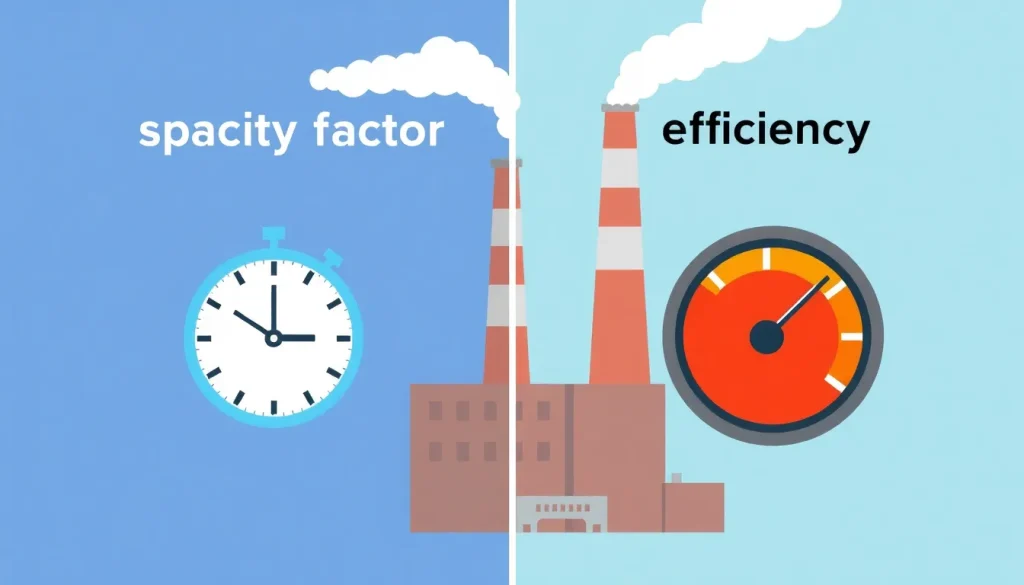
Capacity factor and efficiency are two distinct performance metrics used to evaluate power plants and other energy systems. Capacity factor is a measure of utilization: it compares the actual energy output of a plant over a given period to the maximum possible output if the plant operated at its full nameplate capacity continuously during that same period. Efficiency, on the other hand, is a measure of conversion effectiveness: it quantifies how much of the input energy (e.g., fuel, sunlight, wind) is converted into useful output energy (usually electricity). While both are expressed as percentages, they describe fundamentally different aspects of a plant’s operation.
In simple terms, capacity factor answers the question, “How much of the time did the plant run at full power?” whereas efficiency answers, “How well did the plant turn its fuel or resource into electricity?” A plant with a high capacity factor is producing a large fraction of its theoretical maximum output, but it might be doing so with low efficiency if it wastes a lot of input energy. Conversely, a highly efficient plant may have a low capacity factor if it only operates during peak demand periods. Understanding this distinction is essential for energy planning, cost analysis, and comparing different generation technologies.
Overview
In the energy sector, capacity factor and efficiency are often cited together but serve different analytical purposes. Capacity factor is primarily a measure of reliability and utilization, reflecting how consistently a plant is available to generate power. It is influenced by factors such as resource availability (for renewables), maintenance schedules, grid demand, and economic dispatch. Efficiency, on the other hand, is a measure of technical performance, indicating how effectively a plant converts its primary energy source into electricity. It is governed by the laws of thermodynamics and the specific technology employed.
Both metrics are critical for comparing different generation technologies. For example, a nuclear power plant typically has a high capacity factor (often above 90%) because it runs almost continuously, but its thermal efficiency is moderate (around 33%). A solar photovoltaic (PV) system has a relatively low capacity factor (10–25%) due to the intermittent nature of sunlight, but its conversion efficiency is steadily improving. A combined-cycle gas turbine can achieve both high efficiency (up to 60%) and a high capacity factor when run as a baseload plant. Thus, evaluating a technology requires looking at both metrics in context.
How It Works
Capacity factor is calculated as the ratio of actual energy output over a specified time period to the energy that would have been produced if the plant operated at its full nameplate capacity for the entire period. The formula is:
Capacity Factor = (Actual Energy Output in kWh) / (Nameplate Capacity in kW × Hours in Period) × 100%
For example, a 100 MW wind farm that generates 200,000 MWh over a year (8,760 hours) has a capacity factor of (200,000 MWh) / (100 MW × 8,760 h) = 22.8%. This metric is dimensionless and time-dependent; a plant’s capacity factor can vary seasonally or annually.
Efficiency, in contrast, is the ratio of useful output energy to total input energy. For a thermal power plant, it is often expressed as:
Efficiency = (Net Electricity Output) / (Fuel Energy Input) × 100%
For renewable sources like solar panels, efficiency is the percentage of incident solar energy converted to electricity. Efficiency is limited by physical laws; for heat engines, the Carnot efficiency sets an upper bound based on temperature differences. Unlike capacity factor, efficiency is an instantaneous or average conversion rate and does not depend on how long the plant runs.
Importance and Impact
Capacity factor directly affects the economic viability of a power plant. A higher capacity factor means more electricity is sold over the same capital investment, reducing the levelized cost of energy (LCOE). For intermittent renewables, low capacity factors necessitate overbuilding capacity or adding storage to meet demand, which increases system costs. Conversely, plants with high capacity factors, such as nuclear or combined-cycle gas, provide stable baseload power and improve grid reliability.
Efficiency impacts operating costs and environmental footprint. A more efficient plant consumes less fuel per unit of electricity, lowering fuel expenses and reducing emissions of CO₂ and other pollutants. For fossil fuel plants, even small efficiency improvements can yield significant cost savings and emission reductions over the plant’s lifetime. In renewable systems, higher conversion efficiency means more energy harvested from the same resource, improving land use and material requirements. Both metrics are therefore central to energy policy, investment decisions, and sustainability goals.
Common Misconceptions
One widespread misconception is that capacity factor and efficiency are interchangeable or that a low capacity factor implies poor efficiency. In reality, a solar panel with 20% efficiency might have a 15% capacity factor due to nighttime and cloudy weather, but its efficiency remains 20% whenever it is generating. Similarly, a natural gas peaker plant might have a high efficiency (e.g., 40%) but a capacity factor of only 5% because it runs only a few hundred hours per year.
Another misconception is that renewable energy sources are inherently inefficient because of their low capacity factors. While wind and solar do have lower capacity factors than fossil fuel or nuclear plants, their “fuel” is free and emission-free, so the economic and environmental calculus differs. Efficiency for renewables is often about conversion technology, not utilization. Finally, some assume that a high capacity factor always means a plant is economically superior, but if the plant has high fuel costs or low efficiency, its overall profitability may still be poor.
Examples
Typical capacity factor and efficiency ranges for common generation technologies illustrate the distinction:
- Nuclear power: Capacity factor ~90% (baseload operation), thermal efficiency ~33%.
- Coal-fired plant: Capacity factor 40–80% (depending on age and dispatch), efficiency 30–45% (supercritical plants higher).
- Combined-cycle gas turbine (CCGT): Capacity factor 50–90%, efficiency 50–60%.
- Open-cycle gas turbine (peaker): Capacity factor 5–15%, efficiency 35–40%.
- Solar photovoltaic: Capacity factor 10–25% (varies by location), module efficiency 15–22%.
- Wind onshore: Capacity factor 20–40%, aerodynamic efficiency limited by Betz’s law (~59% theoretical max, practical ~35–45%).
- Hydropower: Capacity factor 30–60% (depending on water availability), conversion efficiency >90% (turbine efficiency).
These numbers show that high efficiency does not guarantee high capacity factor, and vice versa. Hydropower has very high conversion efficiency but a moderate capacity factor due to seasonal water flows. Nuclear has modest efficiency but an extremely high capacity factor.
Connections to Other Systems
Capacity factor and efficiency are closely linked to other key energy metrics. Levelized cost of energy (LCOE) depends heavily on capacity factor because fixed costs are spread over more kilowatt-hours. A plant with a low capacity factor will have a higher LCOE, all else being equal. Efficiency influences LCOE through fuel costs: a more efficient plant uses less fuel, reducing variable costs.
Capacity credit is a measure of a plant’s contribution to grid reliability during peak demand. It is related to capacity factor but not identical; a wind farm with a 35% capacity factor might have a capacity credit of only 10–20% because wind may not blow during peak hours. Efficiency does not directly affect capacity credit, but high-efficiency plants are often dispatched more frequently, indirectly improving their reliability value. Heat rate (Btu/kWh) is the inverse of efficiency and is commonly used in thermal plant analysis. Understanding these interconnections helps grid operators and policymakers design robust, cost-effective electricity systems.
FAQ
What is the difference between capacity factor and efficiency?
Capacity factor measures how much energy a plant actually produces compared to its maximum potential over time, while efficiency measures how well the plant converts input energy into useful output. Capacity factor is about utilization; efficiency is about conversion.
Why do renewable energy sources have low capacity factors?
Renewable sources like solar and wind depend on variable natural resources. Solar panels only generate when the sun shines, and wind turbines only when the wind blows, leading to capacity factors typically between 10% and 40%. This does not mean they are inefficient; their conversion efficiency can be high when operating.
Can a power plant have high efficiency but low capacity factor?
Yes. A peaking natural gas turbine may have an efficiency of 40% but only run a few hundred hours per year, resulting in a capacity factor of 5–15%. Its high efficiency reduces fuel costs when it operates, but its low utilization means fixed costs are spread over less energy.
References
- U.S. Energy Information Administration, 'Electric Power Monthly' and 'Levelized Cost and Levelized Avoided Cost of New Generation Resources'
- International Energy Agency, 'Key World Energy Statistics' and 'World Energy Outlook'
- National Renewable Energy Laboratory, 'Capacity Factor and Efficiency: Definitions and Uses'