In brief
At a glance
Quick Facts
- Primary cause
- Sunlight reflected off satellite surfaces, especially solar panels and antennae, and radio emissions from satellite transmitters.
- Affected observatories
- Both optical and radio observatories worldwide, including major facilities like the Vera C. Rubin Observatory and the Square Kilometre Array.
- Typical satellite brightness
- Many LEO satellites are visible to the naked eye at magnitude 4–6, but even fainter ones affect sensitive astronomical instruments.
- Radio interference bands
- Satellite downlinks can spill into protected radio astronomy bands such as 1.4 GHz (hydrogen line) and 10.6–10.7 GHz.
- Mitigation techniques
- Dark coatings, sunshades, orientation adjustments, and coordination with observatories to reduce optical and radio impact.
- Number of satellites
- As of the early 2020s, thousands of operational satellites are in LEO, with plans for tens of thousands more from multiple operators.
- Cultural impact
- Satellite trails alter the traditional appearance of the night sky, affecting cultural practices, astrophotography, and public enjoyment.
Key Takeaways
- Satellite pollution is the unintended brightening of the night sky and radio interference caused by artificial satellites, primarily from large constellations in low Earth orbit.
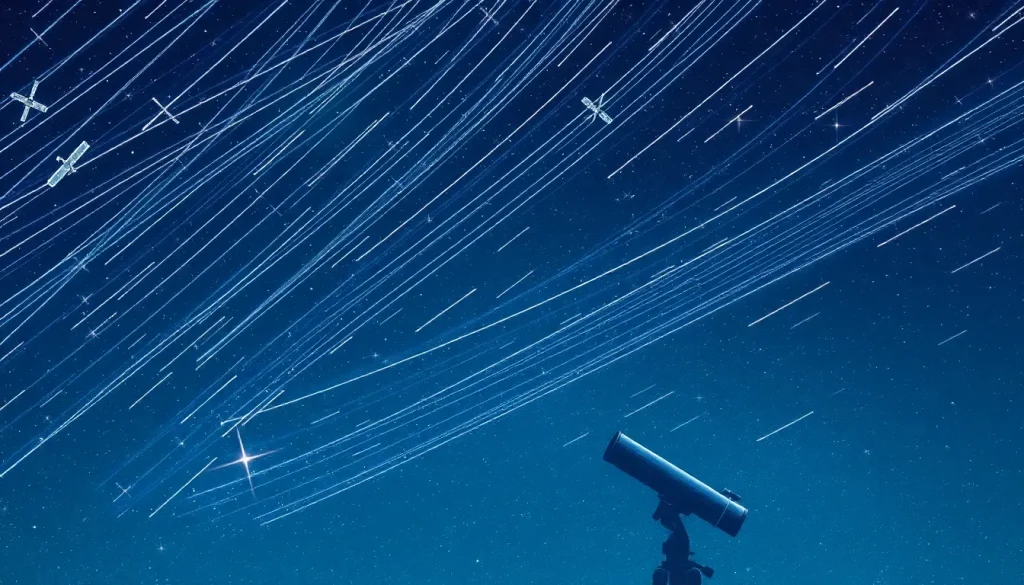
- Sunlight reflected off satellites creates visible streaks in astronomical images and contributes to an overall increase in sky brightness, hindering both professional and amateur observations.
- Radio emissions from satellites can interfere with radio telescopes, affecting the study of faint cosmic signals and potentially violating internationally protected frequency bands.
- Mitigation measures such as dark coatings, sunshades, and operational adjustments can reduce but not eliminate the impact, and the rapid growth of satellite constellations poses a continuing challenge.
What Is Satellite Pollution and the Night Sky?
Satellite pollution, in the context of the night sky, is the degradation of the natural darkness and radio quiet of the celestial sphere caused by artificial satellites orbiting Earth. It encompasses both the visible light reflected by satellites—creating streaks in telescopic images and adding to the diffuse glow of the night sky—and the radio frequency interference that disrupts sensitive astronomical observations. This form of pollution is a byproduct of the growing number of satellites, especially those in low Earth orbit (LEO) that form large constellations for global communications and Earth observation.
The night sky has long been a natural laboratory for science and a source of cultural inspiration. Satellite pollution threatens this heritage by making it harder to observe faint celestial objects, increasing the cost and complexity of ground-based astronomy, and altering the appearance of the sky for everyone. While individual satellites have been visible since the dawn of the space age, the sheer scale of modern constellations—with thousands of satellites planned—has turned what was once a rare curiosity into a persistent and widespread phenomenon.
Overview
Satellite pollution arises primarily from the reflection of sunlight off satellite surfaces, such as solar panels and antennae, back to Earth. When a satellite passes through the field of view of a telescope, it leaves a bright trail that can ruin long-exposure images. Even when no satellite is directly in the field of view, the cumulative effect of many faint satellites can increase the overall brightness of the night sky, a phenomenon known as diffuse sky brightness. This makes it harder to detect faint astronomical objects, such as distant galaxies or near-Earth asteroids.
In addition to optical interference, satellites emit radio waves for communication and navigation. These signals can spill over into frequency bands allocated for radio astronomy, which relies on extremely quiet radio environments to study natural cosmic emissions. The problem is exacerbated by the fact that many satellite constellations operate in low Earth orbit, where they are visible from large portions of the Earth’s surface and can affect observatories worldwide.
How It Works
Satellites become visible from the ground when they are illuminated by the Sun while the observer is in darkness—typically during twilight hours or just after sunset and before sunrise. The brightness of a satellite depends on its size, shape, surface materials, and orientation relative to the Sun and the observer. Flat, reflective surfaces like solar panels can act as mirrors, producing bright flares. Even when not flaring, a satellite can appear as a moving point of light, leaving a streak in long-exposure astronomical images.
Radio interference occurs when satellite transmitters emit signals in or near frequency bands used for radio astronomy. Radio telescopes are designed to detect extremely faint cosmic signals, and even weak satellite transmissions can overwhelm them. This is particularly problematic for spectral line observations, where astronomers study specific frequencies to understand the chemical composition and motion of celestial objects. Unwanted satellite emissions can create false signals or raise the noise floor, making it impossible to detect the desired astronomical signals.
Environmental and Human Impacts
The most direct impact of satellite pollution is on astronomical research. Ground-based observatories, both optical and radio, face increasing difficulty in obtaining uncontaminated data. Long-exposure images are often marred by satellite trails, requiring complex post-processing or rendering some data unusable. For time-sensitive observations—such as searching for near-Earth asteroids or studying transient events—satellite streaks can obscure critical information. The Vera C. Rubin Observatory, for example, designed to survey the entire sky every few nights, is expected to have a significant fraction of its images affected by satellite trails.
Beyond professional astronomy, satellite pollution affects amateur astronomers, astrophotographers, and the general public’s enjoyment of the night sky. The cultural and spiritual significance of a pristine, star-filled sky is diminished when artificial objects constantly traverse it. There are also concerns about the impact on nocturnal wildlife, as many species rely on natural light cues for navigation and behavior. While research is ongoing, the addition of numerous moving lights in the night sky could disrupt ecosystems.
Solutions
Several mitigation strategies have been proposed and, in some cases, implemented to reduce satellite pollution:
- Darkening treatments: Applying anti-reflective coatings or using darker materials on satellite surfaces can significantly reduce their reflectivity. For example, some operators have tested “DarkSat” and “VisorSat” designs to dim their spacecraft.
- Operational adjustments: Changing the orientation of satellites during twilight passes can minimize sunlight reflection toward the ground. Satellites can also be placed in orbits that keep them in Earth’s shadow during critical observing times.
- Radio quiet zones and coordination: Satellite operators can avoid transmitting in protected radio astronomy bands and coordinate with observatories to schedule transmissions during non-observing periods. Dynamic spectrum sharing and improved filtering on telescopes can also help.
- Regulatory frameworks: National and international bodies, such as the International Telecommunication Union (ITU) and the United Nations Committee on the Peaceful Uses of Outer Space (COPUOS), are developing guidelines to balance the benefits of satellite services with the protection of the night sky.
Benefits, Limitations and Trade-offs
Satellite constellations provide substantial benefits, including global broadband internet access, improved disaster response, and enhanced connectivity for remote and underserved regions. These services can drive economic development and bridge the digital divide. However, these benefits come with trade-offs. The same satellites that connect people also pollute the night sky, and mitigating the impact adds cost and complexity to satellite design and operations.
Current mitigation techniques have limitations. Dark coatings can cause satellites to absorb more heat, potentially affecting their performance and lifespan. Sunshades add weight and may interfere with antenna patterns. Operational adjustments, such as changing orientation, can reduce power generation from solar panels. Moreover, the sheer number of satellites means that even with mitigation, the cumulative effect on sky brightness and radio interference remains significant. Balancing the societal benefits of satellite services with the preservation of the night sky is an ongoing challenge that requires collaboration among industry, scientists, and policymakers.
Common Misconceptions
Misconception: Satellite pollution only affects professional astronomers. While professional observatories are heavily impacted, amateur astronomers, astrophotographers, and anyone who enjoys a dark night sky are also affected. Satellite trails can ruin long-exposure photographs and diminish the aesthetic experience of stargazing.
Misconception: Satellites are only visible to the naked eye during twilight. Many satellites are faint and not visible without optical aid, but they still appear in telescope images. Even satellites too dim to see individually contribute to the overall brightening of the night sky, a cumulative effect that is harder to perceive but scientifically significant.
Misconception: Satellite pollution is the same as space debris. Space debris refers to defunct, uncontrolled objects in orbit, while satellite pollution is caused by operational, functioning satellites. However, both contribute to orbital congestion and can interfere with observations, and the line blurs when satellites fail and become debris.
FAQ
What is satellite pollution?
Satellite pollution is the degradation of the night sky caused by artificial satellites, including visible light streaks, increased sky brightness, and radio frequency interference that disrupts astronomical observations.
How do satellites affect the night sky?
Satellites reflect sunlight, creating moving points of light that appear as streaks in long-exposure images. They also emit radio waves that can interfere with radio telescopes. The cumulative effect of many satellites brightens the overall sky background, making faint objects harder to see.
Why does satellite pollution matter?
It threatens ground-based astronomy, which relies on dark and radio-quiet skies to study the universe. It also impacts cultural heritage, amateur stargazing, and potentially nocturnal wildlife. Preserving the night sky is important for science, education, and human connection to the cosmos.
References
- International Astronomical Union (IAU) Statement on Satellite Constellations
- American Astronomical Society (AAS) Committee on Light Pollution, Radio Interference, and Space Debris
- United Nations Office for Outer Space Affairs (UNOOSA) Guidelines for the Long-term Sustainability of Outer Space Activities
- National Science Foundation (NSF) Report on the Impact of Satellite Constellations on Astronomy
- European Southern Observatory (ESO) Studies on the Effect of Satellite Constellations on Optical and Radio Astronomy