In brief
At a glance
Quick Facts
- Primary location
- Onshore turbines are on land; offshore turbines are in water.
- Typical turbine size
- Offshore turbines are larger, often exceeding 10 MW, while onshore turbines are usually 2–5 MW.
- Cost comparison
- Onshore wind is generally cheaper to install and maintain than offshore wind.
- Wind resource
- Offshore winds are stronger and more consistent, leading to higher capacity factors.
- First offshore wind farm
- Vindeby, Denmark, installed in 1991 with 11 turbines.
- Environmental concerns
- Onshore: land use, noise, bird collisions. Offshore: marine life disturbance, visual impact.
- Grid connection
- Onshore uses land-based lines; offshore requires subsea cables.
- Global capacity share
- Onshore wind accounts for the majority of installed wind capacity worldwide.
Key Takeaways
- Onshore wind energy is generated by turbines on land, while offshore wind energy uses turbines in bodies of water, typically oceans or large lakes.
- Offshore turbines are generally larger and more powerful, capturing stronger and more consistent winds, but they are more expensive to install and maintain.
- Onshore wind is currently the most cost-effective source of new electricity in many regions, but it faces land-use conflicts and visual impact concerns.
- Both onshore and offshore wind play critical roles in the global transition to renewable energy, with offshore wind offering vast untapped potential near densely populated coastal areas.
What Is Onshore Wind vs Offshore Wind?
Onshore wind energy refers to electricity generated by wind turbines located on land, typically in rural or open areas with consistent wind patterns. These turbines are often grouped into wind farms and connected to the electrical grid via land-based transmission lines. Onshore wind is the most mature and widely deployed form of wind energy, accounting for the majority of global wind power capacity. It has been used for centuries, from traditional windmills to modern multi-megawatt turbines, and remains a cornerstone of renewable energy strategies worldwide.
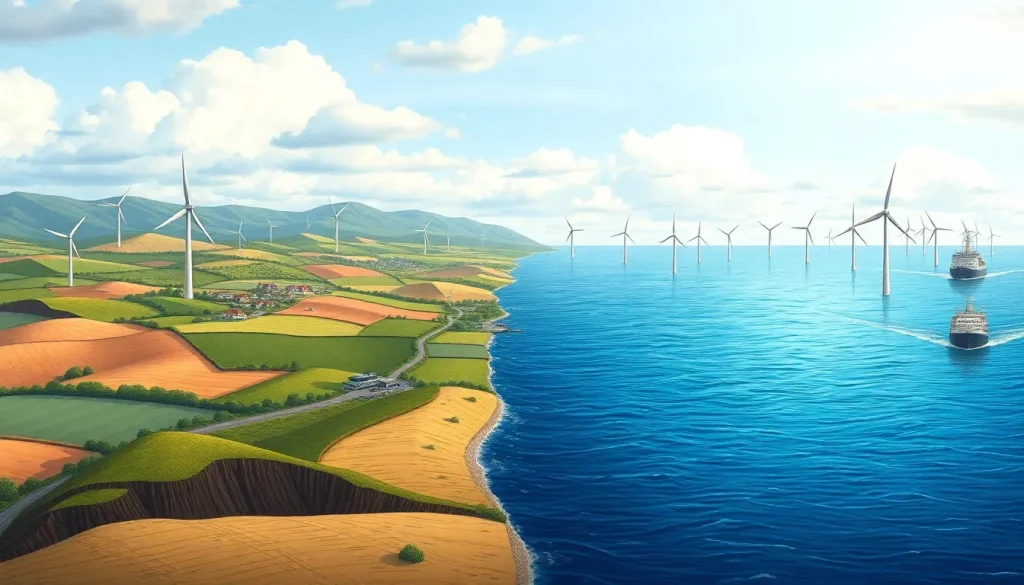
Offshore wind energy, in contrast, involves turbines installed in bodies of water, usually on the continental shelf. These turbines are larger and more powerful than their onshore counterparts, designed to withstand harsh marine environments. Offshore wind farms take advantage of stronger, more consistent winds over the ocean, resulting in higher energy yields. While the technology is newer and more expensive, it has grown rapidly due to its ability to provide large-scale clean energy near densely populated coastal regions, where land is scarce and electricity demand is high.
History
The use of wind energy on land dates back thousands of years, with early windmills used for grinding grain and pumping water. The first electricity-generating wind turbines appeared in the late 19th century, and by the mid-20th century, onshore wind farms began to emerge as a viable source of power. The oil crises of the 1970s spurred significant investment in wind energy technology, leading to the development of modern, efficient turbines. Today, onshore wind is a mature industry with millions of installations worldwide, from small single-turbine setups to vast wind farms spanning hundreds of square kilometers.
Offshore wind energy is a more recent innovation. The first offshore wind farm was installed in 1991 in Vindeby, Denmark, consisting of 11 turbines with a total capacity of 5 megawatts. Since then, the technology has advanced rapidly, with turbines growing in size and farms moving into deeper waters. The early 2000s saw the first large-scale offshore projects in Europe, and the industry has since expanded to Asia and North America. Today, offshore wind is a key component of many nations’ renewable energy targets, with floating turbine technology opening up new possibilities for deep-water sites.
How It Works
Both onshore and offshore wind turbines operate on the same basic principle: the kinetic energy of moving air turns the blades of a turbine, which spins a generator to produce electricity. However, the design, installation, and operation of these turbines differ significantly due to their environments.
Onshore turbines are typically smaller, with rotor diameters of 100–150 meters and hub heights of 80–120 meters. They are anchored to concrete foundations and connected to the grid via underground or overhead power lines. Onshore wind farms can be built in a variety of terrains, including plains, hills, and even mountainous regions, though they require careful siting to minimize turbulence and maximize wind capture. Maintenance is relatively straightforward, with technicians able to access turbines by road.
Offshore turbines are much larger, with rotor diameters exceeding 200 meters and hub heights of 150 meters or more. They are mounted on specialized foundations—such as monopiles, jackets, or floating platforms—that are fixed to the seabed or anchored in deep water. The turbines are connected to offshore substations, which transmit electricity to shore via subsea cables. Installation and maintenance require specialized vessels and equipment, and the turbines must be designed to withstand corrosive saltwater, high winds, and waves. Despite these challenges, offshore turbines benefit from higher wind speeds and less turbulence, leading to greater energy production per unit.
Benefits, Limitations and Trade-offs
Onshore wind energy offers several advantages. It is the most cost-effective renewable energy source in many regions, with low levelized costs of electricity. Onshore turbines are easier to install and maintain, and the supply chain is well-established. However, onshore wind faces limitations such as land availability, visual and noise impacts, and potential conflicts with agriculture, wildlife, and local communities. Wind resources on land can also be less consistent than at sea, leading to lower capacity factors.
Offshore wind energy provides access to stronger, more reliable winds, resulting in higher capacity factors and more stable electricity generation. Turbines can be built at a massive scale, and wind farms can be located near major coastal cities, reducing transmission losses. However, offshore wind is more expensive to build and maintain due to the harsh marine environment and the need for specialized vessels and equipment. Installation and maintenance are also weather-dependent, and the technology is still evolving, particularly for floating foundations in deep water. Environmental concerns include impacts on marine life, visual effects from shore, and potential conflicts with shipping and fishing.
Environmental and Human Impacts
Both onshore and offshore wind energy have environmental and social impacts that must be carefully managed. Onshore wind farms can affect local ecosystems through habitat disruption, bird and bat collisions, and noise. They may also alter landscapes, leading to opposition from nearby residents. However, these impacts are generally lower than those of fossil fuel-based power generation, and careful siting can mitigate many concerns.
Offshore wind farms have different environmental considerations. Construction and operation can disturb marine life, including fish, marine mammals, and seabirds. Underwater noise from pile driving during installation can affect species such as porpoises and dolphins. However, once operational, turbine foundations can create artificial reefs, potentially enhancing biodiversity. Visual impacts are a concern for coastal communities, though offshore farms are often located far enough from shore to be less intrusive. Both onshore and offshore wind energy produce no air pollution or greenhouse gas emissions during operation, making them critical tools for combating climate change.
Regional Differences
The suitability of onshore versus offshore wind varies significantly by region. In areas with abundant land and strong winds, such as the Great Plains of the United States or parts of China, onshore wind dominates. In densely populated regions with limited land, such as Europe and East Asia, offshore wind has become increasingly important. For example, countries like Denmark, the United Kingdom, and Germany have invested heavily in offshore wind to meet renewable energy targets while minimizing land-use conflicts.
Coastal nations with shallow continental shelves, such as those bordering the North Sea, have a natural advantage for fixed-bottom offshore wind. In contrast, regions with deep coastal waters, like Japan or the west coast of the United States, are exploring floating offshore wind technology. Onshore wind remains the primary option for landlocked countries or those with limited coastlines. The choice between onshore and offshore often depends on a combination of geographic, economic, and policy factors.
Importance and Impact
Understanding the differences between onshore and offshore wind is essential for energy planning and policy. Onshore wind provides a low-cost, rapidly deployable solution for reducing carbon emissions, particularly in regions with suitable land and wind resources. Offshore wind, while more expensive, offers a pathway to large-scale renewable energy near population centers, helping to decarbonize electricity grids and support the transition away from fossil fuels.
Both technologies are critical for achieving global climate goals. The growth of onshore wind has already made significant contributions to reducing greenhouse gas emissions, while offshore wind is poised to play an increasingly important role as costs decline and technology advances. Together, they form a complementary pair that can help meet the world’s growing energy demand sustainably, enhance energy security, and create economic opportunities in manufacturing, installation, and maintenance.
FAQ
What is the difference between onshore and offshore wind energy?
Onshore wind energy is produced by turbines on land, while offshore wind energy comes from turbines in water. Offshore turbines are larger and capture stronger winds, but they are more expensive to install.
How does onshore wind energy work?
Wind turns the blades of a turbine, which spins a generator to produce electricity. Onshore turbines are connected to the grid via land-based transmission lines.
Why does offshore wind matter?
Offshore wind provides access to stronger, more consistent winds, allowing for higher energy production and the potential to power large coastal cities with clean energy.
References
- International Energy Agency (IEA) – Wind Energy Technology Roadmap
- National Renewable Energy Laboratory (NREL) – Wind Energy Basics
- Global Wind Energy Council (GWEC) – Annual Wind Report