In brief
At a glance
Quick Facts
- Production Method (Green)
- Water electrolysis using renewable electricity
- Production Method (Blue)
- Steam methane reforming with carbon capture and storage (CCS)
- Carbon Emissions (Green)
- Near zero (lifecycle)
- Carbon Emissions (Blue)
- 60–90% lower than grey hydrogen, but not zero
- Primary Energy Source (Green)
- Wind, solar, hydropower
- Primary Energy Source (Blue)
- Natural gas (methane)
- Technology Maturity (Green)
- Commercially available but scaling up
- Technology Maturity (Blue)
- Commercially demonstrated; CCS at scale still limited
- Cost Drivers (Green)
- Renewable electricity price, electrolyzer cost
- Cost Drivers (Blue)
- Natural gas price, carbon capture cost, CO₂ transport and storage
Key Takeaways
- Green hydrogen is produced by splitting water with renewable electricity, resulting in zero direct carbon emissions; blue hydrogen is produced from natural gas with carbon capture and storage, significantly reducing but not eliminating emissions.
- The primary difference lies in the production method and carbon footprint: green hydrogen uses electrolysis powered by renewables, while blue hydrogen relies on steam methane reforming combined with carbon capture technology.
- Green hydrogen is considered the most sustainable long-term option, but it is currently more expensive and less mature than blue hydrogen, which leverages existing natural gas infrastructure.
- Both forms of hydrogen are critical for decarbonizing sectors like heavy industry, long-haul transport, and power generation, but their environmental and economic trade-offs influence their role in the energy transition.
What Is Green Hydrogen vs Blue Hydrogen?
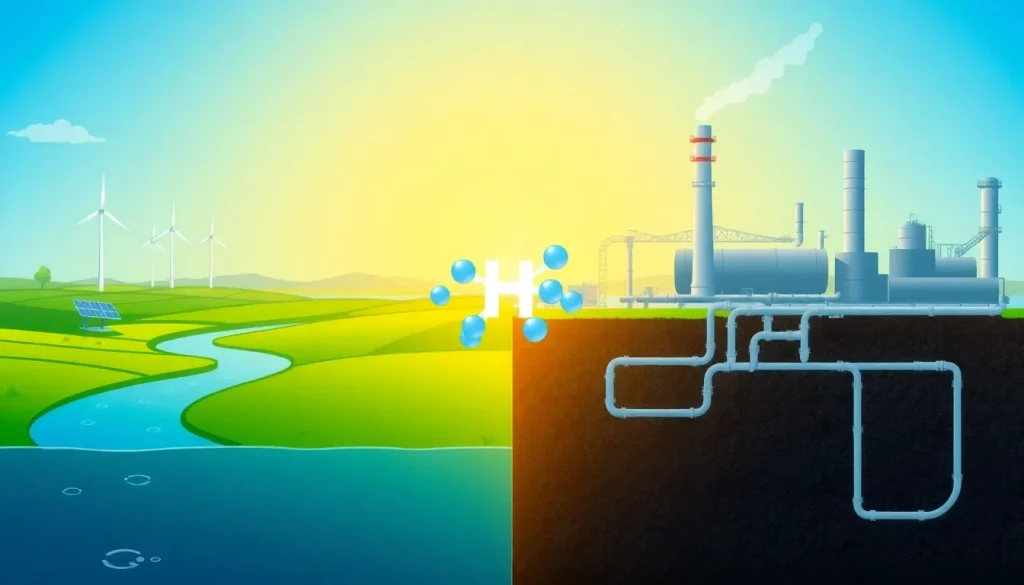
Green hydrogen and blue hydrogen are two distinct production pathways for hydrogen gas, differentiated primarily by their carbon intensity and the energy sources used. Green hydrogen is produced through water electrolysis powered entirely by renewable energy sources such as wind, solar, or hydropower, resulting in a fuel with virtually no carbon emissions across its lifecycle. Blue hydrogen, on the other hand, is derived from natural gas via steam methane reforming (SMR) or autothermal reforming (ATR), with the resulting carbon dioxide captured and stored rather than released into the atmosphere. Both are considered low-carbon hydrogen options, but they occupy different positions on the spectrum of environmental sustainability and technological readiness.
The distinction matters because hydrogen is increasingly viewed as a versatile energy carrier that can decarbonize sectors where direct electrification is challenging, such as steelmaking, chemicals, heavy transport, and seasonal energy storage. However, the climate benefits of hydrogen depend heavily on how it is produced. Green hydrogen offers a truly renewable pathway, while blue hydrogen serves as a transitional or complementary solution that can scale up more quickly using existing fossil fuel infrastructure. Understanding the nuances between these two types is essential for evaluating their roles in a future low-carbon economy.
Overview
Hydrogen is the most abundant element in the universe, but on Earth it is almost always bound to other elements, such as in water (H₂O) or methane (CH₄). To use hydrogen as a fuel, it must be separated from these compounds through energy-intensive processes. The color-coded terminology—green, blue, grey, turquoise, and others—has emerged as a shorthand to describe the production method and associated carbon footprint. Grey hydrogen, produced from natural gas without carbon capture, is the most common today and accounts for the vast majority of global hydrogen production, but it releases significant CO₂ emissions. Green and blue hydrogen are the two leading low-carbon alternatives designed to mitigate those emissions.
Green hydrogen is often called “renewable hydrogen” and is central to visions of a fully decarbonized energy system. It can be produced anywhere with access to water and renewable electricity, offering energy independence and the potential for decentralized production. Blue hydrogen, sometimes termed “low-carbon hydrogen,” is seen as a bridge technology that can utilize existing natural gas reserves and infrastructure while reducing emissions by 60–90% compared to grey hydrogen. The choice between green and blue hydrogen involves trade-offs in cost, scalability, environmental impact, and alignment with long-term climate goals.
How It Works
Green hydrogen is produced through electrolysis, a process that uses an electric current to split water (H₂O) into hydrogen (H₂) and oxygen (O₂). The electrolyzer consists of an anode and a cathode separated by an electrolyte. When renewable electricity is applied, water molecules at the anode are oxidized to produce oxygen gas and positively charged hydrogen ions; these ions migrate through the electrolyte to the cathode, where they are reduced to form hydrogen gas. The overall reaction is: 2H₂O → 2H₂ + O₂. Because the electricity comes from renewable sources, the process has no direct carbon emissions. The main electrolyzer technologies include alkaline, proton exchange membrane (PEM), and solid oxide electrolysis, each with different efficiencies and operating characteristics.
Blue hydrogen production begins with steam methane reforming (SMR), the same process used for grey hydrogen. In SMR, high-temperature steam (700–1,000°C) reacts with methane (CH₄) in the presence of a catalyst to produce hydrogen and carbon monoxide. A subsequent water-gas shift reaction converts the carbon monoxide and additional steam into more hydrogen and carbon dioxide. The key difference for blue hydrogen is that the CO₂ is captured rather than vented. Carbon capture can be applied to the concentrated CO₂ stream from the SMR process (pre-combustion capture) or from the flue gases after combustion. The captured CO₂ is then compressed, transported, and injected into deep geological formations such as depleted oil and gas reservoirs or saline aquifers for permanent storage. Advanced reforming technologies like autothermal reforming (ATR) can achieve higher CO₂ capture rates and are often paired with carbon capture for blue hydrogen production.
Environmental and Human Impacts
Green hydrogen has the lowest environmental impact of all hydrogen production methods. When produced using 100% renewable electricity, its lifecycle greenhouse gas emissions are near zero. Water consumption is a consideration—electrolysis requires about 9 liters of water per kilogram of hydrogen—but this is comparable to or less than the water used in fossil-fuel-based hydrogen production when accounting for cooling and extraction. The main environmental concerns for green hydrogen relate to the land use and material demands of building large-scale renewable energy and electrolyzer capacity, as well as the need for critical minerals like platinum and iridium for some electrolyzer types.
Blue hydrogen reduces CO₂ emissions by 60–90% compared to grey hydrogen, but it is not emission-free. Methane leakage from natural gas extraction and transport can significantly erode the climate benefits, as methane is a potent greenhouse gas. Additionally, carbon capture systems typically do not capture 100% of CO₂, and the energy penalty for capture and compression can increase upstream emissions. There are also local environmental risks associated with CO₂ storage, such as potential leakage or induced seismicity, though these are considered manageable with proper site selection and monitoring. From a human health perspective, both pathways reduce air pollution compared to unabated fossil fuel use, but blue hydrogen still involves natural gas extraction, which can have local environmental and community impacts.
Benefits, Limitations and Trade-offs
Green hydrogen offers a truly sustainable, zero-emission fuel that aligns with long-term decarbonization goals. It can be produced locally, reducing dependence on fossil fuel imports and enhancing energy security. However, it faces significant challenges: high production costs (largely driven by the cost of renewable electricity and electrolyzers), the need for massive new renewable energy capacity, and the current lack of dedicated transport and storage infrastructure. Electrolyzer manufacturing must also scale up dramatically to meet projected demand.
Blue hydrogen benefits from using existing natural gas infrastructure and can be produced at a lower cost than green hydrogen in many regions, especially where natural gas is cheap and carbon storage geology is favorable. It can serve as a near-term solution to reduce emissions from current hydrogen production (which is almost entirely grey) and help build hydrogen demand and infrastructure. The main limitations are its reliance on fossil fuels, incomplete carbon capture, methane leakage concerns, and the risk of locking in fossil fuel dependence. Over time, as renewable energy costs fall and electrolyzer technology improves, green hydrogen is expected to become cost-competitive, potentially making blue hydrogen a transitional rather than permanent solution.
Common Misconceptions
One common misconception is that blue hydrogen is completely carbon-free. While carbon capture significantly reduces emissions, it does not eliminate them, and the overall carbon footprint can vary depending on capture rates and methane leakage. Another misunderstanding is that green hydrogen is always more expensive than blue hydrogen; costs depend heavily on local renewable energy prices and natural gas prices, and in regions with abundant low-cost renewables, green hydrogen can already be competitive. Some also believe that hydrogen can simply replace natural gas in existing pipelines without modifications, but in reality, blending limits and material compatibility issues require careful management. Finally, the idea that blue hydrogen is only a temporary solution is debated—some scenarios show it playing a long-term role in a net-zero economy, particularly in regions with limited renewable resources or where carbon storage provides a valuable service.
Importance and Impact
The choice between green and blue hydrogen has profound implications for the global energy transition. Hydrogen is a key enabler for decarbonizing sectors that are difficult to electrify directly, such as steelmaking, chemicals (e.g., ammonia production), heavy-duty transport, and high-temperature industrial heat. It can also be used for long-duration energy storage, helping to balance intermittent renewable energy sources. The scalability and cost of low-carbon hydrogen will influence the pace at which these sectors can reduce emissions. Green hydrogen, if produced at scale, offers a fully renewable pathway, while blue hydrogen can provide a bridge by utilizing existing natural gas resources and infrastructure, potentially accelerating near-term emission reductions. The development of both pathways also drives innovation in electrolysis, carbon capture, and hydrogen storage technologies, with spillover benefits for other industries.
FAQ
What is the main difference between green hydrogen and blue hydrogen?
Green hydrogen is produced by splitting water using renewable electricity, resulting in zero direct carbon emissions. Blue hydrogen is made from natural gas with carbon capture and storage, which reduces but does not eliminate emissions.
Is blue hydrogen really low-carbon?
Blue hydrogen can reduce CO₂ emissions by 60–90% compared to grey hydrogen, but its overall carbon footprint depends on the capture rate, methane leakage from the natural gas supply chain, and the energy used for carbon capture. It is not emission-free.
Which is cheaper: green or blue hydrogen?
Currently, blue hydrogen is generally cheaper to produce than green hydrogen because natural gas is often less expensive than renewable electricity and electrolyzers. However, costs for green hydrogen are falling rapidly and may reach parity in the coming decades, especially in regions with abundant low-cost renewables.
References
- International Energy Agency (IEA), "The Future of Hydrogen," 2019.
- Intergovernmental Panel on Climate Change (IPCC), "Special Report on Carbon Dioxide Capture and Storage," 2005.
- National Renewable Energy Laboratory (NREL), "Hydrogen Production: Electrolysis," technical overview.
- Global CCS Institute, "Blue Hydrogen: A Key Step in the Energy Transition," 2021.