In brief
At a glance
Quick Facts
- Verdict
- Promising
- Problem addressed
- Overlooking embodied energy in building design and policy
- Evidence strength
- Moderate
- Potential scale
- Global
- Relative cost
- Low to moderate
- Time to impact
- Years to decades
Quick verdict
Addressing both operational and embodied energy in buildings is a necessary evolution of sustainable construction. While operational energy has been the primary target of efficiency policies for decades, the growing share of embodied energy—especially in low-energy buildings—demands a lifecycle perspective. The approach is promising and supported by a growing body of research, but it remains limited by inconsistent data, methodological gaps, and a lack of regulatory mandates. Its full potential will only be realized with standardized assessment frameworks, material innovation, and policy integration.
Problem addressed
Buildings are responsible for approximately 30–40% of global energy use and a similar share of greenhouse gas emissions. Historically, building energy policies have focused almost exclusively on reducing operational energy—the energy used for heating, cooling, lighting, and appliances. However, as operational efficiency improves, the relative importance of embodied energy—the energy consumed during material extraction, manufacturing, transportation, construction, maintenance, and end-of-life disposal—has increased. Ignoring embodied energy can lead to misleading conclusions about a building’s true environmental impact and may result in design choices that inadvertently increase total lifecycle energy use.
How the solution works
The solution is not a single technology but a shift in assessment and design philosophy: evaluating buildings based on their whole-life energy and carbon footprint, rather than operational performance alone. This involves:
- Lifecycle Assessment (LCA): A standardized methodology (e.g., ISO 14040/14044) that quantifies energy and environmental impacts from cradle to grave. For buildings, LCA typically covers product stage (A1–A3), construction process (A4–A5), use stage (B1–B7, including operational energy), and end-of-life (C1–C4).
- Embodied energy calculation: Summing the primary energy required to produce building materials (e.g., cement, steel, glass) and to construct, maintain, and demolish the building. This is often expressed in MJ per m² of floor area.
- Operational energy modeling: Using building performance simulation to estimate heating, cooling, lighting, and plug loads over the building’s lifespan.
- Design optimization: Balancing material choices, insulation levels, and system efficiency to minimize total lifecycle energy. For example, adding insulation reduces operational energy but increases embodied energy; the optimal point is where the sum is lowest.
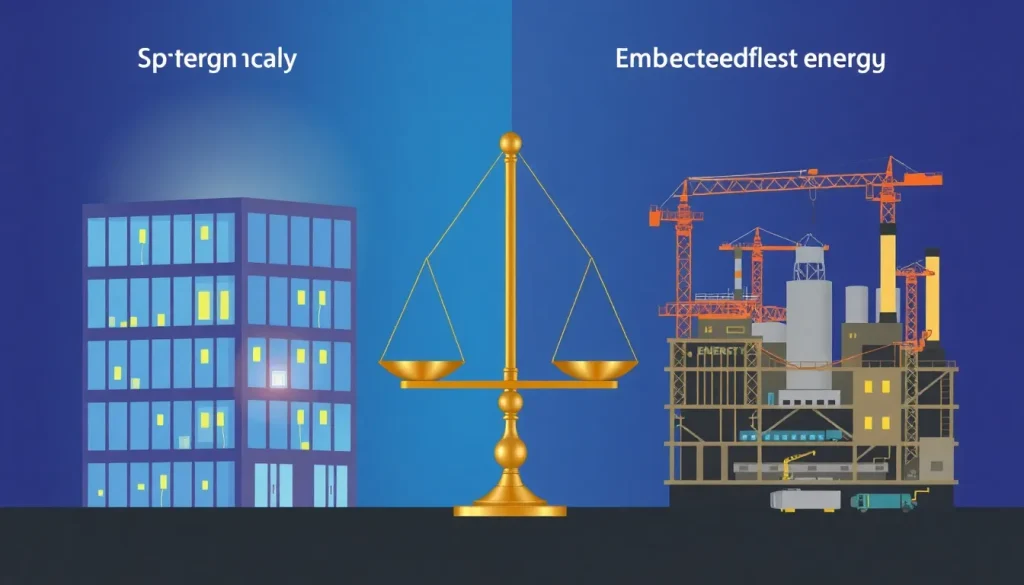
The table below summarizes the key differences between operational and embodied energy.
| Aspect | Operational Energy | Embodied Energy |
|---|---|---|
| Definition | Energy used during building occupancy (heating, cooling, lighting, appliances) | Energy used to produce materials, construct, maintain, and demolish the building |
| Timeframe | Recurring annually over building lifespan (typically 50–100 years) | Upfront (initial) plus recurring for maintenance and end-of-life |
| Share of total lifecycle energy | Historically 70–90% in conventional buildings; can drop to 50% or less in high-performance buildings | Historically 10–30%; can rise to 50% or more in low-energy or passive buildings |
| Key drivers | Building envelope, HVAC efficiency, occupant behavior, climate | Material choice (concrete, steel, timber), construction methods, supply chains |
| Policy focus | Well-established (building codes, energy performance certificates) | Emerging (few mandatory regulations, voluntary rating schemes) |
Evidence strength
The evidence base for operational energy is robust, with decades of measured data and well-calibrated simulation tools. For embodied energy, the evidence is moderate and growing. Numerous lifecycle assessment studies have quantified embodied energy for common building types, but results vary widely due to differences in system boundaries, data sources, and methodological choices. A 2020 review by Röck et al. found that embodied carbon can account for 20–50% of a new building’s total lifecycle carbon emissions, with the share increasing as operational efficiency improves. However, most studies rely on industry-average data rather than project-specific supply-chain information, and there is no global standard for embodied energy coefficients. The field is rapidly evolving, with more primary data becoming available from Environmental Product Declarations (EPDs), but significant gaps remain, especially for non-structural elements and building services.
Potential scale
The potential impact of incorporating embodied energy into building design and policy is global. The construction sector consumes about 40% of raw materials and is responsible for roughly 10% of energy-related CO₂ emissions from materials manufacturing alone. If all new buildings were designed with a lifecycle perspective, the cumulative energy savings could be substantial. However, the scale of impact depends on the rate of new construction versus renovation. In rapidly urbanizing regions (e.g., parts of Asia and Africa), where new construction dominates, addressing embodied energy is urgent. In mature economies with slower growth, the focus may shift to reducing embodied energy in renovations and material reuse. The solution is scalable in principle, but practical barriers—such as the availability of low-carbon materials and the capacity to perform LCAs—limit near-term global adoption.
Cost considerations
The direct cost of conducting a lifecycle assessment for a building project is relatively low, typically ranging from a few thousand to tens of thousands of dollars, depending on project complexity. The larger cost implications come from material and design choices. Low-embodied-energy materials (e.g., timber, recycled steel, low-carbon concrete) can sometimes carry a price premium of 5–15% over conventional alternatives, though this varies by region and market maturity. However, these upfront costs can be offset by operational energy savings over the building’s life, and in some cases, by reduced material quantities through efficient design. From a societal perspective, internalizing the external costs of carbon emissions would make low-embodied-energy options more cost-competitive. Overall, the cost-effectiveness of a lifecycle approach is favorable when long-term savings are considered, but the initial cost barrier can be a deterrent without policy support or incentives.
Implementation time
Shifting to a lifecycle energy perspective is not an overnight change. For individual projects, an LCA can be completed during the design phase, taking a few weeks to a few months. However, systemic adoption—where embodied energy is routinely considered in building codes, procurement, and industry practice—will take years to decades. The development of standardized databases, training of professionals, and establishment of regulatory frameworks are all necessary steps. Early-adopter regions (e.g., the European Union, California) are already implementing policies that require embodied carbon reporting, but global harmonization is still distant. The full benefits of reduced total lifecycle energy will accrue gradually as the building stock turns over, which can take 50–100 years.
Environmental benefits
The primary environmental benefit is a reduction in total primary energy demand and associated greenhouse gas emissions across the building lifecycle. By avoiding burden-shifting (e.g., reducing operational energy at the expense of high embodied energy), a lifecycle approach ensures genuine net reductions. Additional benefits include reduced resource extraction, lower waste generation, and decreased pollution from material manufacturing. For example, substituting concrete with cross-laminated timber can reduce embodied carbon by 20–50% while also storing biogenic carbon. However, the magnitude of benefits depends on the energy mix used in material production; if manufacturing relies on fossil fuels, embodied energy remains high even for otherwise sustainable materials.
Social and economic co-benefits
Adopting a lifecycle perspective can stimulate innovation in low-carbon materials and construction techniques, creating new jobs in green manufacturing and sustainable forestry. It can also improve indoor environmental quality if material choices consider health impacts (e.g., low-VOC products). For building owners and occupants, lower lifecycle energy often translates to lower utility bills and potentially higher property values. At the community level, promoting local and low-embodied-energy materials can strengthen regional supply chains and reduce dependence on imported, energy-intensive products. Furthermore, designing for adaptability and deconstruction—a key strategy to reduce end-of-life embodied energy—can extend building lifespans and preserve cultural heritage.
Risks and unintended consequences
One risk is that a narrow focus on reducing embodied energy could lead to choices that compromise operational efficiency or durability. For instance, minimizing material use might result in under-insulated buildings that consume more energy over their lifetime. There is also a risk of “carbon tunnel vision,” where embodied carbon is prioritized over other environmental impacts like water use, biodiversity loss, or toxicity. Methodological inconsistencies can lead to greenwashing, with manufacturers making unverified claims about low embodied energy. Additionally, if policies mandate embodied energy limits without providing sufficient lead time or support, they could disrupt construction markets and increase costs, especially in developing countries where data and alternatives are scarce. Rebound effects are possible if lifecycle assessment is used to justify larger buildings or more frequent replacement cycles under the guise of “efficiency.”
Where it works best
The lifecycle approach is most effective in new construction projects where design teams have the flexibility to optimize material and system choices from the outset. It is particularly valuable for buildings with long expected lifespans (e.g., 60+ years) and in climates where operational energy demands are moderate, making embodied energy a larger relative share. Regions with strong regulatory support, such as the European Union (with its Level(s) framework) and California (Buy Clean Act), provide an enabling environment. The approach also works well for public and institutional buildings, where long-term ownership and sustainability goals align with lifecycle thinking. In renovation projects, focusing on embodied energy can guide decisions about whether to retrofit or rebuild.
Where it may not work
In contexts where operational energy dominates—such as poorly insulated existing buildings in extreme climates—the immediate priority should remain on operational efficiency, as the payback from reducing heating or cooling loads is far greater. In regions with limited access to low-carbon materials or where construction is dominated by informal practices, the data and supply chains needed for embodied energy assessment may be absent. For short-lived or temporary structures, the upfront embodied energy may be less critical than operational performance. Additionally, in markets where building codes are weak and enforcement is lax, adding embodied energy requirements without addressing basic operational standards could be counterproductive.
Comparison with alternatives
The main alternative to a lifecycle approach is the status quo: focusing solely on operational energy through building energy codes and rating systems (e.g., LEED, BREEAM) that give limited weight to embodied impacts. While these have driven significant improvements in operational efficiency, they can inadvertently encourage material-intensive solutions. Another alternative is a purely carbon-focused approach that uses carbon metrics (CO₂ equivalent) rather than primary energy, which can better capture the climate impact of different energy sources but may overlook other environmental issues. A hybrid approach—using both energy and carbon metrics—is increasingly common. Compared to these, a full lifecycle energy assessment provides a more comprehensive picture but is more complex and data-intensive. The choice depends on the specific goals and context of the project.
Case studies
The Bullitt Center, Seattle, USA: This six-story office building was designed to meet the Living Building Challenge, which requires net-zero energy and water. The project team conducted a detailed LCA and chose a heavy timber structure over concrete and steel, reducing embodied carbon by an estimated 30% compared to a conventional design. Operational energy use is extremely low (EUIs around 16 kBtu/ft²/yr), making embodied energy a significant portion of the lifecycle total. The building demonstrates that high performance and low embodied impact can be achieved simultaneously, though at a cost premium of about 20% over standard construction at the time.
Enterprise Centre, University of East Anglia, UK: This building used locally sourced, natural materials (thatch, timber, clay) to achieve exceptionally low embodied carbon—estimated at 350 kg CO₂e/m², roughly half that of a typical university building. The project also meets Passivhaus standards for operational energy. The case illustrates the potential of bio-based materials but also highlights challenges in scaling such approaches due to limited supply chains and higher labor costs.
France’s RE2020 regulation: Since 2022, France has mandated that new buildings meet lifecycle carbon limits, including embodied carbon. Early results indicate a shift toward timber and low-carbon concrete, with developers reporting that compliance adds about 1–3% to construction costs. This real-world policy experiment provides evidence that regulation can drive market transformation, though long-term outcomes are still being evaluated.
Final assessment
The integration of operational and embodied energy considerations is not merely an academic exercise; it is a necessary step toward genuinely sustainable buildings. The evidence clearly shows that as operational efficiency improves, embodied energy becomes the dominant source of lifecycle impacts. A lifecycle approach is most promising for new construction in regions with supportive policies and access to low-carbon materials. However, it is not a panacea: it must be implemented thoughtfully, with robust data, standardized methods, and a careful balance of trade-offs. For existing buildings, operational energy remains the priority. Overall, the solution is proven in principle and increasingly feasible in practice, but its widespread adoption hinges on continued methodological development, policy leadership, and industry capacity building.
FAQ
What is the difference between operational and embodied energy?
Operational energy is the energy consumed during a building's use, primarily for heating, cooling, lighting, and appliances. Embodied energy is the energy used to produce the building materials, construct the building, and eventually demolish and dispose of it. Operational energy is recurring annually, while embodied energy is largely upfront but also includes maintenance and end-of-life phases.
Why has embodied energy been overlooked in building regulations?
Historically, operational energy dominated a building's total lifecycle energy use, so policies focused on improving insulation and HVAC efficiency. Embodied energy was considered a small fraction and was harder to quantify due to complex supply chains and lack of data. As operational efficiency has improved, embodied energy's share has grown, making it impossible to ignore for deep decarbonization.
How can we reduce both operational and embodied energy in buildings?
A lifecycle approach optimizes the whole. Strategies include: using low-carbon materials (e.g., timber, recycled steel, low-carbon concrete), designing for material efficiency and adaptability, improving construction processes, and balancing insulation levels to avoid excessive embodied energy. Policy tools like mandatory LCA reporting and embodied carbon limits can drive market transformation.
References
- IPCC Sixth Assessment Report, Working Group III, Chapter 9 (Buildings), 2022.
- IEA, Global Status Report for Buildings and Construction 2022.
- Röck, M., et al. 'Embodied GHG emissions of buildings – The hidden challenge for effective climate change mitigation.' Applied Energy, vol. 258, 2020, 114107.
- UNEP, 2021 Global Status Report for Buildings and Construction.
- Sartori, I., and A. G. Hestnes. 'Energy use in the life cycle of conventional and low-energy buildings: A review article.' Energy and Buildings, vol. 39, no. 3, 2007, pp. 249-257.