In brief
At a glance
Quick Facts
- Core Principle
- Fairness and equity in the shift to low-carbon energy.
- Origin
- Rooted in labor movements of the 1970s and 1980s.
- Key Stakeholders
- Workers, communities, governments, businesses, and indigenous groups.
- International Recognition
- Mentioned in the preamble of the Paris Agreement.
- Primary Goal
- To ensure no one is left behind in the energy transition.
- Common Focus
- Retraining fossil fuel workers for clean energy jobs.
- Economic Aspect
- Includes investment in affected regions for diversification.
- Social Aspect
- Addresses energy poverty and access to affordable clean energy.
- Policy Tools
- Social dialogue, just transition funds, and community benefit agreements.
- Challenge
- Balancing rapid decarbonization with social protection.
Key Takeaways
- A just energy transition ensures that the global shift from fossil fuels to renewable energy is fair and inclusive, protecting workers and communities dependent on carbon-intensive industries.
- It integrates social justice, economic diversification, and stakeholder participation into climate and energy policies to avoid deepening inequality.
- Without a just transition, the move to clean energy risks job losses, regional decline, and social unrest, undermining climate action.
- Successful just transitions require collaboration among governments, businesses, labor unions, and civil society to create decent work, provide retraining, and invest in affected regions.
What Is a Just Energy Transition?
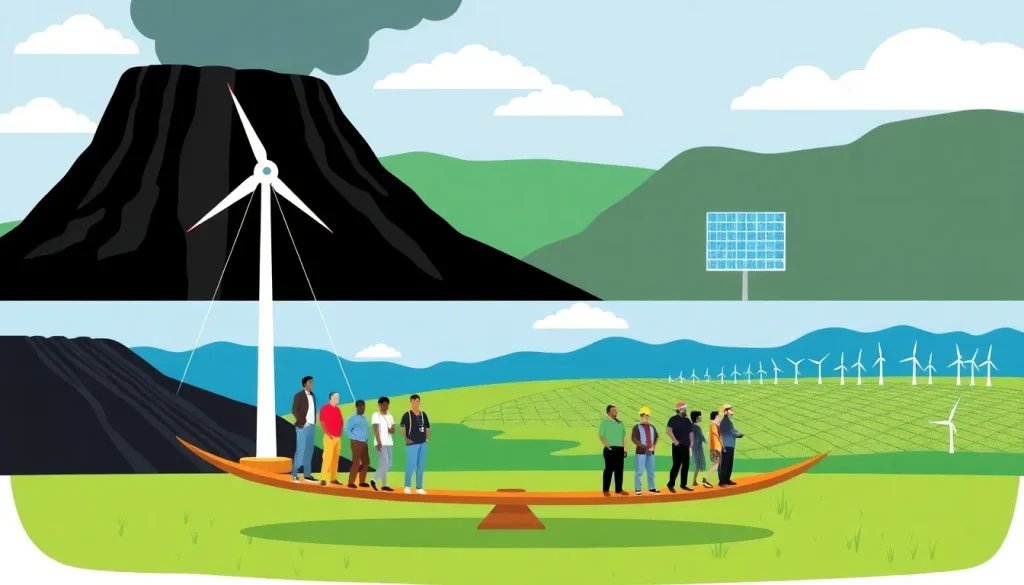
A just energy transition is the process of transforming energy systems from fossil fuel dependence to low-carbon and renewable sources in a way that is fair, equitable, and inclusive. It goes beyond simply replacing coal, oil, and gas with solar, wind, and other clean technologies; it actively addresses the social, economic, and environmental impacts of this shift on workers, communities, and vulnerable populations. The goal is to ensure that the benefits of the transition—such as cleaner air, new jobs, and energy access—are shared widely, while the burdens—like job displacement and regional economic decline—are mitigated through deliberate policies and investments.
The concept emerged from the recognition that climate action, while urgent, can create winners and losers. A just energy transition seeks to embed principles of social justice, equity, and inclusion into the heart of energy and climate policy. It emphasizes the need for social dialogue, decent work, retraining programs, social protection, and economic diversification to support those whose livelihoods depend on fossil fuel industries. By doing so, it aims to build broad-based support for the transition to a sustainable energy future and to ensure that no one is left behind.
History
The idea of a “just transition” has its roots in the labor movements of the 1970s and 1980s, particularly in North America. Trade unionists, notably Tony Mazzocchi of the Oil, Chemical and Atomic Workers Union in the United States, advocated for a “Superfund for Workers” to support those displaced by environmental regulations. This concept evolved into a broader call for a just transition that would protect workers and communities affected by the shift away from polluting industries. Over time, the framework expanded beyond labor to include social justice, indigenous rights, and community resilience.

Internationally, the just transition gained prominence in climate negotiations. The preamble of the Paris Agreement (2015) acknowledges “the imperatives of a just transition of the workforce and the creation of decent work and quality jobs in accordance with nationally defined development priorities.” Subsequent UN climate conferences, such as COP24 in Katowice, Poland, adopted the Solidarity and Just Transition Silesia Declaration, emphasizing the need to consider the social dimensions of climate action. The International Labour Organization (ILO) has also developed guidelines for a just transition, linking it to decent work and sustainable development.
How It Works
A just energy transition operates through a combination of policy measures, stakeholder engagement, and financial mechanisms designed to manage the socio-economic impacts of decarbonization. Key elements include:
- Social dialogue: Governments, employers, workers, and communities collaborate to design transition strategies that reflect local needs and priorities.
- Retraining and reskilling: Programs are established to equip workers from declining fossil fuel sectors with skills for jobs in renewable energy, energy efficiency, and other growing industries.
- Economic diversification: Investments are directed toward regions heavily dependent on fossil fuels to create new economic opportunities, such as in clean energy manufacturing, technology, or sustainable agriculture.
- Social protection: Safety nets, including income support, pensions, and healthcare, are provided to workers and communities during the transition period.
- Community benefit agreements: Local communities are given a stake in new energy projects, ensuring they share in the economic benefits and have a voice in decision-making.
- Energy access and affordability: Policies ensure that the transition does not increase energy poverty and that clean energy is accessible to all, particularly marginalized groups.
These mechanisms are often integrated into national climate plans (Nationally Determined Contributions) and supported by international funding, such as the Just Transition Fund in the European Union.
Why It Matters
The urgency of climate change demands a rapid shift away from fossil fuels, but this transition can have profound social consequences. Without a just transition, the closure of coal mines, oil refineries, and related industries can lead to mass unemployment, community disintegration, and regional economic collapse. This not only causes human suffering but also fuels political resistance to climate policies, potentially slowing down the necessary decarbonization. A just transition addresses these risks by ensuring that the costs and benefits of the energy transformation are distributed fairly.
Moreover, a just energy transition is essential for achieving the Sustainable Development Goals (SDGs), particularly those related to decent work, reduced inequalities, and affordable clean energy. It recognizes that environmental sustainability and social justice are interdependent. By building broad coalitions and demonstrating that climate action can improve lives, a just transition enhances the political feasibility of ambitious climate policies and fosters long-term resilience.
Benefits, Limitations and Trade-offs
Benefits: A well-managed just transition can lead to social cohesion, political stability, and economic revitalization. It creates new, often higher-quality jobs in clean energy sectors, reduces health costs from pollution, and can empower marginalized communities. It also helps secure public support for climate policies, making the overall energy transition smoother and more sustainable.
Limitations and trade-offs: Implementing a just transition requires significant financial resources, institutional capacity, and political will, which may be lacking in some regions. There can be tensions between the speed of decarbonization and the time needed for retraining and economic restructuring. Additionally, defining what is “just” can be contentious, as different stakeholders may have conflicting interests. There is also a risk of “greenwashing” if just transition language is used without meaningful action. Balancing these trade-offs is a central challenge for policymakers.
Common Misconceptions
Misconception 1: A just transition is only about coal miners. While coal workers are a key focus, the concept applies to all workers and communities affected by the shift away from any fossil fuel, including oil and gas, as well as those in related supply chains. It also encompasses broader social groups, such as indigenous peoples and low-income households, who may be disproportionately impacted by energy policies.
Misconception 2: A just transition slows down climate action. On the contrary, by addressing social concerns and building public support, a just transition can accelerate climate action. Ignoring the social dimension often leads to backlash and policy delays, whereas inclusive processes can create momentum for faster and more durable change.
Misconception 3: It is a new concept. The idea has been discussed in labor and environmental circles for decades, though it has gained wider recognition in international climate policy only more recently. Its principles are rooted in long-standing social justice and labor rights movements.
FAQ
What is a just energy transition?
A just energy transition is the shift from fossil fuels to renewable energy that prioritizes fairness, equity, and inclusion, ensuring that workers, communities, and vulnerable groups are protected and benefit from the change.
How does a just energy transition work?
It works through policies like retraining programs, social protection, economic diversification, and stakeholder dialogue, designed to manage the social and economic impacts of moving to a low-carbon economy.
Why does a just energy transition matter?
It matters because without it, the energy transition could cause job losses, inequality, and social unrest, undermining climate goals. A just approach builds public support and ensures that the benefits of clean energy are shared by all.
References
- International Labour Organization (ILO) – Guidelines for a just transition towards environmentally sustainable economies and societies for all
- United Nations Framework Convention on Climate Change (UNFCCC) – Just Transition
- Intergovernmental Panel on Climate Change (IPCC) – Special Report on Global Warming of 1.5°C (Chapter on sustainable development and poverty eradication)