In brief
At a glance
Quick Facts
- Definition
- A climate transition plan is a time-bound action plan that clearly outlines how an organization will pivot its existing assets, operations, and entire business model towards a net-zero emissions trajectory.
- Key Components
- Typically includes emissions targets, decarbonization strategies, governance, financial planning, and metrics.
- Regulatory Context
- Many jurisdictions are moving towards mandatory transition plan disclosures, such as the EU's Corporate Sustainability Reporting Directive (CSRD).
- Frameworks
- Common frameworks include the TCFD recommendations, the Transition Plan Taskforce (TPT) disclosure framework, and GFANZ guidance.
- Scope
- Should cover Scope 1, 2, and material Scope 3 emissions across the value chain.
- Time Horizon
- Usually includes short-term (e.g., 2025-2030), medium-term, and long-term (2050) targets.
- Governance
- Requires board-level oversight and integration into corporate strategy.
- Financial Planning
- Must detail capital expenditure, R&D, and how the plan is embedded in financial statements.
- Stakeholder Importance
- Investors, lenders, and insurers use transition plans to assess climate-related risks and opportunities.
- Challenges
- Data availability, especially for Scope 3 emissions, and uncertainty in technology pathways are common hurdles.
Key Takeaways
- A climate transition plan is a time-bound action plan that clearly outlines how an organization will adapt its business model, operations, and value chain to achieve a low-carbon, climate-resilient future.
- Effective plans include science-based emissions reduction targets, a detailed decarbonization strategy, governance and accountability structures, and financial planning that aligns with the transition.
- Transition plans are increasingly expected by investors, regulators, and other stakeholders as a means to assess climate-related risks and opportunities.
- While frameworks and guidance exist, challenges remain around data quality, Scope 3 emissions, and the need for credible, verifiable commitments.
What Is a Climate Transition Plan?
A climate transition plan is a comprehensive, forward-looking strategy that details how an organization intends to transform its business model, operations, and value chain to align with a low-carbon, climate-resilient economy. It goes beyond a simple pledge or target by providing a concrete roadmap with specific actions, timelines, and accountability mechanisms. The plan serves as a bridge between high-level climate commitments—such as achieving net-zero emissions by 2050—and the practical steps needed to get there.
Transition plans are typically developed by corporations, financial institutions, and sometimes governments. They are designed to be dynamic documents that evolve as technologies, regulations, and market conditions change. A credible transition plan is grounded in climate science, incorporates both mitigation (reducing emissions) and adaptation (building resilience to climate impacts), and is integrated into the organization’s overall business strategy. It is not merely a sustainability report but a core component of corporate governance and risk management.
How Climate Transition Plans Work
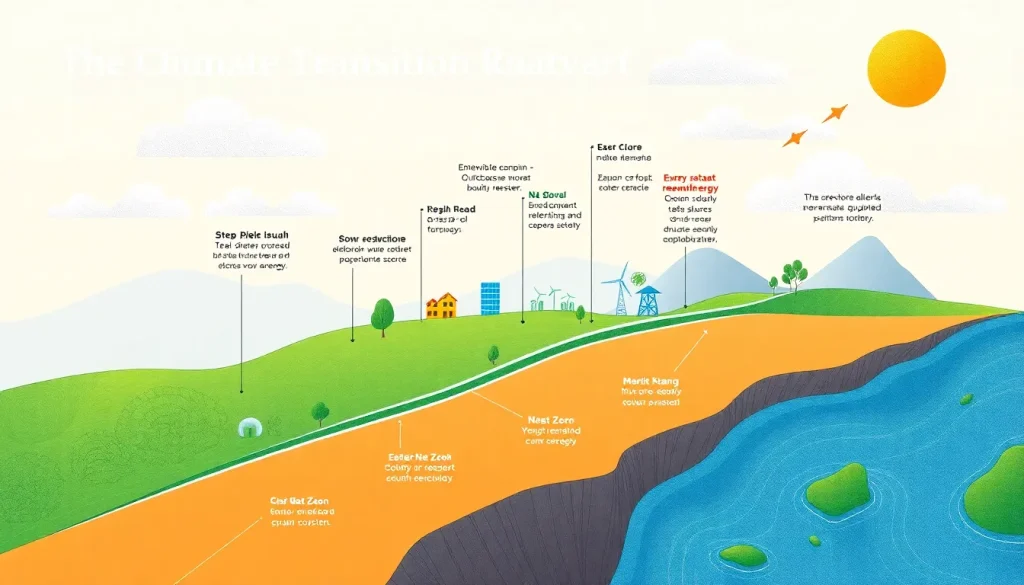
A climate transition plan operates as a strategic management tool that translates long-term climate goals into actionable steps. It works by establishing a clear baseline, setting measurable targets, and defining the pathways to achieve them. The plan is typically structured around several key pillars:
- Emissions Baseline and Targets: The organization first measures its current greenhouse gas (GHG) emissions across Scopes 1, 2, and 3. It then sets short-, medium-, and long-term reduction targets, often aligned with science-based criteria (e.g., limiting global warming to 1.5°C).
- Decarbonization Strategy: This outlines the specific actions to reduce emissions, such as improving energy efficiency, switching to renewable energy, electrifying processes, adopting circular economy principles, and phasing out high-carbon assets. It may also include the use of carbon offsets or removals for residual emissions.
- Governance and Accountability: The plan assigns clear responsibilities, often at the board and executive level, for overseeing climate-related risks and opportunities. It integrates climate metrics into performance management and links executive compensation to progress.
- Financial Planning: A credible transition plan details the capital expenditures, R&D investments, and operational changes required. It explains how the transition is funded and how climate risks are reflected in financial statements and planning assumptions.
- Value Chain Engagement: The plan addresses Scope 3 emissions by engaging suppliers, customers, and other partners. It may include procurement policies, product design changes, and collaboration initiatives.
- Metrics and Reporting: The plan defines key performance indicators (KPIs) and commits to regular, transparent disclosure of progress against targets, often using established frameworks like the Task Force on Climate-related Financial Disclosures (TCFD).
By integrating these elements, a transition plan helps an organization systematically manage the shift to a low-carbon economy, identify new business opportunities, and mitigate transition risks such as policy changes, technological disruption, and shifting market preferences.
Why Climate Transition Plans Matter
Climate transition plans matter because they provide a structured approach to managing one of the most significant risks and opportunities of the 21st century. For businesses, a credible plan can enhance resilience, unlock access to capital, and strengthen reputation. Investors and lenders increasingly use transition plans to assess which companies are prepared for a net-zero future and which face stranded asset risks. Regulators in many jurisdictions are moving toward mandatory disclosure of transition plans, making them a compliance necessity.
From a broader perspective, transition plans are critical for achieving the goals of the Paris Agreement. They translate global climate targets into concrete actions at the organizational level, helping to align capital flows with a low-carbon economy. Without robust transition plans, there is a risk of “greenwashing”—where entities make vague commitments without real action—undermining trust and delaying the necessary transformation. A well-designed plan also helps identify social impacts and ensure a just transition for workers and communities affected by the shift away from fossil fuels.
What Businesses and Governments Can Do
Businesses can develop and implement climate transition plans by following established frameworks and best practices. They should start by securing board-level commitment and conducting a thorough assessment of climate-related risks and opportunities. Engaging with stakeholders—including investors, employees, and communities—helps ensure the plan is robust and credible. Companies can seek external assurance or verification of their emissions data and progress to build trust. Collaboration within industry groups and value chains can accelerate the development of common standards and solutions.
Governments play a crucial role in creating an enabling environment for transition planning. They can mandate disclosure requirements, provide clear policy signals (such as carbon pricing or phase-out dates for high-emission technologies), and offer incentives for clean energy and innovation. Public investment in infrastructure, research, and workforce training supports a just transition. Governments can also lead by example by developing transition plans for state-owned enterprises and public sector operations. International coordination through bodies like the International Sustainability Standards Board (ISSB) helps harmonize reporting standards and reduce fragmentation.
Common Misconceptions
Data Limitations and Uncertainties
Developing a credible climate transition plan is challenged by data gaps and inherent uncertainties. Scope 3 emissions—those from the value chain—are often difficult to measure accurately due to reliance on estimates and supplier data. Methodologies for calculating financed emissions in financial institutions are still evolving. Future technology pathways, such as the availability and cost of green hydrogen or carbon capture, are uncertain, making long-term projections difficult. Policy and regulatory landscapes can shift, affecting the viability of planned actions.
Additionally, the use of carbon offsets remains controversial, with concerns about additionality, permanence, and verification. Organizations must navigate these uncertainties by using scenario analysis, stress testing, and transparent assumptions. They should acknowledge limitations and commit to improving data quality over time. Standard-setters and industry groups continue to work on harmonizing metrics and guidance to address these challenges.
Benefits, Limitations and Trade-offs
Benefits: A robust transition plan can drive innovation, reduce operating costs through efficiency gains, and open new markets for low-carbon products and services. It enhances access to green finance and improves resilience against climate-related disruptions. It also strengthens stakeholder trust and can attract and retain talent who prioritize sustainability.
Limitations: Developing a comprehensive plan requires significant resources, expertise, and data that may not be readily available, especially for smaller organizations. There is a risk of “paper decarbonization” if plans rely heavily on offsets without real emissions cuts. Plans can become obsolete quickly if technology or policy landscapes shift unexpectedly.
Trade-offs: The transition may involve short-term costs, such as write-downs of high-carbon assets or investments in new infrastructure, which can affect profitability. Balancing the speed of decarbonization with social impacts—such as job losses in carbon-intensive sectors—requires careful management to ensure a just transition. Organizations must weigh the credibility of using offsets versus investing in direct emissions reductions, as over-reliance on offsets can undermine the integrity of the plan.
FAQ
What is a climate transition plan?
A climate transition plan is a detailed, time-bound strategy that outlines how an organization will transform its business model, operations, and value chain to align with a low-carbon economy. It includes emissions reduction targets, specific actions, governance, and financial planning.
How does a climate transition plan work?
It works by establishing a baseline of current emissions, setting science-based targets, and defining a roadmap of actions to achieve those targets. It integrates climate considerations into governance, risk management, and financial decision-making, and requires regular reporting on progress.
Why do climate transition plans matter?
They matter because they help organizations manage climate risks, seize opportunities in the low-carbon transition, meet regulatory requirements, and build trust with investors and other stakeholders. They are essential for aligning the global economy with the goals of the Paris Agreement.
References
- Task Force on Climate-related Financial Disclosures (TCFD). Final Report: Recommendations of the Task Force on Climate-related Financial Disclosures.
- Transition Plan Taskforce (TPT). Disclosure Framework and Implementation Guidance.
- Glasgow Financial Alliance for Net Zero (GFANZ). Financial Institution Net-zero Transition Plans.
- Science Based Targets initiative (SBTi). Corporate Net-Zero Standard.
- International Sustainability Standards Board (ISSB). IFRS S2 Climate-related Disclosures.