In brief
At a glance
Quick Facts
- Status
- Six of nine boundaries transgressed (2023 assessment)
- Control variable
- Multiple, specific to each boundary (e.g., CO2 concentration, extinction rate, forest area)
- Proposed boundary
- Safe limits defined for each control variable (e.g., 350 ppm CO2, <10 extinctions per million species-years)
- Current value
- Varies; e.g., atmospheric CO2 ~420 ppm, extinction rate >100 E/MSY, global forest area ~60% of original
- Pre-industrial baseline
- Holocene variability ranges (e.g., CO2 ~280 ppm, extinction rate ~0.1-1 E/MSY)
Current status
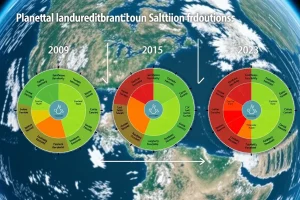
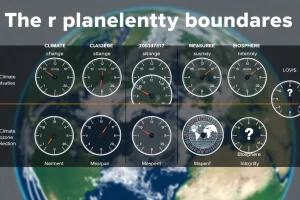
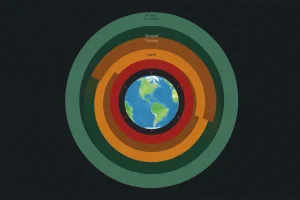
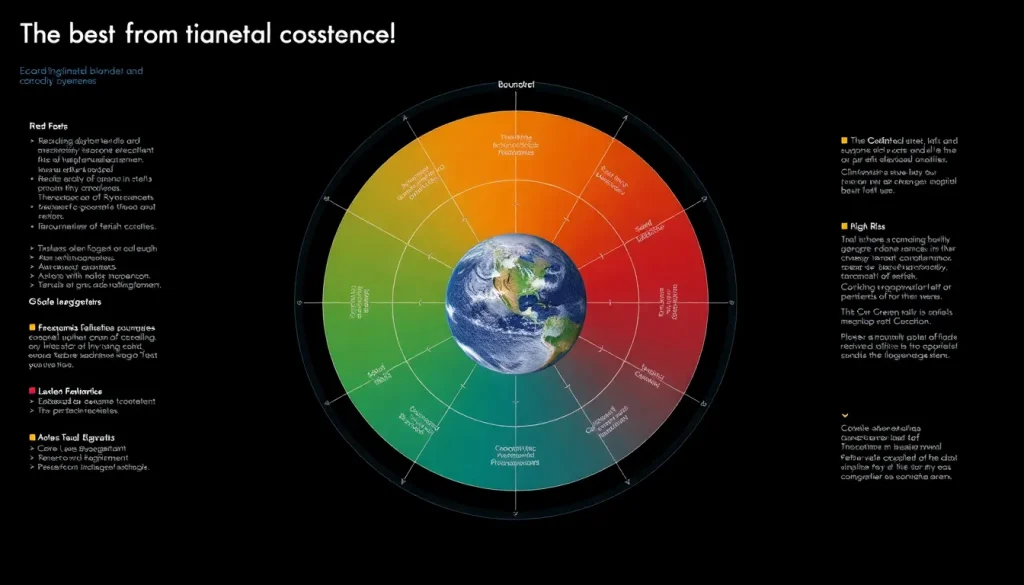
As of the most recent comprehensive assessment (Richardson et al., 2023), six of the nine planetary boundaries are transgressed, meaning their control variables have exceeded the proposed safe boundary values. The transgressed boundaries are climate change, biosphere integrity (genetic diversity), land-system change, freshwater change, biogeochemical flows (nitrogen and phosphorus), and novel entities. Of these, several are in the zone of high risk, where the likelihood of triggering irreversible Earth-system changes is significantly elevated. The boundaries for ocean acidification, atmospheric aerosol loading, and stratospheric ozone depletion remain within the safe operating space, though ocean acidification is approaching its boundary.
| Planetary Boundary | Status (2023) |
|---|---|
| Climate change | Transgressed (zone of increasing risk) |
| Biosphere integrity (genetic diversity) | Transgressed (zone of high risk) |
| Land-system change | Transgressed (zone of increasing risk) |
| Freshwater change | Transgressed (zone of increasing risk) |
| Biogeochemical flows (N and P) | Transgressed (zone of high risk) |
| Novel entities | Transgressed (zone of increasing risk) |
| Ocean acidification | Within safe operating space (approaching boundary) |
| Atmospheric aerosol loading | Within safe operating space |
| Stratospheric ozone depletion | Within safe operating space |
FAQ
What does it mean when a planetary boundary is transgressed?
Transgression means that the control variable for that boundary has moved beyond the proposed safe limit, entering a zone of increasing risk. It does not imply an immediate catastrophe, but it signals that the Earth system is being pushed away from the stable Holocene-like state, raising the probability of triggering nonlinear changes, feedback loops, and tipping points that could have severe and potentially irreversible consequences for human societies and ecosystems.
Can a transgressed boundary be reversed?
In principle, some transgressions can be reversed if the control variable is brought back within the safe operating space through deliberate mitigation and restoration efforts. For example, the stratospheric ozone boundary was transgressed in the 1980s but has since returned to the safe zone thanks to the Montreal Protocol. However, other boundaries involve processes with long time lags or irreversible thresholds (e.g., species extinctions, ice sheet collapse), making reversal extremely difficult or impossible on human timescales.
Which planetary boundaries are currently transgressed?
According to the 2023 update by Richardson et al., six boundaries are transgressed: climate change, biosphere integrity (genetic diversity), land-system change, freshwater change, biogeochemical flows (nitrogen and phosphorus), and novel entities. Ocean acidification is approaching its boundary but remains within the safe zone, while atmospheric aerosol loading and stratospheric ozone depletion are within safe limits.
References
- Rockström, J., et al. (2009). A safe operating space for humanity. Nature, 461, 472–475.
- Steffen, W., et al. (2015). Planetary boundaries: Guiding human development on a changing planet. Science, 347(6223), 1259855.
- Richardson, K., et al. (2023). Earth beyond six of nine planetary boundaries. Science Advances, 9(37), eadh2458.
- Lenton, T. M., et al. (2019). Climate tipping points — too risky to bet against. Nature, 575, 592–595.
- Persson, L., et al. (2022). Outside the safe operating space of the planetary boundary for novel entities. Environmental Science & Technology, 56(3), 1510–1521.