In brief
At a glance
Quick Facts
- Definition
- A critical threshold where a small change triggers a large, often irreversible shift in a climate system component.
- Key characteristic
- Self-reinforcing feedback loops that make the change self-sustaining once the threshold is crossed.
- Major tipping elements
- Greenland and Antarctic ice sheets, AMOC, Amazon rainforest, permafrost, coral reefs.
- Temperature threshold range
- Many tipping points are estimated to lie between 1.5°C and 2°C of global warming above pre-industrial levels.
- Potential sea-level rise
- Complete melting of Greenland ice sheet would raise sea levels by about 7 meters; West Antarctic Ice Sheet by 3-5 meters.
- Cascading risk
- Crossing one tipping point can increase the likelihood of crossing others, leading to a domino effect.
- Irreversibility
- Many tipping point changes are irreversible on human timescales, lasting centuries to millennia.
- Policy relevance
- The Paris Agreement goal of limiting warming to well below 2°C is partly motivated by the desire to avoid triggering tipping points.
Key Takeaways
- A climate tipping point is a critical threshold where a small additional change can cause a large, often irreversible shift in a natural system.
- Once crossed, the system may enter a new state, with changes that can be self-perpetuating even if the original driver is removed.
- Major tipping elements include the Amazon rainforest, Greenland and Antarctic ice sheets, Atlantic Ocean circulation, and permafrost regions.
- Crossing one tipping point can trigger others in a cascade, amplifying global climate impacts and making them harder to reverse.
What Is a Climate Tipping Point?
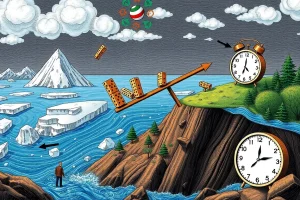
A climate tipping point is a critical threshold in the Earth system where a small additional perturbation can trigger a large, often abrupt and irreversible change in a major component of the climate system. The term draws on the concept of a physical tipping point, where a slight push can cause an object to fall into a new state. In the climate context, these are points of no return: once crossed, the system shifts to a fundamentally different mode of operation, even if the forcing that caused the shift is reduced or removed.
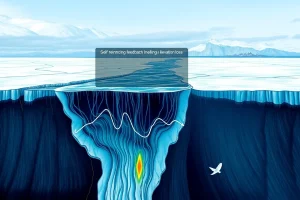
Climate tipping points are associated with self-reinforcing feedback loops. For example, as Arctic sea ice melts, the darker ocean surface absorbs more solar radiation, which warms the water and accelerates further melting. This positive feedback can push the system past a threshold where the ice cannot recover, leading to an ice-free Arctic in summer. The concept is central to understanding the risks of climate change because it implies that gradual warming can lead to sudden, non-linear, and potentially catastrophic changes in the Earth system.
Overview
The Earth system comprises interconnected physical, chemical, and biological processes that have historically maintained a relatively stable climate. However, human activities—primarily the emission of greenhouse gases—are pushing the system toward thresholds where these stabilizing mechanisms can break down. Climate tipping points represent critical junctures where a subsystem, such as an ice sheet or an ocean current, shifts from one stable state to another. The new state may be dramatically different and can persist for centuries or millennia, even if global temperatures are later reduced.
Scientists have identified several potential tipping elements in the climate system. These include the large-scale melting of the Greenland and West Antarctic ice sheets, the collapse of the Atlantic Meridional Overturning Circulation (AMOC), the dieback of the Amazon rainforest, the thawing of permafrost, and the loss of coral reefs. Each of these systems has a critical threshold, often expressed in terms of global mean temperature rise, beyond which the risk of triggering a tipping point increases sharply. The exact location of these thresholds is uncertain, but many are estimated to lie between 1.5°C and 2°C of warming above pre-industrial levels.
How It Works
Tipping points operate through positive feedback mechanisms that amplify small initial changes. In a stable system, negative feedbacks dampen disturbances and restore equilibrium. However, when a system approaches a tipping point, positive feedbacks dominate, pushing the system further away from its original state. Once the threshold is crossed, the change becomes self-sustaining and can proceed independently of the original forcing.
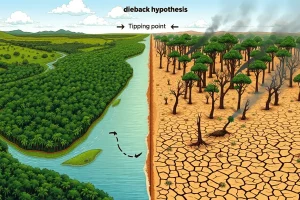
For instance, the Greenland ice sheet is subject to a feedback loop involving elevation and temperature. As the ice sheet melts, its surface lowers, exposing it to warmer air at lower altitudes, which accelerates melting. This process can become self-reinforcing: beyond a certain temperature threshold, the ice sheet will continue to shrink even if global temperatures stabilize, eventually leading to its near-complete loss over centuries. Similarly, the Amazon rainforest generates its own rainfall through evapotranspiration; deforestation and warming can reduce this moisture recycling, pushing the forest past a tipping point where it transitions to a savanna-like state, releasing vast amounts of carbon and altering regional climate.
Examples
Several key tipping elements have been identified in the Earth system, each with distinct characteristics and potential global consequences:
- Greenland Ice Sheet: Sustained warming above a certain threshold (estimated around 1.5°C to 2°C) could trigger irreversible melting, contributing up to 7 meters of sea-level rise over millennia.
- West Antarctic Ice Sheet: Much of this ice sheet rests on bedrock below sea level, making it vulnerable to marine ice sheet instability. Its collapse could add several meters to global sea levels.
- Atlantic Meridional Overturning Circulation (AMOC): This ocean current system transports heat to the North Atlantic. Freshwater influx from melting ice could slow or shut it down, drastically altering regional climates, cooling Europe, and shifting tropical rainfall patterns.
- Amazon Rainforest: Combined pressures of deforestation, drought, and fire could push the Amazon past a tipping point where it no longer sustains itself as a rainforest, transitioning to a drier, savanna-like ecosystem with massive carbon release.
- Permafrost Thaw: Permanently frozen ground in the Arctic stores vast amounts of organic carbon. Thawing releases methane and CO₂, accelerating global warming and creating a self-reinforcing feedback loop.
- Coral Reefs: Rising ocean temperatures and acidification can push coral ecosystems past a tipping point, leading to widespread bleaching and mortality, with severe losses to marine biodiversity and coastal protection.
Importance and Impact
Climate tipping points matter because they represent thresholds beyond which the impacts of climate change become far more severe, widespread, and difficult to reverse. Crossing a tipping point can lock in changes that persist for centuries or millennia, such as multi-meter sea-level rise from ice sheet collapse, which would permanently reshape coastlines and displace hundreds of millions of people. The economic costs of such changes are projected to be enormous, affecting agriculture, infrastructure, and entire industries.
Moreover, tipping points are interconnected. The crossing of one can increase the likelihood of crossing others, creating a cascade of abrupt changes. For example, melting of the Greenland ice sheet could weaken the AMOC, which in turn could shift tropical rainfall patterns and accelerate Amazon dieback. These cascades could lead to a global tipping point, fundamentally altering the Earth system and making large parts of the planet uninhabitable. Understanding and avoiding these thresholds is therefore a central goal of climate policy aimed at limiting warming to well below 2°C, as outlined in the Paris Agreement.
Data Limitations and Uncertainties
Despite growing scientific understanding, significant uncertainties remain about the exact location of climate tipping points. Most knowledge comes from a combination of paleoclimate records, which show evidence of past abrupt changes, and complex Earth system models. However, models often struggle to capture the full nonlinear dynamics and feedbacks that drive tipping behavior, and historical data are sparse for some systems. As a result, the critical temperature thresholds for many tipping elements are expressed as wide ranges rather than precise values.
Another challenge is the potential for “committed” changes that are already locked in but not yet observable. For instance, even if warming were halted today, the Greenland ice sheet may already be committed to substantial melting due to past emissions. The irreversibility of many tipping points also means that waiting for clear empirical evidence of a shift before acting could be too late—the system may have already passed the point of no return. This deep uncertainty underscores the precautionary principle in climate policy: the risk of triggering irreversible changes justifies strong mitigation efforts even if the exact thresholds are not known with precision.
Common Misconceptions
One common misconception is that climate tipping points are like a light switch—once flipped, the change happens instantly. In reality, many tipping processes unfold over decades to millennia. The “point” refers to the threshold beyond which the change becomes inevitable and self-sustaining, not the speed of the transition. For example, the collapse of the Greenland ice sheet would take centuries to fully manifest, but the tipping point that commits it to eventual collapse could be crossed within this century.
Another misunderstanding is that tipping points are purely physical phenomena. In fact, they can also occur in human systems, such as the rapid adoption of new technologies or sudden shifts in social norms. In the climate context, social tipping points—like the point at which renewable energy becomes cheaper than fossil fuels without subsidies—can accelerate the transition to a low-carbon economy. However, these positive tipping points are not guaranteed to occur in time to prevent the negative ones, and they often require deliberate policy and investment to trigger.
Solutions
The most effective way to reduce the risk of crossing climate tipping points is to limit global warming by rapidly reducing greenhouse gas emissions. This involves transitioning to renewable energy sources, improving energy efficiency, and protecting and restoring natural carbon sinks such as forests and wetlands. International cooperation, as embodied in the Paris Agreement, is critical to setting and achieving emission reduction targets that keep warming well below 2°C, and ideally to 1.5°C, above pre-industrial levels.
In addition to mitigation, adaptation strategies can help reduce vulnerability to tipping point impacts. For example, coastal communities can invest in sea walls and managed retreat in anticipation of sea-level rise. Early warning systems that monitor key tipping elements—such as satellite observations of ice sheet mass balance or ocean circulation—can provide critical information for decision-making. Some scientists also explore the potential of “negative emissions” technologies to draw down atmospheric CO₂, though these remain largely unproven at scale and carry their own risks and trade-offs.
FAQ
What is a climate tipping point?
A climate tipping point is a critical threshold where a small additional change can cause a large, often irreversible shift in a major component of the Earth's climate system, such as an ice sheet or ocean current.
How do climate tipping points work?
They work through self-reinforcing feedback loops. Once a threshold is crossed, positive feedbacks dominate, pushing the system into a new state even if the original driver is removed.
Why do climate tipping points matter?
They matter because crossing them can lead to abrupt, severe, and long-lasting impacts like rapid sea-level rise, extreme weather shifts, and ecosystem collapse, with profound consequences for human societies and the global economy.
References
- IPCC Special Report on Global Warming of 1.5°C (2018) - Chapter 3: Impacts of 1.5°C global warming on natural and human systems.
- Lenton, T. M., et al. (2008). Tipping elements in the Earth's climate system. Proceedings of the National Academy of Sciences, 105(6), 1786-1793.
- Steffen, W., et al. (2018). Trajectories of the Earth System in the Anthropocene. Proceedings of the National Academy of Sciences, 115(33), 8252-8259.