In brief
At a glance
Quick Facts
- Verdict
- Promising
- Problem addressed
- Waste and resource inefficiency in industrial systems
- Evidence strength
- Moderate
- Potential scale
- Regional
- Relative cost
- Moderate
- Time to impact
- Years
Quick verdict
Industrial symbiosis is a proven concept at local and regional scales, delivering measurable environmental and economic benefits. However, its broader adoption faces significant organizational, regulatory, and economic barriers. It is a promising component of a circular economy but not a standalone solution.
Problem addressed
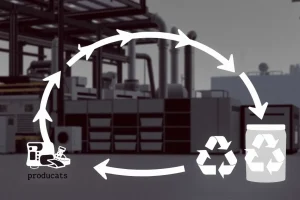
Traditional industrial processes operate in a linear fashion: raw materials are extracted, transformed into products, and eventually discarded as waste. This linear model leads to resource depletion, environmental pollution, greenhouse gas emissions, and growing volumes of waste that require disposal. Industrial symbiosis addresses this by creating closed-loop systems where the waste or by-products of one company become the feedstock for another, thereby reducing the overall consumption of virgin resources and minimizing waste generation.
How the solution works
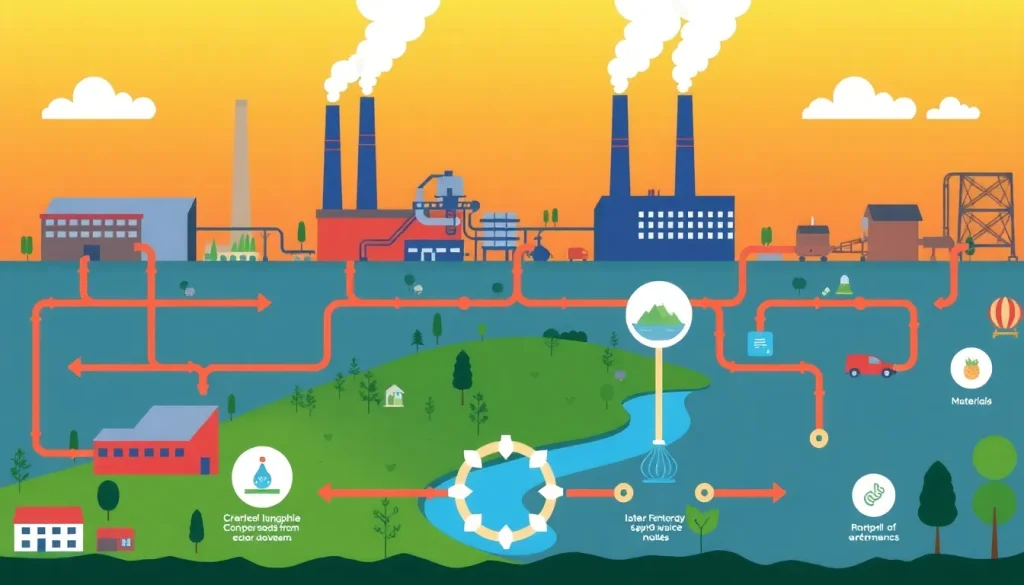
Industrial symbiosis involves the physical exchange of materials, energy, water, and by-products among geographically proximate firms. It is often described as a network where “one industry’s waste is another’s raw material.” The concept draws inspiration from natural ecosystems, where there is no waste. Key mechanisms include:
- Material exchanges: By-products such as fly ash, gypsum, or organic residues are transferred between companies for use as inputs in production processes. For example, fly ash from a power plant can be used in cement production, and spent grain from a brewery can become animal feed.
- Energy cascading: Excess heat or steam from one facility is used by another, reducing the need for additional fuel consumption. A refinery might supply waste heat to a district heating system or a neighboring greenhouse.
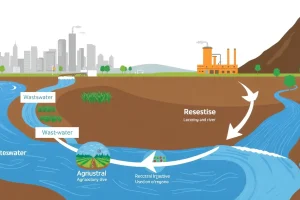
- Water reuse: Treated wastewater or cooling water is shared among facilities, lowering freshwater intake and discharge volumes. A water treatment plant may supply reclaimed water to a manufacturing plant for non-potable uses.
- Shared infrastructure and services: Companies may jointly invest in or utilize common treatment plants, logistics, or resource recovery facilities, spreading costs and improving efficiency.
Successful industrial symbiosis requires information sharing, trust, and often facilitation by a third party (e.g., a local authority or a dedicated coordinating body) to identify potential synergies and overcome transaction costs. The process can be self-organizing, as in the early stages of Kalundborg, or planned through eco-industrial park design.
Evidence strength
The evidence base for industrial symbiosis is moderate. The most famous and well-documented example is the Kalundborg Symbiosis in Denmark, which has evolved since the 1970s and involves exchanges of steam, water, gypsum, and other materials among a power plant, oil refinery, pharmaceutical company, and others. Quantitative assessments of Kalundborg show significant reductions in CO₂ emissions, water consumption, and virgin materials use, along with economic savings. Other case studies exist worldwide, including in China, the UK, and the US, often within eco-industrial parks. However, systematic, large-scale quantitative evidence is limited. Many projects remain small or fail to move beyond the planning stage. Academic literature is rich in case studies and conceptual frameworks but lacks comprehensive data on the global prevalence and aggregate impact of industrial symbiosis. The success factors and barriers are well-documented, but the overall evidence is still considered emerging rather than fully mature. Meta-analyses are rare, and most studies rely on qualitative or single-case quantitative data.
Potential scale
Industrial symbiosis has primarily been implemented at the local or regional level due to the need for geographic proximity, which reduces transportation costs and energy losses. The potential for scaling up to national or global levels is constrained by these physical and logistical requirements. However, “virtual” or “facilitated” symbiosis, where information platforms match waste streams with potential users across larger distances, could extend the reach. The concept could contribute significantly to circular economy targets if integrated into industrial policy and spatial planning. Nevertheless, the inherent complexity of coordinating multiple independent firms and the need for compatible waste streams limit its potential to become a universal solution. It is best viewed as a regional strategy within a broader circular economy framework. Estimates of global potential are speculative; the actual scale achieved remains a fraction of total industrial throughput.
Cost considerations
Implementing industrial symbiosis involves both initial investment and ongoing operational costs. Companies may need to invest in infrastructure for material handling, treatment, or transportation. Transaction costs, including search, negotiation, and monitoring, can be substantial. These include the costs of finding partners, conducting feasibility studies, drafting contracts, and ensuring quality control. However, these are often offset by long-term savings from reduced waste disposal fees, lower raw material costs, and additional revenue from selling by-products. In Kalundborg, the total investment in symbiotic infrastructure was recouped within a few years, and the network generates ongoing economic benefits. The cost-effectiveness varies by project and depends on factors such as the value of exchanged materials, regulatory incentives (e.g., landfill taxes), and the stability of partnerships. For many firms, the economic case is positive, but the upfront costs and risks can be a barrier without external support or facilitation. Public subsidies or tax breaks are sometimes used to kick-start networks.
Implementation time
Developing an industrial symbiosis network is typically a multi-year process. The initial phase of identifying potential synergies, building trust among partners, and negotiating agreements can take several years. Physical infrastructure construction may add additional time. For example, the Kalundborg Symbiosis evolved organically over decades, with new exchanges added incrementally. Planned eco-industrial parks can be established more quickly if designed from the outset, but even then, full realization of symbiosis often takes 5–10 years. The benefits accrue gradually as exchanges come online, and the network may continue to expand over time. Rapid implementation is rare; patience and long-term commitment are essential.
Environmental benefits
Industrial symbiosis yields multiple environmental benefits. By substituting virgin materials with by-products, it reduces the extraction of natural resources and the associated environmental impacts. Waste diversion from landfills and incinerators lowers pollution and land use. Energy exchanges reduce fossil fuel consumption and greenhouse gas emissions. Water reuse decreases freshwater withdrawals and wastewater discharge. In Kalundborg, annual savings include approximately 3 million cubic meters of water, 20,000 tons of oil equivalent in energy, and 200,000 tons of CO₂ emissions, among other benefits. These figures are context-specific, but the potential for significant environmental gains is well-established. Life cycle assessments of symbiosis networks generally show net positive environmental outcomes, though the magnitude depends on the specific exchanges and the baseline scenario.
Social and economic co-benefits
Beyond environmental gains, industrial symbiosis can generate social and economic co-benefits. It can create new business opportunities and jobs in waste management, logistics, and processing. By reducing costs, it enhances the competitiveness of participating firms. It can also improve community relations by reducing local pollution and demonstrating corporate responsibility. In some cases, it fosters innovation and knowledge sharing among companies. Additionally, it can contribute to regional economic resilience by diversifying revenue streams and reducing dependence on external resources. For example, a network that uses local waste as fuel is less vulnerable to global energy price fluctuations. However, these co-benefits are not automatic; they require intentional design and inclusive governance.
Risks and unintended consequences
Industrial symbiosis is not without risks. Over-dependence on a single partner for critical inputs can create vulnerabilities if that partner fails or changes its processes. The network may become locked into specific technologies or material flows, hindering future innovation or adaptation. There is also a risk of “rebound effects,” where cost savings from symbiosis lead to increased production and overall resource consumption. Environmental risks include the potential for hazardous waste exchanges if not properly managed. Regulatory barriers, such as waste classification rules that treat by-products as waste, can impede exchanges. Confidentiality concerns and competitive dynamics may also undermine collaboration. Furthermore, if symbiosis prolongs the life of polluting industries by reducing their costs, it could delay the transition to cleaner alternatives. Careful governance and continuous monitoring are needed to mitigate these risks.
Where it works best
Industrial symbiosis is most effective in regions with a diverse industrial base, where a variety of waste streams and resource needs can be matched. Geographic proximity is crucial to minimize transportation costs and energy losses. Supportive policy frameworks, such as those that recognize by-products as resources rather than waste, facilitate exchanges. The presence of a coordinating entity, whether a public agency or a private facilitator, significantly increases the likelihood of success. Industrial parks and clusters, particularly those with mixed tenants, are ideal settings. Examples include heavy industrial zones, chemical parks, and food processing clusters. Regions with high landfill taxes or stringent environmental regulations also create strong economic incentives for symbiosis.
Where it may not work
Industrial symbiosis is less suitable in areas with a sparse or homogeneous industrial structure, where few complementary exchanges are possible. High transportation costs or lack of infrastructure can render exchanges uneconomical. In regulatory environments that classify all secondary materials as waste, the legal hurdles may be insurmountable. A lack of trust or a short-term business culture can prevent the necessary long-term commitments. Additionally, industries with highly specialized or hazardous waste streams may find it difficult to identify safe and viable synergies. In regions with abundant cheap virgin resources and low waste disposal costs, the economic incentive for symbiosis is weak.
Comparison with alternatives
Industrial symbiosis is one of several strategies for improving resource efficiency. Compared to traditional waste management (landfill, incineration), it offers a more circular approach by keeping materials in use. Unlike cleaner production, which focuses on reducing waste at the source within a single facility, symbiosis addresses waste by finding external uses. It complements other circular economy practices such as product life extension, remanufacturing, and sharing platforms. While industrial symbiosis is powerful for bulk material and energy flows, it is not a substitute for upstream design changes that eliminate waste altogether. It is best seen as a bridging strategy that can deliver immediate gains while longer-term systemic changes are pursued. In some cases, symbiosis may be less efficient than direct process integration within a single company, but it offers flexibility and risk-sharing among independent entities.
Case studies
Kalundborg Symbiosis, Denmark: The most cited example, involving a power plant, refinery, pharmaceutical plant, and others. Exchanges include steam, water, gypsum, and biomass. Documented annual savings: 3 million m³ of water, 20,000 tons of oil, 200,000 tons of CO₂, and significant economic returns. The network evolved organically and is often held up as a model of self-organizing symbiosis.
Rotterdam Harbour, Netherlands: A large industrial cluster where waste heat, CO₂, and chemical by-products are exchanged among refineries, chemical plants, and greenhouses. The port authority actively facilitates symbiosis as part of its sustainability strategy. The scale and diversity of industries make it a leading example of planned industrial symbiosis.
Chinese Eco-Industrial Parks: China has promoted eco-industrial parks as part of its circular economy policy. Examples include the Tianjin Economic-Technological Development Area, where numerous material and water exchanges have been established, though results vary. Some parks have achieved notable reductions in waste and emissions, while others struggle with enforcement and data transparency.
National Industrial Symbiosis Programme (NISP), UK: A facilitated network that ran from 2005 to 2013, connecting companies across the country. It claimed to have diverted millions of tons of waste from landfill and generated significant cost savings, though the program’s end highlights the challenge of sustaining such initiatives without ongoing government support. Independent evaluations confirmed environmental and economic benefits but noted difficulties in attributing outcomes solely to the program.
Final assessment
Industrial symbiosis is a valuable and proven approach to enhancing resource efficiency and reducing environmental impacts at the local and regional levels. Its strengths lie in turning waste into resources, fostering collaboration, and delivering both economic and environmental benefits. However, it is not a panacea. Success depends on specific contextual factors, including industrial diversity, geographic proximity, supportive policies, and effective facilitation. The evidence, while compelling in individual cases, remains fragmented, and scaling up remains a challenge. For policymakers and business leaders, industrial symbiosis is worth pursuing where conditions are favorable, but it should be integrated into a broader circular economy strategy that also addresses product design, consumption patterns, and systemic change. When implemented thoughtfully, it can be a win-win for industry and the environment.
FAQ
What is the difference between industrial symbiosis and circular economy?
Industrial symbiosis is a specific practice within the broader circular economy framework, focusing on inter-firm collaboration to exchange waste and by-products, while circular economy encompasses product design, business models, and system-level changes to keep resources in use for as long as possible.
Can industrial symbiosis work in developing countries?
Yes, there are examples in developing countries, often in informal settings, but it requires supportive policies, trust, and infrastructure. It can be particularly beneficial where resources are scarce and waste disposal is costly, though regulatory and financial barriers may be higher.
What are the main barriers to implementing industrial symbiosis?
Barriers include lack of information about potential synergies, regulatory hurdles that classify by-products as waste, high transaction costs for finding and negotiating with partners, technical incompatibilities, and the need for long-term commitment and trust among firms.
References
- Chertow, M. R. (2000). Industrial symbiosis: literature and taxonomy. Annual Review of Energy and the Environment, 25(1), 313-337.
- Jacobsen, N. B. (2006). Industrial symbiosis in Kalundborg, Denmark: a quantitative assessment of economic and environmental aspects. Journal of Industrial Ecology, 10(1‐2), 239-255.
- Lombardi, D. R., & Laybourn, P. (2012). Redefining industrial symbiosis. Journal of Industrial Ecology, 16(1), 28-37.
- Ehrenfeld, J., & Gertler, N. (1997). Industrial ecology in practice: the evolution of interdependence at Kalundborg. Journal of Industrial Ecology, 1(1), 67-79.
- Boons, F., Spekkink, W., & Mouzakitis, Y. (2011). The dynamics of industrial symbiosis: a proposal for a conceptual framework based upon a comprehensive literature review. Journal of Cleaner Production, 19(9-10), 905-911.