In brief
At a glance
Quick Facts
- Verdict
- Mixed
- Problem addressed
- Reducing carbon and resource impact of buildings
- Evidence strength
- Moderate
- Potential scale
- Global
- Relative cost
- Varies
- Time to impact
- Years
Quick verdict
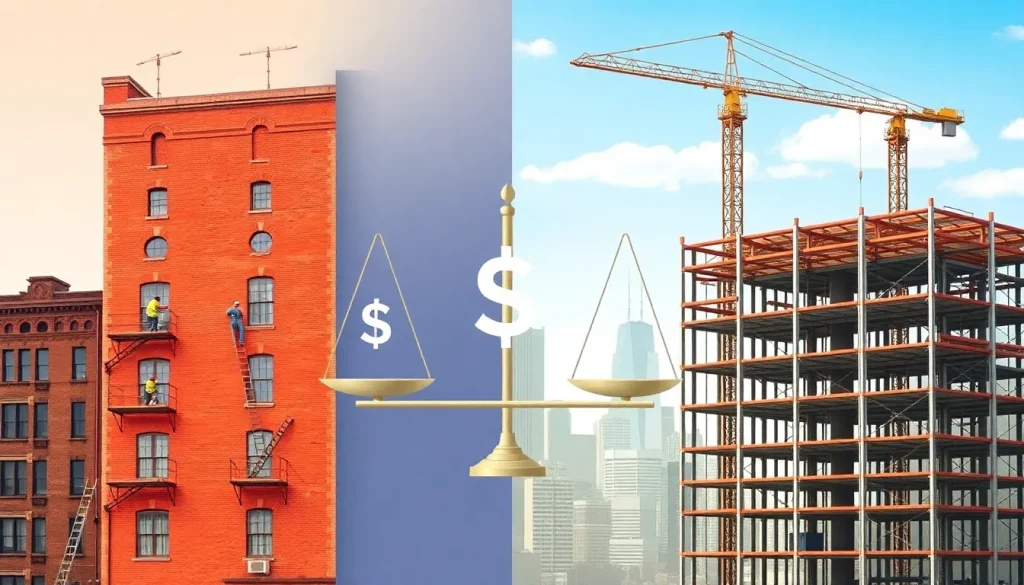
Neither building renovation nor new construction is a one-size-fits-all solution. Renovation typically has lower upfront embodied carbon and can be more cost-effective for structurally sound buildings, while new construction allows for higher energy performance, modern layouts, and increased density. The optimal choice depends on the existing building’s condition, the project’s intended use, local climate, and the availability of low-carbon materials. In many cases, a hybrid approach—deep retrofit with partial reuse—offers the best balance.
Problem addressed
The built environment is responsible for roughly 40% of global energy-related carbon emissions, with building operations (heating, cooling, lighting) and embodied carbon (emissions from material extraction, manufacturing, transport, and construction) each contributing significantly. As urban populations grow, the choice between renovating existing structures and demolishing them to build new ones has major implications for resource consumption, waste generation, and climate change. This analysis addresses the question: under what circumstances is renovation or new construction the more sustainable, cost-effective, and socially beneficial approach?
How the solution works
Renovation involves upgrading an existing building’s envelope, systems, and interior to improve performance, extend its life, and adapt it to new uses. This can range from minor retrofits (e.g., replacing windows, adding insulation) to deep energy retrofits that achieve near-net-zero energy consumption. New construction entails demolishing the old structure (if present) and building from scratch, allowing for optimal design, modern materials, and compliance with current codes. Both approaches aim to provide functional, efficient, and safe spaces, but they differ fundamentally in their treatment of the existing building stock and the associated environmental and economic costs.
Evidence strength
The evidence comparing renovation and new construction is moderate in quality and quantity. Numerous life cycle assessment (LCA) studies indicate that, in most cases, renovating an existing building results in lower total carbon emissions over a 50- to 60-year life cycle than demolishing and building new, primarily because of the avoided embodied carbon from new materials. However, these studies vary widely in scope, assumptions, and building types. For example, a 2021 review in Renewable and Sustainable Energy Reviews found that deep retrofits can reduce life cycle carbon by 50–75% compared to new construction, but the range depends heavily on the energy mix and the extent of renovation. Field data from actual projects is limited, and many claims rely on modeled projections. The evidence is stronger for operational energy savings in new buildings, but the embodied carbon penalty of new construction can take decades to offset through operational efficiency gains, especially in grids that are decarbonizing.
Potential scale
Both renovation and new construction have global relevance. In developed countries with aging building stocks, renovation is critical to meet climate targets; for instance, the European Union estimates that 75% of its building stock is energy-inefficient, and renovation rates need to at least double. In rapidly urbanizing regions, new construction dominates, but even there, adaptive reuse of existing structures can reduce material demand. The potential scale of renovation is limited by the structural integrity of existing buildings, heritage constraints, and the technical feasibility of achieving deep energy savings. New construction can be scaled more flexibly but faces material supply bottlenecks and higher upfront carbon emissions. Globally, both strategies are needed, but renovation likely has a larger near-term role in emissions reduction because it tackles the existing stock.
Cost considerations
Cost comparisons are highly project-specific. Renovation can be cheaper than new construction when the existing structure is sound and the retrofit is moderate, but deep retrofits to meet modern energy standards can approach or exceed the cost of new build. A 2020 study by the UK Green Building Council found that retrofit costs for non-domestic buildings ranged from £500 to £1,500 per square meter, while new construction ranged from £1,200 to £2,500 per square meter, but these figures exclude land and demolition costs. Renovation often benefits from lower site preparation and foundation costs, and may avoid expenses related to planning permission for new builds. However, hidden defects, hazardous materials (e.g., asbestos), and the complexity of working within an occupied building can escalate renovation costs unpredictably. New construction offers more cost certainty and can incorporate value-engineering from the start. Over the life cycle, energy savings from a high-performance new building can offset higher initial costs, but the payback period may be long.
Implementation time
Renovation projects can often be completed faster than new construction, especially for minor retrofits. A typical office building renovation might take 6–18 months, while a new build of similar size could take 18–36 months. However, deep retrofits that involve gutting the interior, replacing facades, and upgrading all systems can take as long as new construction. Renovation also allows phased work, enabling partial occupancy and continued use, which is not possible with demolition and new build. The time to see environmental benefits varies: operational energy savings from renovation can be immediate, but the full carbon payback (offsetting the embodied carbon of renovation materials) may take a few years. New construction’s operational savings are immediate, but the embodied carbon debt can take decades to offset, depending on the energy grid’s carbon intensity.
Environmental benefits
Renovation typically avoids the significant embodied carbon associated with new structural materials (concrete, steel), which can account for 50% or more of a new building’s life cycle carbon. Retaining and upgrading an existing building can reduce total life cycle carbon by 30–70% compared to new construction, according to multiple LCA studies. Renovation also reduces construction and demolition waste, which constitutes a large fraction of landfill volume in many countries. New construction, however, can achieve much lower operational carbon through high-performance envelopes, efficient HVAC, and on-site renewables, potentially reaching net-zero operational emissions. In grids with high carbon intensity, a new, ultra-efficient building may have lower total life cycle emissions than a moderately renovated existing building, but this advantage diminishes as grids decarbonize. Renovation also preserves embodied energy and avoids the environmental impacts of extracting and processing new raw materials.
Social and economic co-benefits
Renovation can preserve cultural heritage, maintain community character, and avoid displacement associated with demolition and redevelopment. It often supports local skilled labor (carpenters, plasterers) and can be more labor-intensive, creating more jobs per dollar spent than new construction. Renovating existing buildings in urban cores can revitalize neighborhoods without gentrification if done inclusively. New construction, on the other hand, can provide modern amenities, improved accessibility, higher density (reducing urban sprawl), and buildings designed for future flexibility. It can also stimulate economic activity through material supply chains and modern construction techniques. Both approaches can improve occupant health and productivity through better indoor environmental quality, but renovation may face limitations in achieving the same level of performance as a purpose-built new building.
Risks and unintended consequences
Renovation carries risks of unforeseen structural issues, hazardous materials (asbestos, lead paint), and cost overruns. It may also lock in suboptimal layouts or energy performance if not done comprehensively, leading to higher long-term operational emissions. There is a risk of “renoviction” where landlords use renovations as a pretext to evict tenants and raise rents. New construction, on the other hand, has high upfront embodied carbon, generates significant waste, and can contribute to urban sprawl if built on greenfield sites. Demolition of structurally sound buildings wastes embodied energy and materials. Both approaches can cause local disruption (noise, dust, traffic), but new construction often has a larger immediate environmental footprint. A rebound effect may occur if renovated buildings become more energy-efficient but are then used more intensively or if new construction enables higher consumption patterns.
Where it works best
Renovation is most suitable for buildings with good structural integrity, historical or cultural value, and locations where demolition would be disruptive or costly. It works well in dense urban areas with existing infrastructure, where land is scarce and new construction is expensive. Deep retrofits are particularly effective in temperate climates where heating and cooling loads can be significantly reduced through envelope upgrades. New construction is preferable on brownfield or underutilized sites where higher density is needed, for buildings with severe structural deficiencies or hazardous materials, or when a completely different building typology is required (e.g., converting a warehouse to a laboratory). It also excels when aiming for the highest energy performance standards, such as Passivhaus or net-zero energy, which are difficult to achieve in many existing structures.
Where it may not work
Renovation may be impractical for buildings with severe structural damage, extensive asbestos or lead contamination, or layouts that cannot be adapted to the intended use without disproportionate cost. In seismic zones, upgrading an old building to meet modern codes can be prohibitively expensive. New construction is less suitable in areas with strong embodied carbon reduction targets, on greenfield sites that contribute to sprawl, or when the existing building has significant heritage value. In regions with a large stock of vacant buildings, demolition and new build can exacerbate blight and waste resources. Both approaches can fail if not accompanied by appropriate urban planning and community engagement.
Comparison with alternatives
Beyond the binary choice, there are hybrid strategies: partial renovation with an extension, adaptive reuse that changes a building’s function while preserving its shell, and deconstruction (rather than demolition) to salvage materials for new construction. The following table summarizes key trade-offs between renovation and new construction:
| Factor | Renovation | New Construction |
|---|---|---|
| Embodied carbon | Low to moderate (avoids new structure) | High (new materials, demolition waste) |
| Operational energy | Moderate to high (limited by existing form) | Low to very low (optimized design) |
| Cost | Variable, often lower upfront | Higher upfront, more predictable |
| Time | Faster for light retrofits | Longer, but more predictable |
| Heritage preservation | Possible | Not applicable |
| Density increase | Limited | High potential |
| Waste generation | Low to moderate | High |
Compared to doing nothing, both renovation and new construction improve building performance, but the baseline condition matters. In some cases, the most sustainable option is to maintain and repair an existing building without major retrofit, if it already performs adequately.
Case studies
Empire State Building Retrofit (USA): A deep energy retrofit completed in 2010 reduced energy consumption by 38% and saved $4.4 million annually, with a payback of about three years. The project retained the iconic structure while upgrading windows, insulation, and HVAC. It demonstrated that even large, historic buildings can achieve significant savings without demolition.
BedZED (UK): A new-build eco-village completed in 2002, designed for zero fossil fuel energy, with high insulation, solar panels, and a biomass CHP plant. It achieved significant operational carbon reductions but had high embodied carbon from concrete and steel. Post-occupancy studies showed mixed results, with some technologies underperforming.
HafenCity Hamburg (Germany): A large-scale urban redevelopment that combines adaptive reuse of old port warehouses with new high-performance buildings. The mix allowed heritage preservation alongside modern density and energy standards, illustrating a hybrid approach.
These cases highlight that success depends on execution, local context, and the balance between embodied and operational carbon.
Final assessment
The choice between renovation and new construction is not a simple binary; it requires a holistic life cycle assessment that accounts for embodied carbon, operational energy, cost, heritage, and social impact. In general, renovating existing buildings—especially with deep energy retrofits—offers a lower-carbon pathway in the short to medium term and should be prioritized where feasible. However, new construction remains essential for meeting housing demand, achieving the highest energy performance, and densifying cities. Policymakers and developers should adopt a “renovation first” principle, but with flexibility to build new when renovation cannot meet the required performance or programmatic needs. The most sustainable strategy is to extend the life of existing buildings while ensuring that any new construction is designed for durability, adaptability, and ultra-low carbon emissions.
FAQ
Is renovating always better for the environment than building new?
Not always. Renovation typically has lower embodied carbon, but if the existing building cannot be made highly energy-efficient, a new ultra-efficient building might have lower total life cycle emissions, especially in regions with carbon-intensive electricity grids. A life cycle assessment is needed for each case.
Which is cheaper: renovation or new construction?
It depends on the project. Light to moderate renovations are often cheaper than new construction, but deep retrofits can cost as much or more. Renovation can have hidden costs from unforeseen issues, while new construction offers more cost predictability.
Can renovated buildings achieve the same energy performance as new ones?
In many cases, yes, but it can be more challenging and expensive. Deep retrofits can bring existing buildings close to modern standards, but some limitations (e.g., building orientation, thermal bridging) may prevent achieving the highest performance levels like Passivhaus.
References
- IPCC Sixth Assessment Report, Working Group III, Chapter 9 (Buildings).
- World Green Building Council, 'Bringing Embodied Carbon Upfront' (2019).
- Pomponi, F., & Moncaster, A. (2017). 'Embodied carbon mitigation and reduction in the built environment: What does the evidence say?' Journal of Environmental Management.
- UK Green Building Council, 'Building the Case for Net Zero: Retrofitting vs New Build' (2020).
- European Commission, 'A Renovation Wave for Europe' (2020).