In brief
At a glance
Quick Facts
- Status
- Planetary Boundaries: 6 of 9 boundaries transgressed; Limits to Growth: business-as-usual scenario aligns with observed data, indicating potential collapse.
- Control variable
- PB: nine Earth-system process indicators; LTG: system dynamics model with population, resources, pollution, etc.
- Proposed boundary
- PB: quantitative safe boundaries (e.g., 350 ppm CO2); LTG: no single boundary, but limits to resource availability and pollution absorption.
- Current value
- PB: CO2 ~420 ppm (2023), extinction rate >100 E/MSY; LTG: model projections closely match historical data from 1970–2020.
- Pre-industrial baseline
- PB: Holocene epoch (last 10,000 years); LTG: model initialized with 1900 data.
Current status
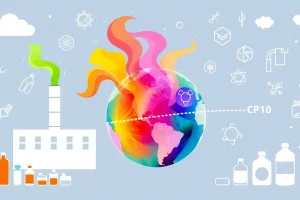
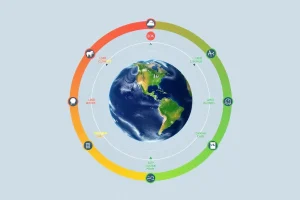
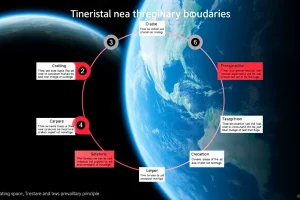
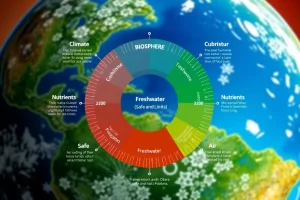
The planetary boundaries framework, first proposed in 2009 and updated in 2015 and 2023, has become a cornerstone of Earth system science and sustainability policy. As of the 2023 assessment, six of the nine boundaries are estimated to have been transgressed: climate change, biosphere integrity, land-system change, freshwater change, biogeochemical flows, and novel entities. The Limits to Growth (LTG) study, published in 1972, used a global system dynamics model to simulate long-term trends in population, industrialization, resource depletion, pollution, and food production. Its “standard run” scenario projected a peak and subsequent decline in global welfare around the mid-21st century. Recent empirical comparisons show that the world has been tracking closely to the LTG business-as-usual trajectory, renewing interest in its warnings. Both frameworks indicate that humanity is currently operating outside a safe space, though they approach the problem from different angles.
Control variable
The planetary boundaries framework defines nine specific control variables, each corresponding to a critical Earth-system process. These include atmospheric CO₂ concentration (for climate change), extinction rate (for biosphere integrity), global forest area remaining (for land-system change), and phosphorus flow to oceans (for biogeochemical flows). The choice of control variables is based on their ability to capture the state of the system relative to a Holocene-like baseline and their sensitivity to human pressures. In contrast, the Limits to Growth model does not rely on a single control variable but on a set of interconnected stocks and flows: population, capital, resources, food, and pollution. The model’s state is determined by the interactions among these variables, with no single indicator serving as a boundary. Instead, the system’s behavior—such as overshoot and collapse—emerges from the feedback structure.
Proposed boundary or threshold
The planetary boundaries framework proposes quantitative boundaries for each Earth-system process, intended to define a “safe operating space” where the risk of triggering abrupt or irreversible environmental change is low. For example, the climate change boundary is set at 350 ppm CO₂ and a radiative forcing of +1.0 W/m²; the biosphere integrity boundary is set at an extinction rate of <10 extinctions per million species-years. These boundaries are often accompanied by a zone of increasing risk and a high-risk zone. The Limits to Growth study did not propose fixed boundaries but identified limits to resource availability and the Earth's capacity to absorb pollution. The model's "standard run" scenario showed that if growth trends continued, the global system would overshoot these limits and subsequently collapse. The concept of "planetary boundaries" is thus prescriptive, while LTG is descriptive and cautionary.
Current measured value
According to the 2023 planetary boundaries update, the control variables for climate change (CO₂ ~420 ppm, radiative forcing ~2.91 W/m²), biosphere integrity (extinction rate tens to hundreds of times above background), and biogeochemical flows (phosphorus and nitrogen cycles heavily disrupted) are well into the high-risk zone. For the Limits to Growth, a 2014 study by Graham Turner compared the World3 standard run with empirical data from 1970 to 2010 and found a close match for population, industrial output, food, services, and pollution. Updated analyses through 2020 continue to show alignment, suggesting that the world is on the “business-as-usual” path that leads to decline in the coming decades. Thus, both frameworks indicate that humanity has already moved beyond safe limits.
How the boundary is calculated
Planetary boundaries are derived from a synthesis of Earth system science, including paleoclimate records, global biogeochemical models, and observed responses to human pressures. For each boundary, scientists identify a critical threshold based on the Holocene state and the point at which feedbacks could destabilize the system. The control variable is then set at a distance from that threshold to account for uncertainty. The Limits to Growth model, World3, is a system dynamics model that simulates the interactions among five sectors using differential equations. It was calibrated with historical data from 1900 to 1970 and then run forward under different assumptions about resource availability, technological change, and policy. The model’s projections are not based on fixed thresholds but on the dynamic behavior of the system.
Historical trend
The planetary boundaries framework has evolved since its inception in 2009. The original set of nine boundaries has been refined, with some control variables changed (e.g., freshwater use now includes green water) and boundaries updated based on new science. The number of transgressed boundaries has increased from three in 2009 to six in 2023. The Limits to Growth study was published in 1972 and updated in subsequent editions (1974, 1992, 2004). Its scenarios have been re-evaluated multiple times, with most studies finding that the “standard run” aligns well with historical data. Both frameworks reflect the “Great Acceleration” of human activities since the mid-20th century, with exponential growth in many pressures.
What is driving the change
The primary drivers of Earth system change are human population growth, economic expansion (GDP), resource consumption, and technological choices that increase throughput of materials and energy. The planetary boundaries framework emphasizes the role of the “Great Acceleration” since 1950, driven by fossil fuel use, industrial agriculture, and globalization. The Limits to Growth model focuses on the reinforcing feedback loops between population and capital growth, which drive exponential increases in resource use and pollution, ultimately constrained by finite resources and the Earth’s absorptive capacity. Both frameworks point to the same underlying drivers: the scale and pattern of human economic activity.
What crossing the boundary means
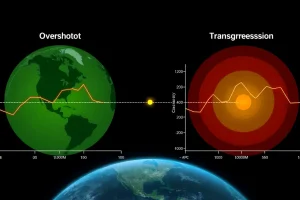
Transgressing a planetary boundary increases the risk of triggering non-linear, abrupt, or irreversible changes in Earth system functioning. For example, crossing the climate boundary could activate tipping elements such as ice sheet collapse or Amazon dieback. Crossing the biosphere integrity boundary undermines ecosystem resilience and the capacity to provide ecosystem services. In the Limits to Growth model, crossing the limits leads to “overshoot and collapse”: as resources become scarce and pollution accumulates, industrial and agricultural output decline, causing a drop in population and living standards. Both frameworks warn that exceeding critical thresholds can lead to a rapid deterioration of the conditions that support human civilization.
Regional variations
Several planetary boundaries have strong regional dimensions. For instance, freshwater use and land-system change are assessed at both global and regional scales, with some regions far exceeding local boundaries while others remain within safe limits. Biogeochemical flows also exhibit regional hotspots of nitrogen and phosphorus pollution. The Limits to Growth model is global in scope and does not explicitly represent regional differences, though subsequent analyses have highlighted that resource consumption and environmental impacts are unevenly distributed, with high-income countries responsible for a disproportionate share of pressure. Both frameworks acknowledge that global aggregates can mask significant regional disparities.
Interaction with other boundaries
The planetary boundaries framework explicitly recognizes that boundaries interact, often amplifying each other. For example, climate change exacerbates biodiversity loss, while land-system change contributes to both climate change and freshwater disruption. These interactions can create cascading effects that push the Earth system further from the Holocene state. The Limits to Growth model is built on the premise of interconnectedness: the five sectors are linked through multiple feedback loops, so that a change in one (e.g., resource depletion) affects all others. Both frameworks thus emphasize that addressing one issue in isolation is insufficient; systemic approaches are needed.
Impacts on people and ecosystems
Transgressing planetary boundaries threatens the stability of ecosystems and the services they provide, including food production, water purification, climate regulation, and disease control. This in turn undermines human well-being, particularly for vulnerable populations. The Limits to Growth model projects a decline in food per capita, industrial output, and eventually population, leading to widespread hardship. Both frameworks converge on the conclusion that continuing on the current trajectory will result in severe consequences for human societies and the natural world, including increased risk of conflict, famine, and economic disruption.
Possible pathways back toward the safe zone
Returning to within planetary boundaries requires transformative changes across multiple sectors: rapid decarbonization of the energy system, sustainable food production, circular economy principles, and conservation of ecosystems. The planetary boundaries framework provides quantitative targets that can guide policy. The Limits to Growth study explored alternative scenarios, such as the “stabilized world” scenario, which combined technological innovation with shifts in societal values (e.g., lower desired family size, resource efficiency) to avoid collapse. Both frameworks suggest that a combination of technological, behavioral, and institutional changes is necessary to steer humanity back toward a safe and sustainable trajectory.
Scientific uncertainty
Both frameworks are subject to significant uncertainties. For planetary boundaries, the exact position of thresholds is often poorly known, especially for novel entities and biosphere integrity. Interactions among boundaries and regional dynamics add further complexity. The Limits to Growth model has been criticized for its assumptions about resource availability, technological progress, and the lack of price mechanisms. However, its broad projections have held up well against historical data. Both frameworks acknowledge deep uncertainty and are intended as heuristic tools to guide decision-making under uncertainty rather than precise predictions.
Criticism and alternative frameworks
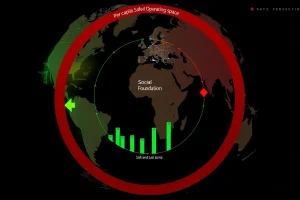
The planetary boundaries framework has been criticized for its global focus, which may obscure local environmental problems, and for the arbitrary nature of some boundary values. Some argue that it does not adequately incorporate social and economic dimensions. The Limits to Growth study faced intense criticism for its alleged Malthusian pessimism and for underestimating the potential of technological innovation and market adaptation. Alternative frameworks include “doughnut economics,” which combines planetary boundaries with social foundations to define a safe and just space for humanity, and the “safe and just operating space” concept. Other approaches, such as the “planetary health” framework, focus on the human health implications of environmental change. Despite criticisms, both the planetary boundaries and Limits to Growth frameworks remain influential in shaping the discourse on global sustainability.
FAQ
How do planetary boundaries differ from the Limits to Growth?
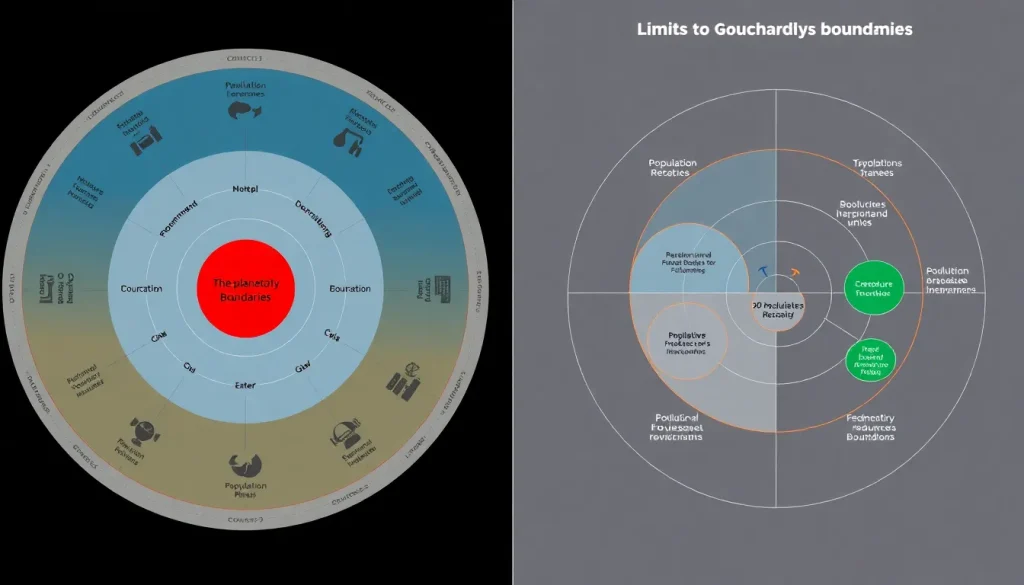
Planetary boundaries define specific quantitative limits for nine Earth-system processes to maintain a safe operating space, while the Limits to Growth used a system dynamics model to simulate long-term global trends and warn of overshoot and collapse. PB is prescriptive, LTG is descriptive.
Are the Limits to Growth predictions still valid?
Recent studies comparing the World3 model's standard run with empirical data from 1970 to 2020 show a close match, suggesting that the world is on a trajectory consistent with the business-as-usual scenario, which leads to decline in the 21st century. However, the exact timing and nature of potential collapse remain uncertain.
Which framework is more useful for policy?
Both frameworks have influenced policy. Planetary boundaries provide clear, quantitative targets that can be incorporated into goal-setting (e.g., climate targets, biodiversity goals). The Limits to Growth highlights the interconnectedness of global challenges and the need for systemic solutions. Many policymakers use elements of both.
References
- Rockström, J., et al. (2009). "A safe operating space for humanity." Nature, 461, 472–475.
- Steffen, W., et al. (2015). "Planetary boundaries: Guiding human development on a changing planet." Science, 347(6223), 1259855.
- Richardson, K., et al. (2023). "Earth beyond six of nine planetary boundaries." Science Advances, 9(37), eadh2458.
- Meadows, D. H., et al. (1972). The Limits to Growth. Universe Books.
- Turner, G. M. (2014). "Is Global Collapse Imminent? An Updated Comparison of The Limits to Growth with Historical Data." MSSI Research Paper No. 4, University of Melbourne.