In brief
At a glance
Quick Facts
- Status
- Six of nine planetary boundaries transgressed; social foundation unmet for billions
- Control variable
- Multiple Earth-system and social indicators
- Proposed boundary
- Ecological ceiling (planetary boundaries) and social foundation (minimum standards)
- Current value
- CO₂ ~417 ppm, extinction rate >100 E/MSY, 700+ million in extreme poverty
- Pre-industrial baseline
- Holocene conditions for Earth-system; mid-20th century for social indicators
Current status
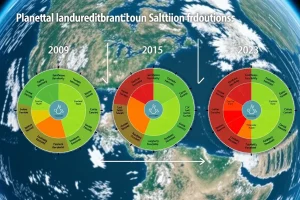
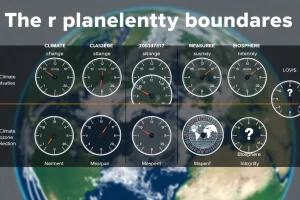
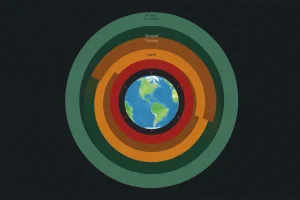
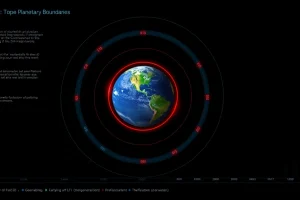
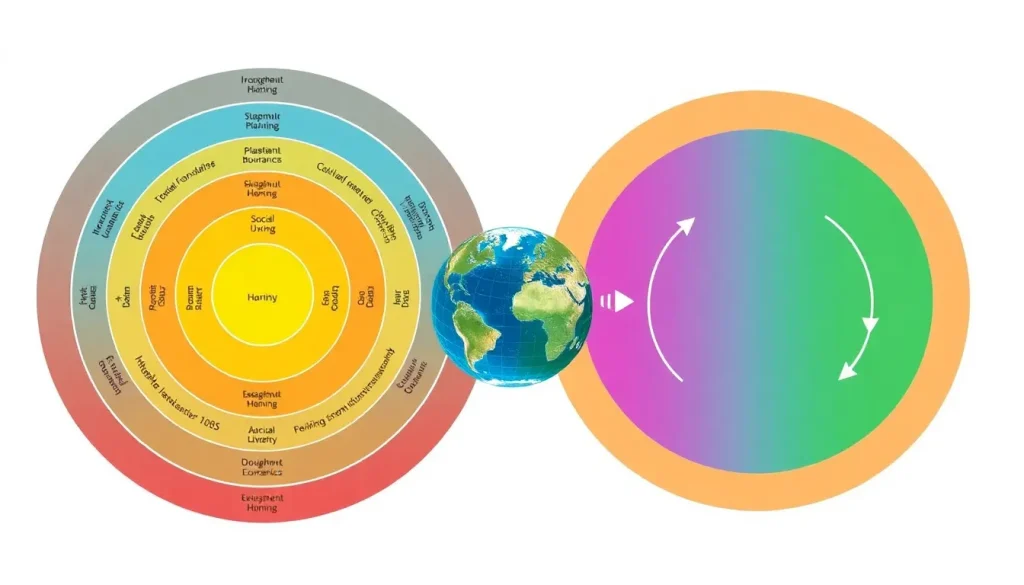
As of the 2023 update by Richardson et al., six of the nine planetary boundaries are transgressed: climate change, biosphere integrity (genetic diversity and functional integrity), land-system change, freshwater change, biogeochemical flows (nitrogen and phosphorus), and novel entities (including plastics and synthetic chemicals). The remaining three—ocean acidification, stratospheric ozone depletion, and atmospheric aerosol loading—are within the safe operating space, though ocean acidification is approaching its boundary. The Doughnut Economics framework, introduced by Kate Raworth, uses the planetary boundaries as the ecological ceiling, and overlays a social foundation of twelve dimensions derived from the Sustainable Development Goals. At the global scale, humanity is falling short on many social foundation indicators (e.g., food security, health, education) while overshooting multiple planetary boundaries, placing the world in the “doughnut’s hole” of deprivation and beyond its outer ring of ecological overshoot.
Control variable
In the Planetary Boundaries framework, each of the nine Earth-system processes is tracked by one or more control variables—quantifiable metrics that define the boundary. For example, climate change is measured by atmospheric CO₂ concentration and radiative forcing; biosphere integrity by genetic diversity (extinction rate) and functional integrity (e.g., human-appropriated net primary production). Doughnut Economics does not prescribe a single set of control variables but instead advocates for a dashboard of indicators to monitor both the ecological ceiling and the social foundation. The ecological ceiling indicators are drawn from the planetary boundaries, while the social foundation indicators are based on internationally agreed minimum standards (e.g., the SDGs). The doughnut framework emphasizes that the choice of indicators should be context-specific and participatory, especially at national and local levels.
Proposed boundary or threshold
The Planetary Boundaries framework proposes quantitative thresholds for each Earth-system process, beyond which the risk of destabilizing the Holocene-like state increases. For instance, the climate change boundary is set at 350 ppm CO₂ and +1.0 W/m² radiative forcing; the biosphere integrity boundary is 75% of potential natural biomass for functional integrity. Doughnut Economics adopts these ecological boundaries as the outer ring, but also defines a social foundation—a set of minimum standards for human well-being, such as sufficient food, clean water, healthcare, education, and political voice. The doughnut’s inner ring represents the threshold below which critical human deprivation occurs. The goal is to bring humanity into the “safe and just space” between the two rings.
Current measured value
According to the 2023 update, the control variables for the transgressed boundaries are: climate change—atmospheric CO₂ concentration ~417 ppm (2022) and radiative forcing ~2.91 W/m²; biosphere integrity—extinction rate >100 E/MSY and functional integrity at ~60% of potential natural biomass; land-system change—global forest cover loss exceeding the boundary; freshwater change—both green water (soil moisture) and blue water (surface and groundwater) boundaries transgressed; biogeochemical flows—global nitrogen and phosphorus application far beyond safe limits; novel entities—production and release of synthetic chemicals and plastics exceed assessment capacity. For the social foundation, global data show that hundreds of millions of people lack access to adequate food, water, healthcare, and education, while billions live in poverty or face political inequality.
How the boundary is calculated
The Planetary Boundaries framework uses Earth-system science and modelling to identify critical thresholds and define a safe distance from them. For processes with known global thresholds (e.g., climate change, ocean acidification), the boundary is set at a level that avoids crossing a tipping point. For processes without a clear global threshold (e.g., freshwater use, land-system change), the boundary is defined based on maintaining the resilience of the Earth system, often using the Holocene state as a reference. The Doughnut’s ecological ceiling is directly derived from the planetary boundaries, while the social foundation is calculated using internationally recognized minimum standards, such as those in the SDGs, human rights frameworks, and global assessments. At the national level, the doughnut can be downscaled by selecting locally relevant indicators and thresholds through participatory processes.
Historical trend
Since the Industrial Revolution, human activities have progressively pushed Earth-system processes away from their Holocene baselines. The first planetary boundary to be transgressed was likely biosphere integrity (genetic diversity) due to accelerating species extinctions. By the mid-20th century, climate change, biogeochemical flows, and land-system change had also moved beyond safe levels. The 2009, 2015, and 2023 assessments show a clear trend of increasing transgression, with novel entities and freshwater change added to the list in 2023. On the social side, global progress on poverty reduction, health, and education has lifted billions out of extreme deprivation, but recent years have seen setbacks due to the COVID-19 pandemic, conflict, and climate impacts, widening the gap between the social foundation and the ecological ceiling.
What is driving the change
The primary drivers of planetary boundary transgression are human population growth, resource-intensive consumption patterns, and the linear “take-make-dispose” economic model. Industrial agriculture, fossil fuel combustion, deforestation, and the proliferation of synthetic chemicals are key proximate drivers. Doughnut Economics identifies the same drivers but frames them as symptoms of a deeper systemic flaw: an economic paradigm fixated on GDP growth that ignores ecological limits and social inequalities. The doughnut highlights how financial markets, corporate structures, and policy frameworks incentivize overshoot and deprivation simultaneously.
What crossing the boundary means
Transgressing a planetary boundary increases the risk of triggering non-linear, abrupt, or irreversible Earth-system changes. For example, exceeding the climate boundary raises the likelihood of ice sheet collapse, permafrost thaw, and shifts in ocean circulation. Crossing the biosphere integrity boundary undermines ecosystem services such as pollination, water purification, and carbon sequestration. In the Doughnut framework, overshooting the ecological ceiling while falling short of the social foundation creates a double crisis: environmental degradation exacerbates poverty and inequality, while social deprivation limits the capacity to respond to ecological challenges. The doughnut’s “safe and just space” is the region where both ecological and social thresholds are respected.
Regional variations
Planetary boundaries are defined at the global scale, but their transgression has heterogeneous regional impacts. For instance, freshwater change is assessed globally but manifests as severe regional water scarcity or flooding. Land-system change affects tropical forests disproportionately, while climate change impacts are most acute in low-latitude and coastal regions. The Doughnut framework explicitly addresses regional variations by encouraging downscaling: cities, countries, and regions can create their own doughnuts using local data and participatory processes. This reveals that high-income countries often overshoot multiple ecological boundaries while meeting most social thresholds, whereas low-income countries may stay within ecological limits but suffer severe social shortfalls.
Interaction with other boundaries
The Planetary Boundaries framework recognizes that Earth-system processes are coupled. For example, land-system change (deforestation) affects climate change (carbon emissions), biosphere integrity (habitat loss), freshwater change (altered runoff), and biogeochemical flows (soil nutrient loss). Similarly, climate change amplifies ocean acidification and freshwater stress. Doughnut Economics emphasizes these interconnections and advocates for systemic solutions that address multiple boundaries simultaneously, such as regenerative agriculture that restores soil carbon, enhances biodiversity, and improves water retention while providing nutritious food.
Impacts on people and ecosystems
Transgressing planetary boundaries directly harms human well-being and ecosystem health. Climate change increases extreme weather events, sea-level rise, and food insecurity. Biosphere integrity loss reduces pollination, pest control, and genetic resources. Freshwater change leads to water scarcity and conflict. Novel entities pose toxicological risks and disrupt endocrine systems. The Doughnut framework highlights that these ecological impacts disproportionately affect marginalized communities, deepening social shortfalls. Conversely, failing to meet the social foundation—such as lack of education or gender inequality—undermines societies’ ability to respond to environmental challenges.
Possible pathways back toward the safe zone
Returning to the safe operating space requires transformative changes in energy, food, and economic systems. The Planetary Boundaries framework suggests global targets such as net-zero CO₂ emissions, halting deforestation, reducing nutrient pollution, and circular economy approaches for novel entities. Doughnut Economics proposes a broader redesign of the economy: shifting from GDP growth to thriving in balance, reforming financial systems to serve long-term well-being, and fostering regenerative and distributive enterprises. Both frameworks call for strengthened global governance, but the doughnut adds a focus on local action and inclusive decision-making to ensure a just transition.
Scientific uncertainty
There are significant uncertainties in defining precise boundary positions and understanding Earth-system interactions. For novel entities, the boundary is qualitative due to the vast number of synthetic chemicals and limited toxicity data. For biosphere functional integrity, the indicator is still being refined. The Planetary Boundaries framework uses a precautionary approach, setting boundaries at the lower end of the uncertainty range. Doughnut Economics inherits these uncertainties and adds the challenge of defining social thresholds, which are inherently normative and context-dependent. Both frameworks acknowledge that boundaries are not fixed lines but zones of increasing risk.
Criticism and alternative frameworks
The Planetary Boundaries framework has been criticized for its global-scale focus, which may obscure regional heterogeneity, and for the difficulty of defining boundaries for processes without clear global thresholds. Some scientists argue that the framework oversimplifies complex Earth-system dynamics. Doughnut Economics has been critiqued for its lack of operational specificity and for relying on the planetary boundaries without fully addressing their uncertainties. Alternative frameworks include the “safe and just operating space” concept, which integrates social justice more explicitly, and the “Earth system justice” approach. Other ecological-economic models, such as steady-state economics and degrowth, also challenge the growth paradigm but differ in their policy prescriptions.
FAQ
What is the main difference between Planetary Boundaries and Doughnut Economics?
Planetary Boundaries focuses on biophysical Earth-system processes and defines a safe operating space, while Doughnut Economics adds a social foundation and frames the goal as a safe and just space for humanity.
How many planetary boundaries have been crossed?
As of 2023, six of the nine boundaries are transgressed: climate change, biosphere integrity, land-system change, freshwater change, biogeochemical flows, and novel entities.
Can the Doughnut model be applied at a national level?
Yes, the Doughnut can be downscaled to cities, countries, or regions by selecting locally relevant indicators for both the ecological ceiling and the social foundation, often through participatory processes.
References
- Rockström, J., et al. (2009). "A safe operating space for humanity." Nature, 461, 472–475.
- Steffen, W., et al. (2015). "Planetary boundaries: Guiding human development on a changing planet." Science, 347(6223), 1259855.
- Richardson, K., et al. (2023). "Earth beyond six of nine planetary boundaries." Science Advances, 9(37), eadh2458.
- Raworth, K. (2017). "Doughnut Economics: Seven Ways to Think Like a 21st-Century Economist." Random House.
- Raworth, K. (2012). "A Safe and Just Space for Humanity: Can we live within the doughnut?" Oxfam Discussion Paper.