In brief
At a glance
Quick Facts
- Status
- Six of nine boundaries transgressed (2023)
- Control variable
- Multiple, one per boundary (e.g., CO₂ for climate, extinction rate for biosphere)
- Proposed boundary
- Safe operating space for each of nine processes
- Current value
- Six boundaries transgressed (2023 assessment)
- Pre-industrial baseline
- Holocene conditions (last 11,700 years)
Current status
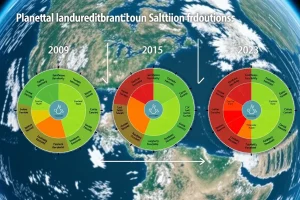
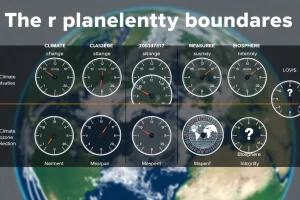
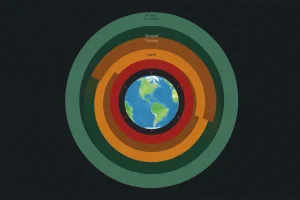
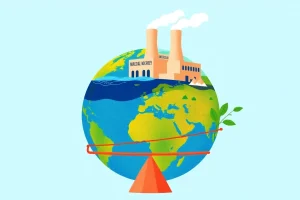
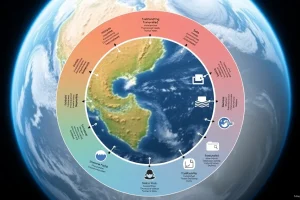
As of the 2023 update by Richardson et al., six of the nine planetary boundaries are assessed as transgressed: climate change, biosphere integrity (genetic diversity and functional integrity), land-system change, freshwater change, biogeochemical flows (nitrogen and phosphorus), and novel entities (including plastics and synthetic chemicals). Stratospheric ozone depletion remains within the safe zone due to the Montreal Protocol, ocean acidification is approaching the boundary, and atmospheric aerosol loading is not yet globally transgressed but has regional exceedances. The overall Earth system is thus operating outside the safe operating space for multiple critical processes, increasing the risk of large-scale irreversible changes.
Control variable
The planetary boundaries framework does not have a single control variable; instead, it defines control variables for each of the nine Earth-system processes. For example, the control variable for climate change is atmospheric CO₂ concentration (and radiative forcing), for biosphere integrity it is genetic diversity (extinction rate) and functional integrity (e.g., net primary production), and for land-system change it is the area of forested land remaining. The overall state of the Earth system is assessed by the number and degree of boundary transgressions. A return within the planetary boundaries would require bringing all transgressed control variables back to their safe levels.
Proposed boundary or threshold
The planetary boundaries framework proposes a safe operating space for each of the nine processes, defined by a boundary value that should not be crossed to avoid destabilizing the Earth system. For example, the climate change boundary is set at 350 ppm CO₂ and 1 W/m² radiative forcing; the biosphere integrity boundary (genetic diversity) is an extinction rate of <10 extinctions per million species-years, and the functional integrity boundary is defined by the net primary production remaining at a level close to Holocene values. The boundaries are not fixed tipping points but rather zones of increasing risk. The overall safe operating space is the region where all boundaries are respected.
Current measured value
According to the 2023 assessment, the current values for the transgressed boundaries are: atmospheric CO₂ concentration ~417 ppm (2022), well above the 350 ppm boundary; extinction rate >100 extinctions per million species-years (boundary: <10); functional integrity of the biosphere is also transgressed; land-system change: global forest area as a percentage of original forest cover is ~60%, below the boundary of 75%; freshwater change: both green water (soil moisture) and blue water (rivers, lakes) boundaries are transgressed; biogeochemical flows: phosphorus flow to oceans and nitrogen fixation are far beyond safe limits; novel entities: the boundary is transgressed due to the release of synthetic chemicals and plastics. Ocean acidification is approaching the boundary, and atmospheric aerosol loading is within the global boundary but regionally exceeded.
How the boundary is calculated
The planetary boundaries are derived from Earth-system science, using models and data to identify thresholds and feedbacks that could destabilize the Holocene-like state. For each process, a control variable is chosen that captures the key dynamics. The safe boundary is set at a distance from the threshold or tipping point to allow for uncertainty and time to respond. For example, the climate boundary of 350 ppm CO₂ was set based on paleoclimate data showing that above this level, ice sheet melting and other feedbacks may be triggered. The methodology involves literature synthesis, expert elicitation, and modeling of Earth-system interactions. The 2023 update introduced a two-tier approach for some boundaries: a global boundary and a regional boundary, recognizing that some processes have sub-global impacts that aggregate to global scale.
Historical trend
During the Holocene epoch (the last ~11,700 years), Earth-system processes remained relatively stable, providing the conditions for human civilization to develop. Since the Industrial Revolution, human activities have pushed several control variables beyond their Holocene variability. Atmospheric CO₂ rose from ~280 ppm to over 420 ppm; species extinction rates increased by orders of magnitude; nitrogen fixation doubled; forest cover declined significantly; and novel entities proliferated. The transgression of multiple boundaries has accelerated since the 1950s, a period often referred to as the Great Acceleration. The 2023 assessment shows that six boundaries are now transgressed, up from three in the 2009 analysis, indicating a deteriorating trend.
What is driving the change
The primary drivers of boundary transgression are human activities linked to population growth, economic expansion, and resource-intensive consumption patterns. Industrial agriculture drives excessive nitrogen and phosphorus use, land-system change, and biodiversity loss. Fossil fuel combustion is the main cause of climate change and ocean acidification. The proliferation of synthetic chemicals and plastics leads to the transgression of the novel entities boundary. These drivers are deeply embedded in the current global economic system, which relies on linear resource flows and externalizes environmental costs.
What crossing the boundary means
Transgressing planetary boundaries increases the risk of triggering non-linear, abrupt, or irreversible changes in the Earth system. These include climate tipping points (e.g., Amazon dieback, ice sheet collapse), biodiversity collapse, and disruptions to freshwater cycles. Crossing multiple boundaries can amplify risks through interactions, potentially pushing the Earth system into a new state that is less hospitable to human societies. The framework emphasizes that the boundaries are not hard thresholds but zones of increasing risk; the further the transgression, the higher the likelihood of severe consequences.
Regional variations
While some boundaries are global (climate, ozone), others manifest regionally but have global implications. For example, freshwater change is assessed at the river basin scale, and many regions already experience severe water stress. Land-system change is measured globally but deforestation is concentrated in tropical regions. Biogeochemical flows cause eutrophication in coastal zones worldwide. The novel entities boundary is global due to the ubiquity of plastics and chemicals. The regional heterogeneity means that returning within boundaries requires differentiated actions, with high-income countries bearing greater responsibility due to historical emissions and consumption.
Interaction with other boundaries
The planetary boundaries are tightly coupled. Climate change exacerbates biodiversity loss and freshwater stress. Land-system change contributes to climate change and reduces biosphere integrity. Excessive nitrogen and phosphorus use harms aquatic ecosystems and contributes to greenhouse gas emissions. Novel entities can affect biosphere integrity and human health. These interactions mean that addressing one boundary in isolation may be insufficient; a holistic approach is needed to return to the safe operating space. Positive feedback loops can accelerate transgression, making timely action critical.
Impacts on people and ecosystems
Transgressing boundaries threatens the stability of ecosystems and the services they provide, including food production, water purification, climate regulation, and disease control. Human health is directly impacted by pollution, extreme weather, and resource scarcity. Economic costs are mounting, with climate-related disasters, biodiversity loss, and water crises affecting livelihoods. Vulnerable populations, particularly in low-income countries, are disproportionately affected. The erosion of Earth-system resilience undermines the foundation for sustainable development and poverty alleviation.
Possible pathways back toward the safe zone
Returning within the planetary boundaries is possible but requires transformative changes across multiple sectors. Key pathways include: rapid decarbonization of the global economy to meet the Paris Agreement goals; sustainable food systems that reduce nitrogen and phosphorus use, halt deforestation, and promote biodiversity; circular economy models to minimize waste and novel entities; integrated water resource management; and conservation and restoration of ecosystems. Governance reforms, including global cooperation, policy coherence, and equitable resource distribution, are essential. Technological innovation, behavioral shifts, and changes in economic paradigms (e.g., moving beyond GDP) can support the transition. The concept of “planetary stewardship” emphasizes the need for collective action to safeguard the Earth system.
Scientific uncertainty
The planetary boundaries framework involves significant uncertainties. The precise position of thresholds and tipping points is often poorly known, and the interactions between boundaries are complex and not fully understood. Some boundaries lack a clear global threshold (e.g., novel entities, atmospheric aerosols). The choice of control variables and boundary values involves expert judgment and can be contested. Regional boundaries are still being developed, and the aggregation of regional transgressions to a global assessment is methodologically challenging. Despite these uncertainties, the framework is widely regarded as a useful heuristic for guiding policy and highlighting risks.
Criticism and alternative frameworks
The planetary boundaries concept has been criticized for oversimplifying complex Earth-system dynamics, for being too global in scope and neglecting regional contexts, and for potentially diverting attention from social and economic dimensions of sustainability. Some scientists argue that the boundaries are arbitrary or not scientifically robust. Alternative frameworks include “doughnut economics” (Raworth, 2017), which combines planetary boundaries with social foundations, and the “safe and just operating space” concept. Others propose focusing on “planetary opportunities” rather than limits. Despite criticism, the framework has been influential in policy and public discourse, and continues to be refined.
FAQ
What does it mean to return within planetary boundaries?
Returning within planetary boundaries means reducing human pressures on Earth-system processes so that all control variables fall back within their proposed safe limits. This would require reversing transgressions such as lowering atmospheric CO₂ concentrations, reducing extinction rates, restoring forest cover, and minimizing pollution from nutrients and synthetic chemicals. The goal is to bring the Earth system back into a state similar to the Holocene, which has proven to be a stable and resilient epoch for human civilization.
Is it still possible to return within the boundaries?
According to Earth-system science, it is still possible to return within the planetary boundaries, but the window of opportunity is narrowing. Transformative changes across energy, food, and economic systems are required, and some changes may already be irreversible (e.g., species extinctions). However, rapid and coordinated global action could halt and eventually reverse many transgressions. The success of the Montreal Protocol in restoring the ozone layer demonstrates that international cooperation can bring a boundary back into the safe zone.
What are the biggest challenges to returning within the boundaries?
The biggest challenges include the inertia of the global economic system, which is heavily dependent on fossil fuels and resource-intensive consumption; political and social resistance to transformative change; the complexity of addressing multiple interacting boundaries simultaneously; and the time lags in Earth-system responses, which mean that even if pressures are reduced, the system may continue to degrade for some time. Additionally, inequities between nations and the need for a just transition pose significant governance challenges.
References
- Rockström, J., Steffen, W., Noone, K., et al. (2009). A safe operating space for humanity. Nature, 461, 472–475.
- Steffen, W., Richardson, K., Rockström, J., et al. (2015). Planetary boundaries: Guiding human development on a changing planet. Science, 347(6223), 1259855.
- Richardson, K., Steffen, W., Lucht, W., et al. (2023). Earth beyond six of nine planetary boundaries. Science Advances, 9(37), eadh2458.
- Persson, L., Carney Almroth, B. M., Collins, C. D., et al. (2022). Outside the safe operating space of the planetary boundary for novel entities. Environmental Science & Technology, 56(3), 1510–1521.
- Stockholm Resilience Centre. (n.d.). Planetary boundaries research. Retrieved from https://www.stockholmresilience.org/research/planetary-boundaries.html