In brief
At a glance
Quick Facts
- Definition of a tipping point
- A critical threshold where a small change causes a large, often irreversible shift in a system's state.
- Key climate tipping points
- Collapse of the Greenland ice sheet, Amazon rainforest dieback, and disruption of the Atlantic Meridional Overturning Circulation (AMOC).
- Primary prediction challenge
- Non-linear dynamics mean systems can appear stable until they abruptly change, making extrapolation from past data unreliable.
- Role of feedback loops
- Positive feedbacks amplify small changes, accelerating the approach to a tipping point, but their strength is often uncertain.
- Early warning signals
- Indicators like critical slowing down and increased variance can signal proximity to a tipping point, but not the exact timing.
- Data limitations
- Short observational records and sparse measurements of key variables hinder precise model calibration.
- Stochastic influences
- Random events, such as extreme weather, can trigger a tipping point earlier than deterministic models predict.
- Cascading risks
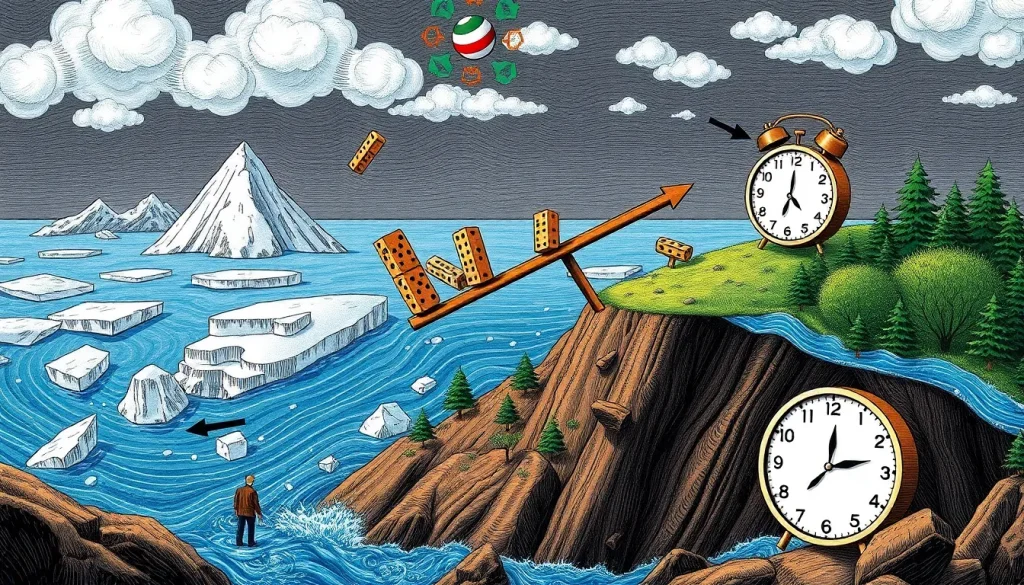
- Crossing one tipping point can increase the likelihood of crossing others, creating a domino effect that is hard to forecast.
Key Takeaways
- Tipping-point timelines are inherently difficult to predict due to the complex, non-linear nature of the systems involved, where small perturbations can trigger large, abrupt changes.
- Incomplete data, imperfect models, and poorly understood feedback mechanisms create deep uncertainties that prevent precise forecasting of when a tipping point will occur.
- Early warning signals can indicate that a system is approaching a tipping point, but they cannot provide exact dates, only probabilistic estimates of proximity.
- Understanding these prediction challenges is essential for risk management, as the consequences of crossing tipping points—such as climate shifts or ecosystem collapses—can be catastrophic and irreversible.
What Is Why Tipping-Point Timelines Are Difficult to Predict?
Why tipping-point timelines are difficult to predict refers to the inherent challenges in forecasting the exact moment when a complex system—such as the Earth’s climate, an ecosystem, or a financial market—will cross a critical threshold and undergo a rapid, often irreversible transformation. A tipping point is a point of no return, where a small additional change can lead to a large-scale shift in the system’s state. The difficulty in predicting timelines arises from the interplay of non-linear dynamics, feedback loops, and uncertainties in both data and models.
This topic sits at the intersection of complexity science, climate science, ecology, and economics. It matters because many of the systems we rely on for stability—ice sheets, ocean currents, and ecosystems—are showing signs of approaching tipping points. Accurately predicting when these shifts might occur is crucial for decision-making, yet the very nature of these systems makes precise timelines elusive. Instead, scientists focus on identifying early warning signals and assessing the risk of crossing thresholds under different scenarios, rather than providing exact dates.
Overview
Tipping points are features of systems that exhibit strong positive feedbacks, meaning that a change in one component amplifies itself, pushing the system further from its original state. Once a tipping point is crossed, the system can shift abruptly to a new equilibrium, often with significant consequences. In the climate system, examples include the collapse of the Atlantic Meridional Overturning Circulation (AMOC), the dieback of the Amazon rainforest, and the disintegration of the Greenland and West Antarctic ice sheets. These events would have profound impacts on global weather patterns, sea levels, and biodiversity.
The challenge of predicting when such tipping points will occur stems from the fact that these systems are not linear. A linear system responds proportionally to a change in input; a non-linear system can respond disproportionately, with little change until a threshold is reached, followed by a sudden jump. This behavior makes it extremely difficult to extrapolate from past trends. Moreover, the exact location of the threshold is often unknown and can shift due to internal variability and external forcing. As a result, even the most advanced models can only provide wide time ranges, often spanning decades to centuries, for when a tipping point might be crossed.
How Tipping Points Work
To understand why timelines are hard to predict, it is essential to grasp the mechanics of tipping points. A system near a tipping point typically exhibits a phenomenon called critical slowing down, where the rate of recovery from small disturbances decreases. This is an early warning signal, but it does not reveal exactly when the threshold will be crossed. The system’s state is determined by a balance of reinforcing (positive) and balancing (negative) feedbacks. As a tipping point approaches, positive feedbacks begin to dominate, amplifying small changes. For example, in the case of Arctic sea ice, melting exposes darker ocean water, which absorbs more heat and accelerates further melting—a positive feedback loop.
Another key concept is hysteresis, which means that reversing a tipping point may require a much larger change in the opposite direction than the one that triggered it. This path dependency adds to the difficulty of prediction because the system’s history matters. Additionally, stochastic events—random fluctuations in the system or its drivers—can trigger a tipping point earlier than deterministic models would suggest. For instance, an extreme weather event could push a drought-stressed forest past its threshold for dieback. Because such events are inherently unpredictable, they introduce a fundamental limit on the precision of timeline forecasts.
Data Limitations and Uncertainties
A major reason tipping-point timelines are difficult to predict is the lack of comprehensive, long-term data. Many of the systems of interest, such as ice sheets or deep ocean currents, have been monitored in detail for only a few decades. This short observational record makes it hard to distinguish natural variability from a long-term trend toward a tipping point. Paleoclimate records can extend the timeline, but they often have coarse temporal resolution and do not capture the rapid dynamics that characterize tipping events.
Models used to simulate these systems are also imperfect. They must simplify complex processes, and key parameters—such as the sensitivity of ice melt to temperature—are often poorly constrained. Different models can give widely divergent predictions for the same tipping point, reflecting structural uncertainties. Furthermore, many tipping points are interconnected, and the interactions between them are not fully understood. A cascade, where crossing one tipping point increases the likelihood of crossing another, adds another layer of complexity that current models struggle to capture. These data and model limitations mean that predictions are inherently probabilistic, with large error bars that make precise timelines unattainable.
Examples of Hard-to-Predict Tipping Points
Several well-known tipping points illustrate the prediction challenge. The Atlantic Meridional Overturning Circulation (AMOC), a major ocean current system that transports heat northward, is believed to have a tipping point beyond which it could collapse. Models suggest this could happen if enough freshwater from melting ice enters the North Atlantic, but the exact amount of freshwater needed and the timing remain highly uncertain. Estimates for a collapse range from decades to centuries, and some research suggests it could be closer than previously thought, but no consensus exists on a specific date.
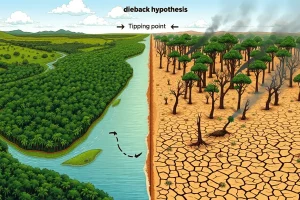
The Amazon rainforest is another example. Deforestation and climate change are reducing rainfall and increasing drought stress, pushing the system toward a tipping point where it could transition from rainforest to savanna. The threshold depends on complex interactions between vegetation, soil moisture, and atmospheric circulation. While scientists can identify that the risk increases with each degree of warming, predicting the exact year or even decade of a dieback is beyond current capabilities. Similarly, the Greenland and West Antarctic ice sheets have tipping points for irreversible melt, but the rate of ice loss depends on poorly understood processes like ice cliff instability and ocean-ice interactions, leading to wide ranges in sea-level rise projections.
Importance and Impact
The difficulty in predicting tipping-point timelines has profound implications for policy and risk management. If decision-makers wait for a precise forecast before acting, it may be too late to prevent crossing a threshold, given the inertia in both the climate system and human response. The precautionary principle suggests that the mere possibility of a catastrophic tipping point justifies early action, even in the face of uncertainty. However, the lack of exact timelines can be used to delay action, making it a politically charged issue.
From an economic perspective, the impacts of tipping points—such as coastal flooding from ice sheet collapse, agricultural disruption from monsoon shifts, or loss of ecosystem services—are enormous. The uncertainty in timing complicates cost-benefit analyses, as the damages could occur sooner or later than expected. This uncertainty also affects adaptation planning; for example, coastal defenses need to be designed for a range of possible sea-level rise scenarios. Ultimately, recognizing the limits of predictability is crucial for building robust strategies that are resilient to a variety of possible futures.
Connections to Other Systems
Tipping points do not exist in isolation; they are often part of a network of interconnected systems. A shift in one component can trigger or accelerate shifts in others, leading to cascading effects. For instance, the melting of the Greenland ice sheet could release enough freshwater to slow the AMOC, which in turn could alter rainfall patterns over the Amazon, increasing the risk of rainforest dieback. These teleconnections make prediction even more challenging because the behavior of the whole network can be more than the sum of its parts.
Feedback loops between climate tipping points and human systems add another dimension. Economic disruptions from a tipping point could lead to policy changes, technological shifts, or social unrest, which then feed back into the drivers of the tipping point. Such coupled human-natural systems are particularly hard to model because human behavior is not governed by fixed physical laws. The complexity of these interactions means that even if individual tipping points were well understood, the overall system could still exhibit surprises, making precise timeline predictions fundamentally out of reach.
FAQ
What is a tipping point?
A tipping point is a threshold in a complex system where a small change can lead to a large, often irreversible shift to a new state. Examples include the collapse of ice sheets or the dieback of a rainforest.
Why are tipping-point timelines difficult to predict?
Timelines are difficult to predict because these systems are non-linear, involve poorly understood feedback loops, and suffer from incomplete data and model uncertainties. Random events can also trigger a tipping point earlier than expected.
Why does predicting tipping points matter?
Accurate predictions would allow for better risk management and policy decisions. The potential impacts—such as sea-level rise, ecosystem loss, and economic disruption—are severe, so even uncertain forecasts are valuable for motivating precautionary action.
References
- Intergovernmental Panel on Climate Change (IPCC) Special Report on Global Warming of 1.5°C (2018)
- Scheffer, M., et al. (2009). Early-warning signals for critical transitions. Nature, 461(7260), 53-59.
- Lenton, T. M., et al. (2008). Tipping elements in the Earth's climate system. Proceedings of the National Academy of Sciences, 105(6), 1786-1793.